


Muhammad Hamza: A Rare F11R Variant Leads to the Identification of the JAMA Blood Group System
Muhammad Hamza, Medical Laboratory Technologist at Alkhidmat Blood Bank and Diagnostic Center, shared a post on LinkedIn about a recent article by Tosti J. Mankelow et al, published in Vox Sanguinis, adding:
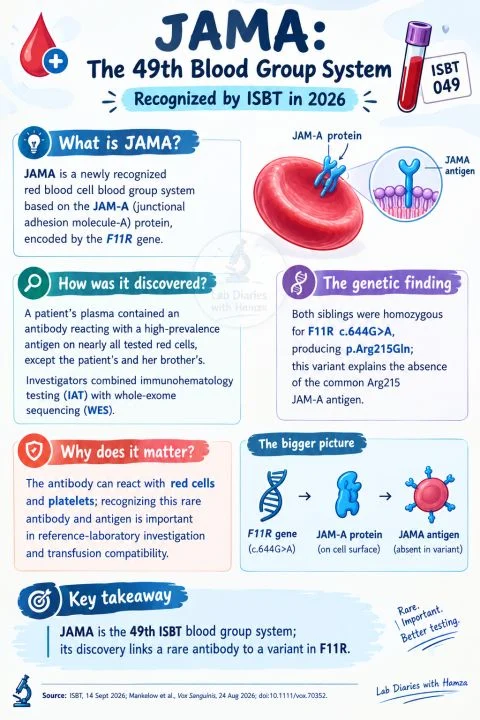
“A New Blood Group System Has Been Discovered — Meet JAMA, the 49th ISBT Blood Group System!
Blood group science continues to surprise us!
In September 2026, the International Society of Blood Transfusion (ISBT) recognized JAMA as the 49th human blood group system.
But what makes this discovery important?
What exactly is JAMA?
JAMA is based on the JAM-A (Junctional Adhesion Molecule-A) protein, found on the surface of red blood cells.
This protein is encoded by the F11R gene and carries the JAMA antigen.
How was it discovered?
The investigation began when a patient’s plasma was found to contain an unusual antibody that reacted with red blood cells from almost all tested individuals, except the patient’s own cells and those of her brother.
Using advanced immunohematological testing and whole-exome sequencing, researchers identified a genetic variant in the F11R gene:
F11R c.644G more than A – p.Arg215Gln
This variant explains the absence of the common JAM-A antigen form in the two siblings.
Why does this matter in transfusion medicine?
The antibody involved can react with both red blood cells and platelets.
Identifying this rare blood group system helps reference laboratories investigate unusual antibody reactions and supports safer transfusion compatibility testing.
Something important to remember:
JAMA is not a new ABO blood type.
It is a separate blood group system, showing that blood group compatibility involves far more than the familiar A, B, AB and O groups.”
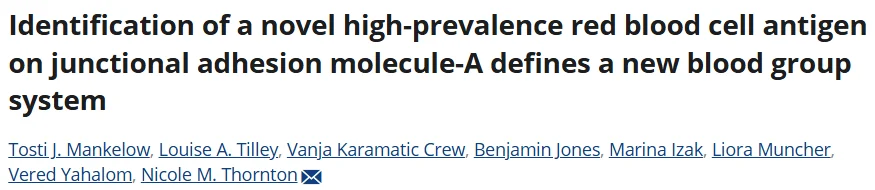
Title: Identification of a novel high-prevalence red blood cell antigen on junctional adhesion molecule-A defines a new blood group system
Authors: Tosti J. Mankelow, Louise A. Tilley, Vanja Karamatic Crew, Benjamin Jones, Marina Izak, Liora Muncher, Vered Yahalom, Nicole M. Thornton
Stay updated on all scientific advances with Hemostasis Today.
-
Nov 1, 2026, 03:17Marcelo Carlin: Unimed Piracicaba Showcases Research in Hemotherapy at HEMO 2026
-
Oct 31, 2026, 20:00Ahmed Alaqab: Proud to Share Our Systematic Review on Medication Adherence After Switching to DOACs
-
Oct 31, 2026, 19:57Katarzyna Kniola: Proud to Share My First Scientific Publication in Haemophilia
-
Oct 31, 2026, 19:53Mohammad Vahabi: Exploring the Role of JAK Inhibitors in Urticarial Vasculitis
-
Oct 31, 2026, 19:50Agata Sobczynska-Malefora: How Age and Ethnicity Influence Active Vitamin B12 and MMA Levels
-
Oct 31, 2026, 19:47David Shoultz: Running for MPN Research at the ASH Annual Meeting
-
Oct 31, 2026, 19:40Andreas Calatzis: Revisiting a Widely Cited Study on Preoperative Screening for Primary Hemostasis Disorders
-
Oct 31, 2026, 19:40How Antiseizure Medication Selection May Influence DOAC Safety in Epilepsy – JAMA Neurology
-
Oct 31, 2026, 19:35Alejandro González Veliz: Balancing Ischemic Protection and Bleeding Risk in Antiplatelet Management