


Nathan Connell: Advancing Prophylaxis for von Willebrand Disease with HMB-002
Nathan Connell, Clinical Chief of Hematology at Brigham and Women’s Faulkner Hospital, shared on LinkedIn about a recent article by Mattias Häger et al, published in Blood Advances:
”Advancing Prophylaxis for von Willebrand Disease: Introducing HMB-002
Excited to learn more about a significant development in the treatment landscape for von Willebrand Disease (VWD), recently published in Blood Advances.
VWD is the most common inherited bleeding disorder, yet current prophylactic options remain burdensome, often requiring frequent intravenous infusions due to the short half-life of available therapies. Mattias Häger et al. introduce HMB-002, a first-in-class, human Fc-silenced monovalent IgG4 antibody designed to transform VWD management through subcutaneous prophylaxis.
How it works: Unlike traditional replacement therapies, HMB-002 targets the endogenous system. It binds with sub-nanomolar affinity to the C-terminal cysteine-knot (CK) domain of von Willebrand Factor (VWF). Because this domain is spatially distant from VWF’s hemostatic regions, the antibody extends the protein’s half-life without interfering with its vital functions.
Key Findings:
- Significant Elevation: In non-human primates, HMB-002 achieved a sustained ~2-fold elevation of endogenous VWF and Factor VIII (FVIII) levels.
- Functional Preservation: In vitro and ex vivo studies confirmed that HMB-002-bound VWF retains its ability to bind platelets (GPIbα), collagen, and FVIII, and remains susceptible to regulation by ADAMTS13.
- Improved Hemostasis: In a type 1 VWD mouse model, a surrogate antibody recapitulated these results, leading to improved hemostatic control.
- Subcutaneous Convenience: The study demonstrates the potential for a long-acting, subcutaneous treatment that could significantly reduce the treatment burden for patients.
This ‘passive engagement’ strategy represents a sophisticated shift in how we approach protein deficiencies—moving from replacement to half-life extension of the patient’s own hemostatic proteins.
Congratulations to Mattias Häger, Catherine Rea, Benny Sorensen, and the whole team at Hemab Therapeutics on this impactful research!”
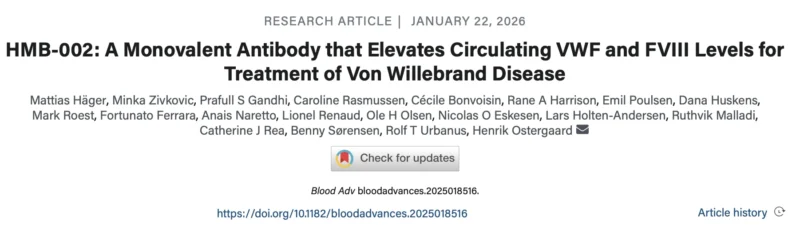
Title: HMB-002: A Monovalent Antibody that Elevates Circulating VWF and FVIII Levels for Treatment of Von Willebrand Disease
Authors: Mattias Häger, Minka Zivkovic, Prafull S Gandhi, Caroline Rasmussen, Cécile Bonvoisin, Rane A Harrison, Emil Poulsen, Dana Huskens, Mark Roest, Fortunato Ferrara, Anais Naretto, Lionel Renaud, Ole H Olsen, Nicolas O Eskesen, Lars Holten-Andersen, Ruthvik Malladi, Catherine J Rea, Benny Sørensen, Rolf T Urbanus, Henrik Ostergaard
Read the Full Article on Blood Advances
Stay updated on all scientific advances with Hemostasis Today.
-
Sep 15, 2026, 23:35Katya McCarthy: From Lab Specialist to Patient – Facing Polycythemia and Venous Thrombosis
-
Sep 15, 2026, 23:19Narat Srivali: Chronic Preoperative Corticosteroid Use Associated with 51% Higher Postoperative VTE Risk
-
Sep 15, 2026, 23:13Grace M Thomas: Join 3rd edition of the Neutrophil Club of SFI Webinar Series on Thromboinflammation
-
Sep 15, 2026, 23:05Noha K Hashmi: Honoured to Present 2 Case-Based Posters at the 5th MENA Conference for Rare Diseases 2026
-
Sep 15, 2026, 22:56Susan Slingluff Hartmann: How NBDF and the BDRC Are Putting Lived Experience at the Heart of Studies
-
Sep 15, 2026, 22:50Shehab Mohamed: New GCC Consensus Recommendations for the Diagnosis and Management of HLH
-
Sep 15, 2026, 22:42100 Years of von Willebrand Disease: What Has a Century of Progress Taught Us? – EAHAD
-
Sep 15, 2026, 22:38Cedric Hermans: How Iis TFPI Inhibition Changing Haemophilia Care?
-
Sep 15, 2026, 17:33Reza Shojaei: Blood and Plasma Donors Are Not a Production Metric