


Osman El-Maarri: Delete Two Genes from a Cell Line and It Secretes Twice as much Factor VIII
Osman El-Maarri, Senior Scientist/ Research Group Leader at University Clinic Bonn, shared a post on LinkedIn about a recent article he and his colleagues co-authored, published in Cells Reports, adding:
“Delete two genes from a cell line and it secretes twice as much factor VIII.
That was not what we expected!
Factor VIII is the difficult one.
It is secreted far less efficiently than factor IX, much of it never escapes the endoplasmic reticulum, and that inefficiency is part of why durable expression has been so hard to achieve in haemophilia A gene therapy.
The usual response is to modify, truncate, and re-engineer the transgene.
My group went looking in the host cell instead.
Our new paper in Cells reports a CRISPR/Cas9 panel covering all three GABARAP-family paralogues in a factor VIII-expressing HEK293 line – each gene alone, all three pairs, and the triple knockout.
Losing GABARAPL1 or GABARAPL2 raised secreted factor VIII activity.
Losing both raised it roughly two-fold. Losing GABARAP did the opposite, cutting it to about 60%.
Three closely related proteins, pulling in opposite directions on the same cargo – not the redundancy you would assume from their sequences.
Across the panel, cellular ATP content tracked secreted factor VIII activity (r = 0.86). Making this protein appears to be expensive.
Congratulations to Mira Ibrahim, who did this work. And to Rawya Al-Rifai Nicole Surges and Johannes Oldenburg.”
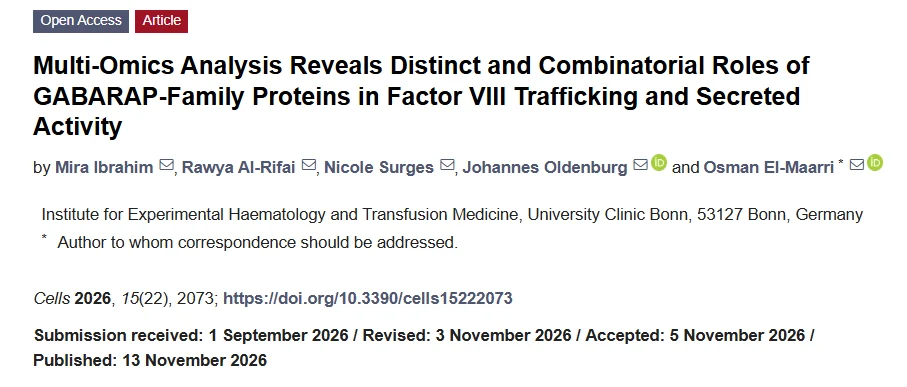
Title: Multi-Omics Analysis Reveals Distinct and Combinatorial Roles of GABARAP-Family Proteins in Factor VIII Trafficking and Secreted Activity
Authors: Mira Ibrahim, Rawya Al-Rifai, Nicole Surges, Johannes Oldenburg and Osman El-Maarri
Stay updated on all scientific advances with Hemostasis Today.
-
Nov 16, 2026, 11:37Chaza Alaji: Unexplained Bruising-Beyond Platelet Counts and Coagulation Tests
-
Nov 16, 2026, 11:33Obed Asumadu: How Can Advanced Laboratory Diagnostics Improve the Detection and Management of Haemophilia?
-
Nov 16, 2026, 11:29Amman Yousaf: Pulmonary Embolism Mortality in Patients With Coagulation Disorders at AHA 2026
-
Nov 16, 2026, 10:48Tareq Abadl: Why the Kell Blood Group System Matters
-
Nov 16, 2026, 10:40TIF in China – Advancing Regional Cooperation in Thalassaemia Prevention and Care
-
Nov 16, 2026, 10:40Dhargam Aljebouri: A Milestone for Transfusion Medicine in Iraq
-
Nov 16, 2026, 10:35Arisha Patel: Why a Normal Blood Count Can Miss Iron Deficiency
-
Nov 16, 2026, 10:29Maxime Dely: The Needle Behind Every Donation
-
Nov 16, 2026, 10:29Marilena Vrana: Building a Resilient Plasma Ecosystem in Europe