


Paul Watton։ New Clues to the Cause of ME/CFS
Paul Watton, Independent Researcher, shared a post on LinkedIn about a recent article by Akiko Eguchi et al., published in Journal of Translational Medicine, adding:
”A newly published study by Eguchi et al. (2026) adds further weight to an emerging pathway involved in the pathogenesis of ME/cfs.
The researchers identified a distinctive extracellular-vesicle miRNA signature in ME/cfs, with pathway enrichment involving focal adhesion, actin-cytoskeleton regulation and PI3K-
Akt signalling.
This is especially interesting because the same research group’s earlier EV proteomics work identified talin-1 and filamin-A, (proteins that are integral to focal-adhesion formation and the organisation of the actin cytoskeleton) thereby implicating the same cellular signalling machinery through a different investigative approach.
These findings also lend additional weight to those of Liu et al. (2026), “Immunoglobulin G complexes from post-infectious ME/CFS, including post-COVID ME/CFS disrupt cellular energetics and alter inflammatory marker secretion.” published in Brain, Behavior, and Immunity – Health.
Their immune-complex proteomics findings implicated extracellular-matrix organisation, whilst demonstrating that patient-derived IgG was capable of altering endothelial mitochondrial architecture and cellular energetics.
Taken together, the evidence now increasingly points towards an important disease axis:
Extracellular matrix leads to Integrins / focal adhesions, which lead to Talin / filamin / actin, which activate Mechanotransduction, leading to PI3K-Akt / calcium / cytoskeletal signalling and ultimately resulting in Cellular adaptation.
This pathway determines how cells sense their extracellular environment and adjust to mechanical, metabolic and immune stress.
Eguchi et al. does not prove that this pathway drives ME/CFS, but the convergence between EV proteomics, EV-miRNA biology and immune-complex/ECM findings makes it increasingly difficult to regard the signal as merely incidental.”
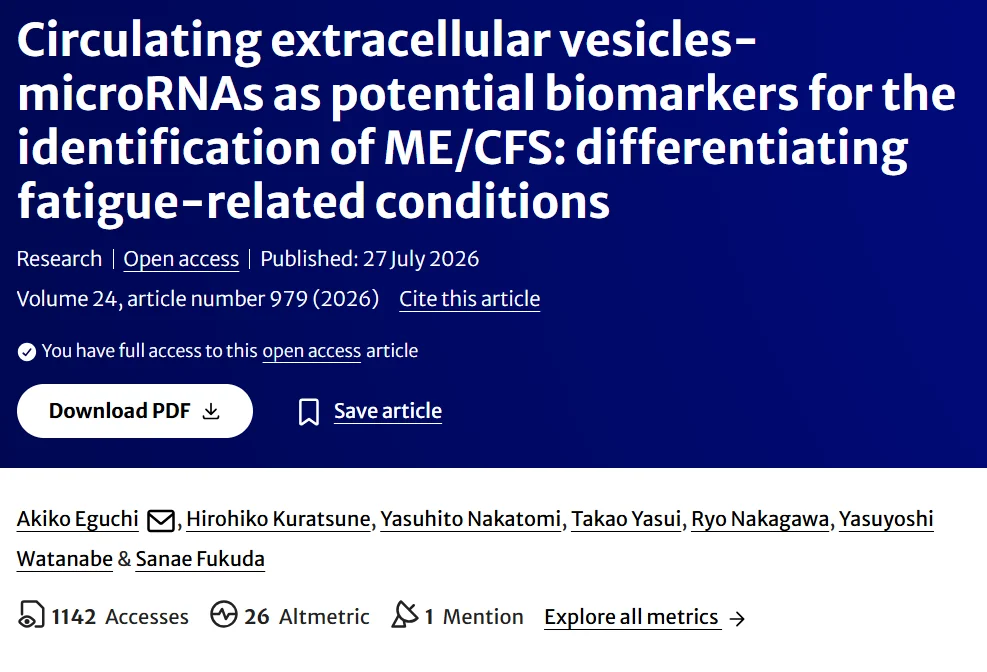
Title: Circulating extracellular vesicles-microRNAs as potential biomarkers for the identification of ME/CFS: differentiating fatigue-related conditions
Authors: Akiko Eguchi, Hirohiko Kuratsune, Yasuhito Nakatomi, Takao Yasui, Ryo Nakagawa, Yasuyoshi Watanabe, Sanae Fukuda
Stay updated with all scientific advances with Hemostasis Today.
-
Sep 25, 2026, 15:00Sarah Richardson: Finding Strength Through Bleeding Disorders Advocacy
-
Sep 25, 2026, 14:54James Fildes: Modeling Device Related Thrombosis in Multi Organ Systems
-
Sep 25, 2026, 14:51Platelet Metabolic Reprogramming: How Cellular Energy Drives Thrombosis
-
Sep 25, 2026, 14:46Thomas Maxwell: From Hemophilia Shame to Strength – Walking for Bleeding Disorders
-
Sep 25, 2026, 14:35Sarita Rani Jaiswal: Sharing Basic Science Insights at EBMT HWP 2026
-
Sep 25, 2026, 14:12Managing Breakthrough Bleeds in Hemophilia – National Bleeding Disorders Foundation
-
Sep 25, 2026, 13:50Alejandro González Veliz: Beyond the Golden Hour in Stroke Care
-
Sep 25, 2026, 13:32Gevorg Yaghjyan: Low Drug Levels, Higher Cardiovascular Risk in Lupus
-
Sep 25, 2026, 12:53Bastu Odoka: What Happened to Blood Donation?