


Reza Bavarsad Shahripour: New AHA Guidance on Cryptogenic Stroke with Reduced Left Ventricular Function
Reza Bavarsad Shahripour, Associate Editor at Clinical Neuroimaging Journal, shared on LinkedIn about a recent article by Richa Sharma et al, published in Stroke, adding:
”A practical teaching point from the new AHA Scientific Statement (Sharma et al., Stroke 2026)
The patient with a cryptogenic/ESUS-type infarct, sinus rhythm, LVEF ≤40% or a moderate–severe wall motion abnormality, and no intracardiac thrombus sits in a genuine gray zone — a cardioembolic-looking stroke with no ‘automatic’ indication to anticoagulate. A few points worth carrying to the bedside:
1. We under-image this heart.
Standard TTE misses LV thrombus far more than we assume (approximately 29% sensitivity vs CMR).
If EF is low or a WMA is present, ask for an ultrasound-enhancing (contrast) agent, and escalate to cardiac CT or late-gadolinium CMR when suspicion persists.
A thrombus is a treatable target — a negative non-contrast echo shouldn’t close the case.
2. Primary vs. secondary prevention are not the same conversation.
- Primary prevention (no prior stroke): anticoagulation lowers stroke events but shows no net clinical benefit — offset by bleeding and mortality. Guidelines recommend against it.
- Secondary prevention: the signal is real but soft. Pooled subgroups (NAVIGATE-ESUS, ARCADIA, CASPR) suggest ~68% lower recurrent-stroke risk — but it’s all post-hoc. This stays a Class 2b, shared-decision discussion.
3. If you anticoagulate: a DOAC dosed as for AF (apixaban preferred) over warfarin; avoid adding an antiplatelet unless separately indicated. Timing is individualized by infarct size and hemorrhagic transformation.
4. Some imaging features tip the scale even without a visible clot: LV noncompaction and spontaneous echo contrast.
5. Don’t stop at the antithrombotic decision.
- Extended rhythm monitoring — HF/LV dysfunction independently predicts occult AF, which changes everything.
- GDMT improves LVEF and may lower new-onset AF.
- Partner with cardiology — the authors propose an integrated ABC-LVD pathway.
Bottom line: Cryptogenic stroke plus low EF or a WMA – image the heart properly, rule out thrombus, and treat this as an individualized decision — while hunting for occult AF and optimizing the failing heart.”
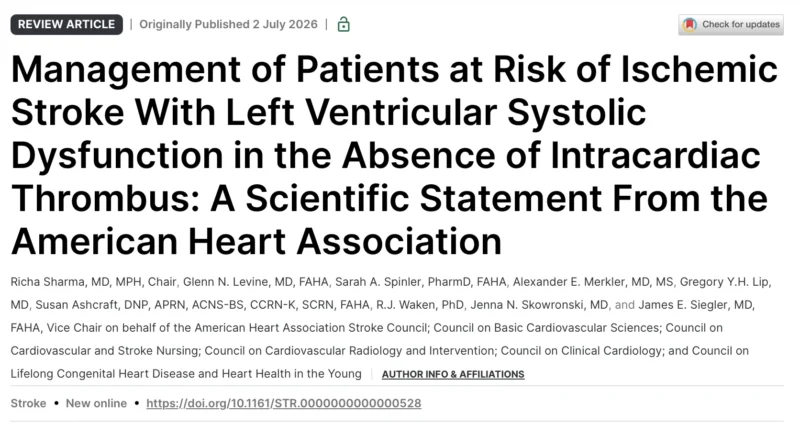
Title: Management of Patients at Risk of Ischemic Stroke With Left Ventricular Systolic Dysfunction in the Absence of Intracardiac Thrombus: A Scientific Statement From the American Heart Association
Authors: Richa Sharma, Glenn N. Levine, Sarah A. Spinler, Alexander E. Merkler, Gregory Y.H. Lip, Susan Ashcraft, R.J. Waken, Jenna N. Skowronski, James E. Siegler
Stay updated on all scientific advances with Hemostasis Today.
-
Sep 30, 2026, 22:28Recent Mechanical Risk Factors and Young-Onset Cryptogenic Ischemic Stroke – American Heart Association International
-
Sep 30, 2026, 22:22Expert Consensus on Inferior Vena Cava Thrombosis – Thrombosis and Haemostasis Journal
-
Sep 30, 2026, 22:21Markus Abeln: How Platelets and Complement Shape Placental Blood Flow
-
Sep 30, 2026, 22:19Fatma Al Arbawi: Studying Blood Clot Mechanics to Understand Aspirin Resistance and Thrombosis
-
Sep 30, 2026, 22:17Sudhir Kumar: Stroke is a Medical Emergency – and Every Minute Matters
-
Sep 30, 2026, 22:15Luisa Medeiros Visentini: Our Research on Cognitive Impairment After CVT Cited in the International Journal of Stroke
-
Sep 30, 2026, 21:50Jagat Narula: Connecting Cardiovascular Health and Sickle Cell Disease on World Heart Day 2026
-
Sep 30, 2026, 21:38John Kastelein: Exploring the Biology of Cardiovascular Disease at BioCentury Grand Rounds Europe
-
Sep 30, 2026, 21:36Mark Murphy: Irish Heart Foundation Meets With Senator Teresa Costello on World Heart Day