


Sex-Specific Models for ASAH Show No Added Benefit over SMA2SH2ERS risk predictions
International Journal of Stroke (IJS) recently shared a post on X:
”Study shows sex-specific models did not perform better than general SMA2SH2ERS risk prediction model.”
Read the full article here.
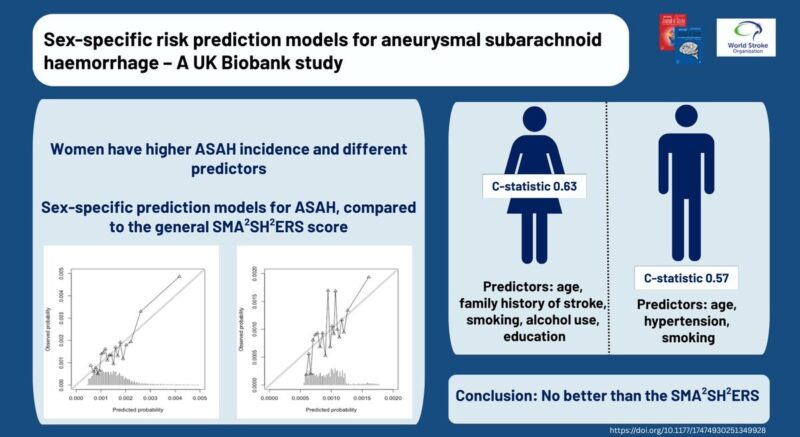
Following the development of the SMA2SH2ERS risk prediction model for aneurysmal subarachnoid hemorrhage (ASAH) in the general population, researchers explored ways to improve its accuracy.
To address known differences in ASAH incidence and predictor effects between men and women, they developed sex-specific models.
While these models included fewer variables and may offer greater usability, their predictive performance remained comparable to the original and similarly suboptimal.
None of the models demonstrated sufficient discriminatory power for clinical use.
Further validation is needed, along with future research into ethnicity-specific models that incorporate sex-based differences using an intersectional approach.
Stay updated with Hemostasis Today.

-
Oct 9, 2026, 11:06Nobles Green: How siRNA Therapy Helps the Body Form Stronger Clots
-
Oct 9, 2026, 10:53Switching From Emicizumab to Denecimig in Hemophilia A – Rare Disease Advisor
-
Oct 9, 2026, 10:40What New U.S. Data Reveal About GT – Glanzmann’s Research Foundation
-
Oct 9, 2026, 10:32Anjali Pandey: The Morphologic Clues to MDS With del(5q)
-
Oct 9, 2026, 10:13Reza Shojaei: 5 Leadership Responsibilities for a Sustainable Plasma Ecosystem
-
Oct 9, 2026, 08:38Johannes Gratz: Perioperative Care in Factor VII Deficiency – Treating the Patient, Not the Number
-
Oct 9, 2026, 08:28Ghanim Fajish: Vascular Cells May Retain a Prothrombotic Memory of Oxidative Stress
-
Oct 9, 2026, 07:43Mehmet Cilingiroglu: The First Diagnosis of Coronary Thrombosis in a Living Patient
-
Oct 9, 2026, 07:21Federico Ravaioli: 40 kPa Spleen Stiffness May Help Avoid Endoscopy in Chronic PVT