

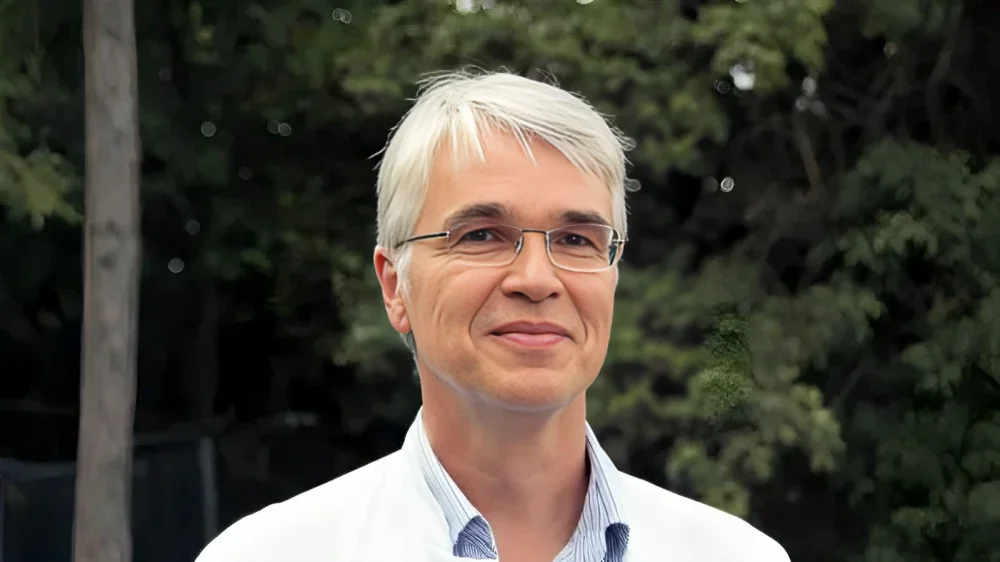
Wolfgang Miesbach on VTE and Cancer: A 20-Year Signal That Can’t Be Ignored
Wolfgang Miesbach, Professor of Medicine at Frankfurt University Hospital, shared on LinkedIn:
”VTE and Cancer: A 20-Year Signal That Can’t Be Ignored.
In a nationwide Danish cohort of 138,049 first‑ever VTE patients (DVT 51.7%, PE 39.3%, SVT 8.9%), followed from 1996–2022, Søren Martiny et al. demonstrate a clear two‑phase cancer risk pattern after thrombosis.
Median age at VTE was 66 years, 52% were women, and 43.8% of events were provoked (≈48% by major factors such as recent surgery or fracture/trauma, the remainder by minor factors including pregnancy, HRT, hormonal contraception, or recent hospitalization).
At the time of the thrombotic event itself, all patients were cancer‑free (prior cancers other than non‑melanoma skin cancer were excluded), so any subsequent malignancy reflects incident cancer emerging after the index VTE rather than known active cancer at baseline.
Year One: The Occult Cancer Signal
During the first year after VTE, the absolute cancer risk was 4.0% and the standardized incidence ratio (SIR) versus the general population was 3.45 (95% CI 3.36–3.55), capturing both unprovoked and provoked events and holding across DVT, PE, and SVT.
The authors previously showed that this early excess is largely driven by cancers presenting within months of VTE, consistent with the concept of VTE as a harbinger of occult malignancy.
Years 2–20: The Persistent Cancer Risk
Beyond year one, cancer risk declines but remains 9–16% higher than expected for up to 20 years (SIR 1.09–1.16 across follow‑up windows), regardless of age group, sex, VTE type (SVT, DVT, or PE), primary vs secondary diagnosis, comorbidity burden, or whether the index event was provoked or unprovoked. After 20 years, the SIR approximates 1.00, suggesting the excess risk is time‑limited but clinically meaningful over two decades.
This long‑term signal is driven particularly by cancers linked to smoking, obesity, and alcohol—lung, pharynx, larynx, esophagus, stomach, liver, pancreas, colon—as well as haematologic malignancies, supporting the idea that VTE and cancer share upstream lifestyle and genetic determinants rather than a simple “occult cancer at baseline” explanation.”
Read the full article here.
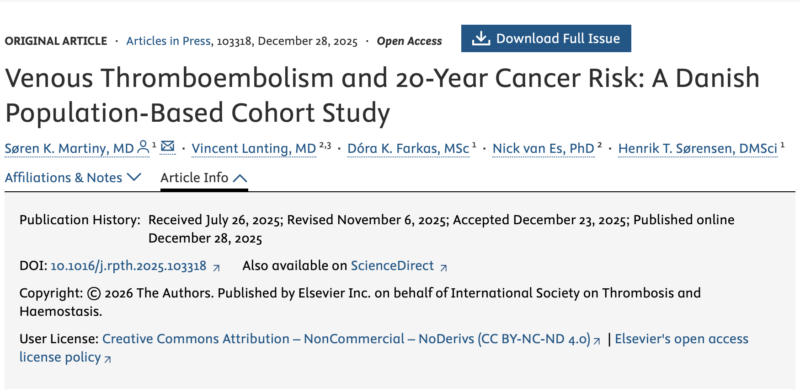
Article: Venous Thromboembolism and 20-Year Cancer Risk: A Danish Population-Based Cohort Study
Authors: Søren K. Martiny, Vincent Lanting, Dóra K. Farkas, Nick van Es, Henrik T. Sørensen
Stay updated on all scientific advances with Hemostasis Today.
-
Oct 13, 2026, 02:01Nour Al-Mozain: Is It Really Anti-D? – Unraveling Auto-Anti-LW in the Transfusion Laboratory
-
Oct 13, 2026, 01:51Berenice Villegas: The Role of Morphologic Evaluation in Body Fluid Differential Analysis
-
Oct 13, 2026, 01:44Debadrita Ray: Evaluating vWF and VITRO Score for Detecting CSPH in cACLD Patients
-
Oct 13, 2026, 01:34Nagesh Ramesh: Donating Blood for International Plasma Awareness Week
-
Oct 12, 2026, 21:51Sam Botchey: Orthobiologics Are Advancing but the Evidence Must Keep Pace
-
Oct 12, 2026, 21:50Serum Vitamin D, Platelet Function, and Bleeding in Primary ITP – Platelets Journal
-
Oct 12, 2026, 21:30Nika Samadzadeh Tabrizi: Looking Forward to the PACeS Trial on Anticoagulation for POAF
-
Oct 12, 2026, 21:28Michael Megaly: Does Coronary Ectasia Affect Outcomes in Acute Coronary Syndromes?
-
Oct 12, 2026, 21:25Vitor Borin P. de Souza: Think Twice Before Anticoagulating an Isolated Subsegmental PE