


Wolfgang Miesbach: Adeno-Associated Virus Neutralizing Antibodies and Their Clinical Impact on Gene Therapy
Wolfgang Miesbach, Professor of Medicine at Frankfurt University Hospital, shared a post on LinkedIn about a recent article by Rafael Parra et al, published in Gene Therapy:
”Pre-existing immunity to AAV vectors — are we underestimating the challenge for gene therapy eligibility?
The SAAVIA study (Parra et al., Gene Therapy, 2026) provides some of the most comprehensive seroprevalence data to date from a healthy adult Spanish population (n=250):
IgG seroprevalence:
- AAV6: 84% | AAV2: 74% | AAV8: 60% | AAV9: 51% | AAV5: 40%
Neutralizing antibodies (NAb):
- AAV6: 63% | AAV8: 60% | AAV9: 52%
These NAb rates are substantially higher than those reported in most other developed countries (3–40%), and the co-seropositivity across serotypes reaches up to 97% for IgG and 83–91% for NAb – raising the possibility of broad cross-reactivity.
What makes this clinically relevant for haemophilia and gene therapy?
- Even low NAb titers can completely abrogate AAV transduction. In most clinical trials, pre-existing NAb are a standard exclusion criterion — meaning a large proportion of otherwise eligible patients may never make it through screening.
- The SAAVIA data suggest this challenge may be particularly pronounced in urban, high-mobility populations like Barcelona.
These findings take on added significance when placed alongside two landmark studies in the haemophilia field:
- Klamroth et al. (2022, Hum Gene Ther) showed that AAV5 carries the lowest global seroprevalence (~35%) in people with haemophilia A across multiple countries – one reason AAV5 became the preferred vector for several haemophilia gene therapy programmes.
- Klamroth et al. (2025, Mol Ther Methods Clin Dev) demonstrated that AAV5 NAb titers remain stable over 6 months in haemophilia B patients screened for etranacogene dezaparvovec – reassuring for trial logistics, but also a reminder that those with pre-existing immunity are consistently excluded.
Together, these three studies paint a clear picture: vector choice matters, regional seroprevalence matters, and standardized NAb testing across centers is needed.”
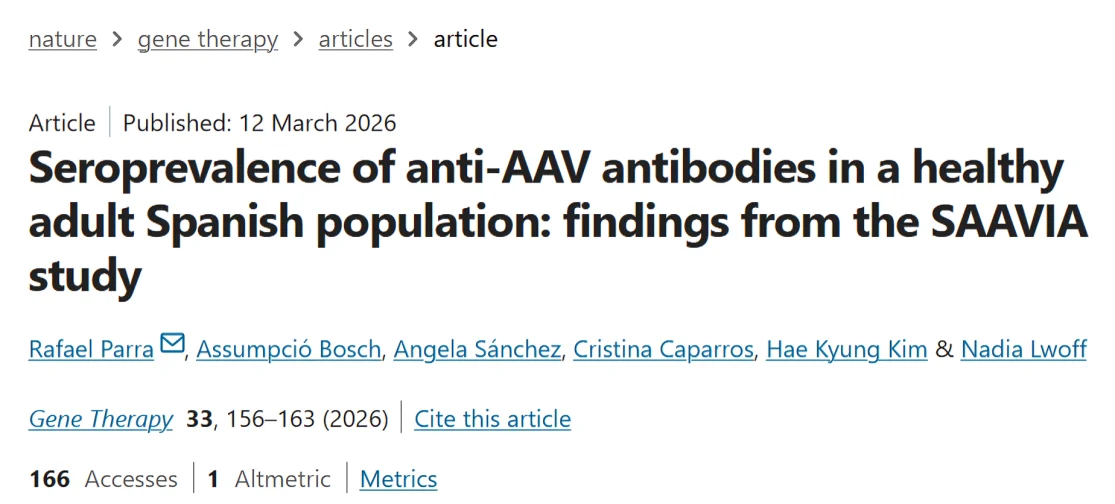
Title: Seroprevalence of anti-AAV antibodies in a healthy adult Spanish population: findings from the SAAVIA study
Authors: Rafael Parra, Assumpció Bosch, Angela Sánchez, Cristina Caparros, Hae Kyung Kim, Nadia Lwoff
Stay updated with Hemostasis Today.
-
Oct 18, 2026, 23:31Rana Al-Hrout: MAHA – More Than Schistocytes
-
Oct 18, 2026, 17:11Owen McCarty: Understanding Prekallikrein and Its Role in Inflammation and Thrombosis
-
Oct 18, 2026, 17:04Emna Gouider Belhadjali: Don’t Miss GPAS 2026 on Bleeding Disorders
-
Oct 18, 2026, 16:53Mehran Ghasemzadeh: Microparticle-Associated Mitochondrial DNA in Stored Platelet Products
-
Oct 18, 2026, 16:38Edward Lee Carter: A 15-Minute Blood Test for Brain Hemorrhage?
-
Oct 18, 2026, 16:29Patrick Taylor: Oral vs Transdermal Estrogen and Cardiovascular Risk in Menopausal Women
-
Oct 18, 2026, 16:19Artangela Henry: A Meaningful Week at the SCDAA National Convention
-
Oct 18, 2026, 16:04Emília Araújo։ New Insights Into the Genetics of Hemophilia B Leyden
-
Oct 18, 2026, 15:43André Marcel Harris: Award-Winning Research on Texas Sickle Cell Data Collection