


Wolfgang Miesbach: How Clonal Hematopoiesis May Explain Age-Related Mitochondrial Mutations
Wolfgang Miesbach, Professor of Medicine at Frankfurt University Hospital, shared on LinkedIn about a recent article by Rahul Gupta et al, published in Nature, adding:
”Has the secret of aging been unlocked?
A groundbreaking Nature study analyzing 750,000 plus
genomes has revealed why our blood cells accumulate mitochondrial DNA mutations as we age—and the answer challenges decades of scientific thinking.
The two-step revelation:
Step 1: Mitochondrial DNA replication errors create low-level ‘cryptic’ mutations in our cells—think of them as hidden genetic typos that go unnoticed.
Step 2: Clonal hematopoiesis (CH) amplifies these mutations by expanding specific cell clones, making the previously invisible mutations detectable.
What makes this paradigm-shifting:
- NOT oxidative stress (the old theory) – Replication errors driving the process
- The mutations are neutral passengers, not drivers of disease—both functional and silent variants accumulate equally in CH carriers
- Clinical impact: Strong associations with myelodysplastic syndrome, leukemias, and chronic kidney disease
- Game-changer: mtDNA mutation burden could detect early CH before traditional screening identifies driver mutations
This elegant work connects three aging hallmarks—mitochondrial mutations, clonal hematopoiesis, and telomere biology—into one unified mechanism.
The implications for early detection and risk stratification in hematologic malignancies are profound.”
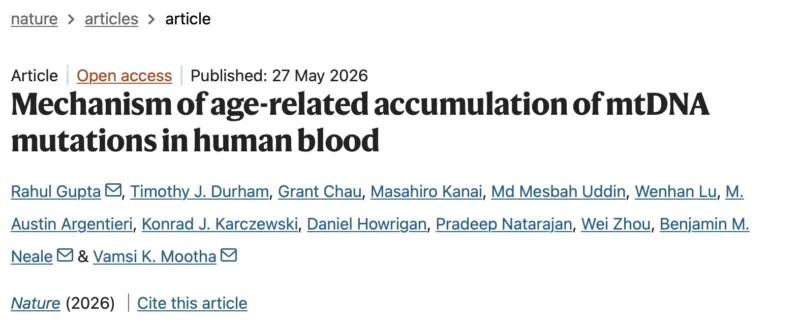
Title: Mechanism of age-related accumulation of mtDNA mutations in human blood
Authors: Rahul Gupta, Timothy J. Durham, Grant Chau, Masahiro Kanai, Md Mesbah Uddin, Wenhan Lu, M. Austin Argentieri, Konrad J. Karczewski, Daniel Howrigan, Pradeep Natarajan, Wei Zhou, Benjamin M. Neale, Vamsi K. Mootha
Stay updated on all scientific advances with Hemostasis Today.
-
Sep 23, 2026, 16:04Monia Ezzalfani: Advancing Patient-Centered Care in Hemophilia A and B
-
Sep 23, 2026, 15:49Bilge Başak: How Activated PRP Modulates Osteoarthritic Chondrocyte Function
-
Sep 23, 2026, 14:50Mbonjo Bitsie Dora: Strengthening Sickle Cell Care Through Education, Awareness and Innovation
-
Sep 23, 2026, 13:58The New B12 Diagnostic Algorithm: From Serum Cobalamin to Functional Deficiency
-
Sep 23, 2026, 13:56Noha Soror: Preparing for Hematology and Medical Oncology Board Certification
-
Sep 23, 2026, 13:46Ugochi Ogu: What Can Platelet Proteomics Reveal about Pain and Neurocognitive Vulnerability in Sickle Cell Disease?
-
Sep 23, 2026, 13:42Melissa Hollo: Connecting Obesity and Anemia for Earlier Maternal Risk Intervention
-
Sep 23, 2026, 13:16Beverley Hunt: Advances in Haemostatic Management of Postpartum Haemorrhage
-
Sep 23, 2026, 13:13Ioanna Mela: Recruiting a Research Associate on DNA nanotechnology