


Wolfgang Miesbach: Mechanisms of Liver Injury After Hemophilia A Gene Therapy
Wolfgang Miesbach, Head of Hemostasis/Hemophilia Center at Frankfurt University Hospital, shared a post on LinkedIn about a recent article he and his colleagues co-authored, published in Haematologica, adding:
“ALT elevation after gene therapy: why ‘transaminitis’ is the wrong word.
New editorial in Haematologica, with Vincenzo Cardinale, on the study by La Mura et al. — the first histopathological, ultrastructural and immunophenotypic characterisation of liver injury after valoctocogene roxaparvovec in severe haemophilia A. Of five treated patients, two developed ALT elevations with loss of transgene expression and underwent transjugular liver biopsy.
Mechanism, confirmed in human tissue. Innate sensing via TLR2 on Kupffer cells and endosomal TLR9 detection of CpG motifs primes capsid-specific CD8+ T cells, which attack transduced hepatocytes at weeks 4–8. Until now this sequence rested on murine and NHP data. The biopsies show it directly: CD8+ predominant interface hepatitis with plasma cell infiltration, high cytotoxic and low regulatory T-cell activity, at exactly the expected window.
Not autoimmune hepatitis. The inflammation was mild and corticosteroid-responsive without prolonged immunosuppression — the profile of drug-induced autoimmune-like hepatitis (DI-ALH) as defined by the 2023 IAIHG/EASL consensus, not idiopathic AIH.
Two processes at once. Electron microscopy showed marked ER proliferation with elevated BiP, XBP1s and CHOP: unfolded protein response activation from high transgene load, coexisting with immune attack in the same biopsies.
Why efficacy suffers. Fong et al. found transduced hepatocytes carrying full-length circular episomes years after dosing, without inflammation — the tolerised steady state. CD8+ T cells destroy precisely those episome-bearing cells. The two studies bracket the ends of the hepatic response.
The clinical consequence: not every ALT rise above 1.5-fold baseline mandates high-dose steroids. Immunosuppression should target tolerance failure, which biopsy can distinguish from the self-limited innate response. Two cases, one centre, hypothesis-generating — prospective validation is needed before WFH or ISTH guidance changes. CpG-depleted vector designs may eventually address the problem at source.
And it reinforces our 2023 call: haematology and hepatology need to work together at every stage of gene therapy.”
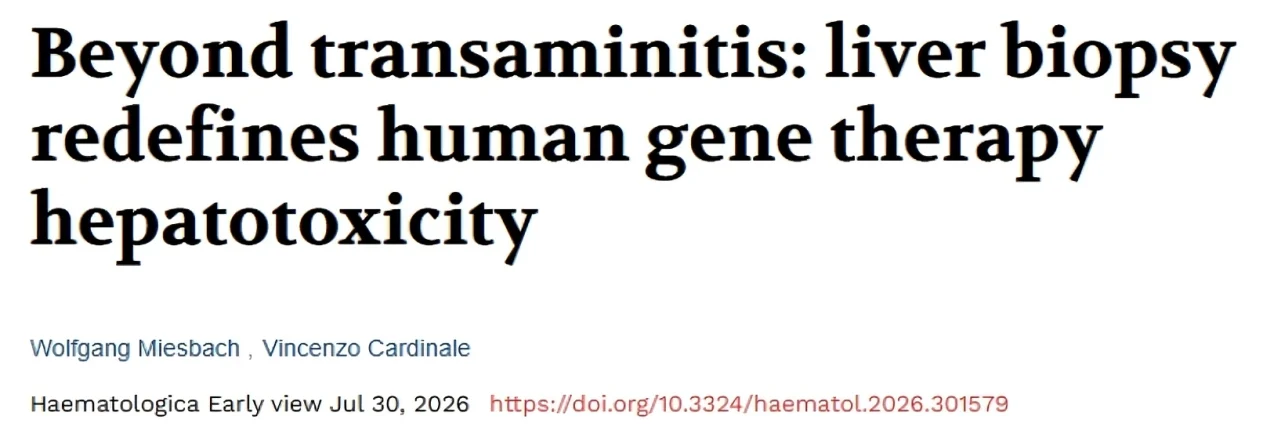
Title: Beyond transaminitis: liver biopsy redefines human gene therapy hepatotoxicity
Authors: Wolfgang Miesbach, Vincenzo Cardinale
Stay updated on all scientific advances with Hemostasis Today.
-
Sep 23, 2026, 06:24Nicolas Gendron: Everolimus and Venous Thromboembolic Risk in Kidney Transplantation
-
Sep 23, 2026, 06:07Hoori Shahwar: Cerebral Venous Sinus Thrombosis Diagnosis and Management
-
Sep 23, 2026, 06:06Advancing Hemophilia Care and Patient Advocacy in Bangladesh – World Federation of Hemophilia
-
Sep 23, 2026, 05:54Bringing the Global Thrombosis and Haemostasis Community Together in 2027 – ISTH
-
Sep 23, 2026, 04:34David Akande: When Sickle Cell Crises Have No Clear Trigger
-
Sep 23, 2026, 04:13Jean Connors: Safety of Heparin Re-Exposure in Patients with Remote HIT
-
Sep 23, 2026, 04:09Beth Psaila: Applications Now Open for the Gordon Research Conference on Megakaryocytes and Platelets
-
Sep 23, 2026, 03:27Abbie Newton: How Better Data Can Reduce Platelet Wastage
-
Sep 23, 2026, 03:01Suvro Sankha Datta: Rapid Blood Group Genotyping Using Gold Oligo Nanonet Assembly