

Ahmed Alotaibi: Rare Rh Phenotype and Severe Fetal Anaemia
Ahmed Alotaibi, Senior Specialist (Blood bank and blood transfusion) at Afif General Hospital – Riyadh Third Health Cluster (Ministry of Health), shared a post on LinkedIn:
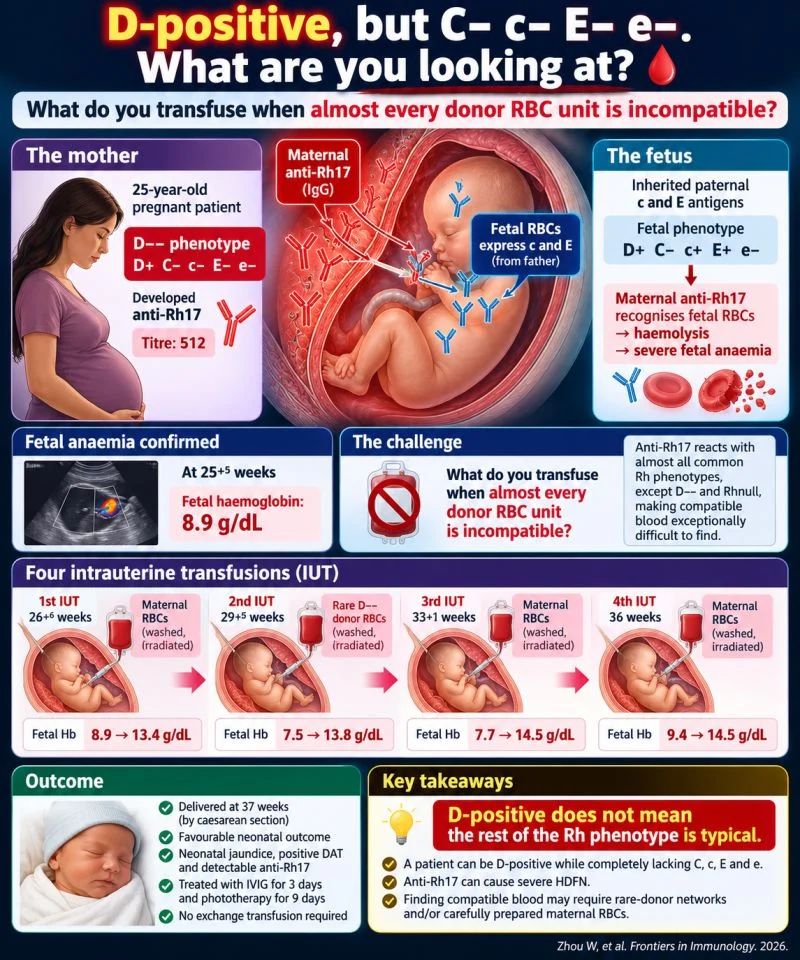
”D-positive, but C− c− E− e−.
What are you looking at?
Most of us think about the Rh system mainly in terms of D positive or D negative.
But this 2026 Frontiers in Immunology case shows how much more complex Rh can be.
A 25-year-old pregnant patient had the extremely rare:
- D− phenotype
- Her red cells expressed D, but lacked the major RhCE antigens:
C− c− E− e−
Why does that matter?
Because exposure to normal RhCE-positive cells through pregnancy or transfusion can lead to formation of anti-Rh17.
In this case, anti-Rh17 was identified at a titre of:
512
The fetus had inherited paternal c and E antigens, making the fetal RBCs RhCE-positive and vulnerable to the maternal antibody.
The result:
Maternal anti-Rh17 antibodies cause fetal red blood cell destruction, leading to severe fetal anaemia.
At 25 plus 5 weeks, fetal anaemia was suspected, and cord blood sampling confirmed a fetal haemoglobin of:
8.9 g/dL
The blood-bank challenge was enormous:
What do you transfuse when almost every donor RBC unit is incompatible?
The fetus ultimately required four intrauterine transfusions:
- 1st: maternal RBCs
- 2nd: rare D−− donor RBCs
- 3rd: maternal RBCs
- 4th: maternal RBCs
The maternal units were carefully prepared, including washing and irradiation.
After each transfusion, fetal haemoglobin improved.
The pregnancy reached 37 weeks, and the baby was delivered with a favourable neonatal outcome.
This case is an important reminder:
D-positive does not mean the rest of the Rh phenotype is typical.
A patient can be D-positive while completely lacking C, c, E and e, creating one of the most difficult compatibility problems in transfusion medicine.”
More posts featuring Ahmed Alotaibi on Hemostasis Today.
-
Oct 22, 2026, 16:36Alissa Odum: Every Blood Type Matters Every Donation Saves Lives
-
Oct 22, 2026, 16:33Mehul Malhotra: Targeted Therapies and Clinical Advances Transform the wAIHA Treatment Landscape
-
Oct 22, 2026, 16:13William Wallace: The Hidden Neurological Impact of Vitamin B12 Deficiency
-
Oct 22, 2026, 16:06Akram Farhadi: Anemia and Low Hemoglobin Associated With Higher Risk of Osteosarcopenia in Older Adults
-
Oct 22, 2026, 15:49Javed Iqbal: NUMC Pulmonary and Critical Care Team Showcases Research at CHEST 2026
-
Oct 22, 2026, 15:37Alina Mitina: Key Concerns Surrounding DVT and Pulmonary Embolism
-
Oct 22, 2026, 14:45Seyed Mehrab Safdari: Prenatal Diagnosis in Hemophilia – Two Decades of Progress and Remaining Challenges
-
Oct 22, 2026, 14:39Mahmoud Abdelnabi: Evaluating the Evidence on Elevated Lp(a) and VTE Before Clinical Translation
-
Oct 22, 2026, 14:34David McIntosh: Fundamental Flaws in National Blood Systems Are Root Causes of Failure