

William Wallace: The Hidden Neurological Impact of Vitamin B12 Deficiency
William Wallace, Co-Founder and Chief Scientific Officer at Supplement Success Solutions, shared a post on LinkedIn:
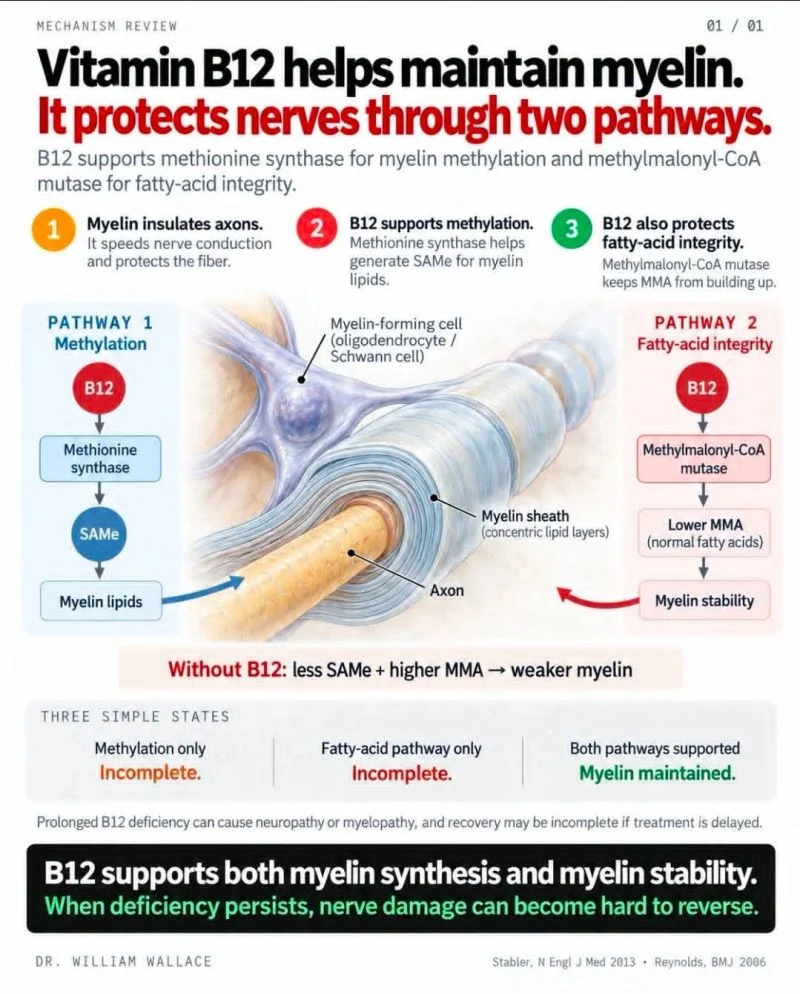
“Every nerve in your body is wrapped in myelin, a multilayered lipid sheath that insulates the axon and lets electrical signals travel fast.
B12 maintains this sheath through two separate pathways, and both fail at the same time when B12 drops.
The first pathway runs through methionine synthase.
B12 (as methylcobalamin) converts homocysteine into methionine, which becomes SAMe.
SAMe provides the methyl groups needed to build phosphatidylcholine, one of myelin’s major lipid components.
When B12 is low, SAMe drops and myelin lipid synthesis stalls.
The second pathway runs through methylmalonyl-CoA mutase.
B12 (as adenosylcobalamin) clears methylmalonyl-CoA by converting it to succinyl-CoA.
Without B12, methylmalonic acid (MMA) accumulates and abnormal fatty acids get incorporated into the myelin sheath itself, weakening its structure from the inside.
What makes this dangerous: the nerve damage can appear before anemia does.
In the Lindenbaum NEJM study, 28 percent of patients with neuropsychiatric symptoms from B12 deficiency had completely normal blood counts.
No anemia, no macrocytosis.
The myelin was already degrading with nothing on the CBC to flag it.
If caught early, repletion can reverse it.
If caught late, the demyelination can become permanent.
- Scalabrino, Prog Neurobiol, 2009.
- Lindenbaum et al., NEJM, 1988.”
Other posts featuring William Wallace on Hemostasis Today.
-
Oct 22, 2026, 16:06Akram Farhadi: Anemia and Low Hemoglobin Associated With Higher Risk of Osteosarcopenia in Older Adults
-
Oct 22, 2026, 15:49Javed Iqbal: NUMC Pulmonary and Critical Care Team Showcases Research at CHEST 2026
-
Oct 22, 2026, 15:37Alina Mitina: Key Concerns Surrounding DVT and Pulmonary Embolism
-
Oct 22, 2026, 14:45Seyed Mehrab Safdari: Prenatal Diagnosis in Hemophilia – Two Decades of Progress and Remaining Challenges
-
Oct 22, 2026, 14:39Mahmoud Abdelnabi: Evaluating the Evidence on Elevated Lp(a) and VTE Before Clinical Translation
-
Oct 22, 2026, 14:34David McIntosh: Fundamental Flaws in National Blood Systems Are Root Causes of Failure
-
Oct 22, 2026, 14:32Aurelio Maggio: Bridging Scientific Progress and Equitable Access to SCD Care in Sub-Saharan Africa
-
Oct 22, 2026, 14:26Khaled Musallam: Longevity and Healthy Aging in Thalassemia
-
Oct 22, 2026, 14:26Deise Catamo Vaz: Two Years of Growth and a New Way of Seeing the World of Stroke