


Edward Lee Carter: Has PEPPER Changed the Role of Aspirin in Arthroplasty VTE Prophylaxis?
Edward Lee Carter, Clinical Pharmacist Practitioner at U.S. Department of Veterans Affairs, shared a post on LinkedIn:
”Aspirin after hip or knee replacement:
Has PEPPER changed the conversation?
The newly published PEPPER trial in NEJM Group adds important evidence to the ongoing debate over VTE prophylaxis following elective total hip and knee arthroplasty.
But when considered alongside EPCAT II, EPCAT III, and CRISTAL, the findings deserve more than a simple aspirin-versus-anticoagulant interpretation.
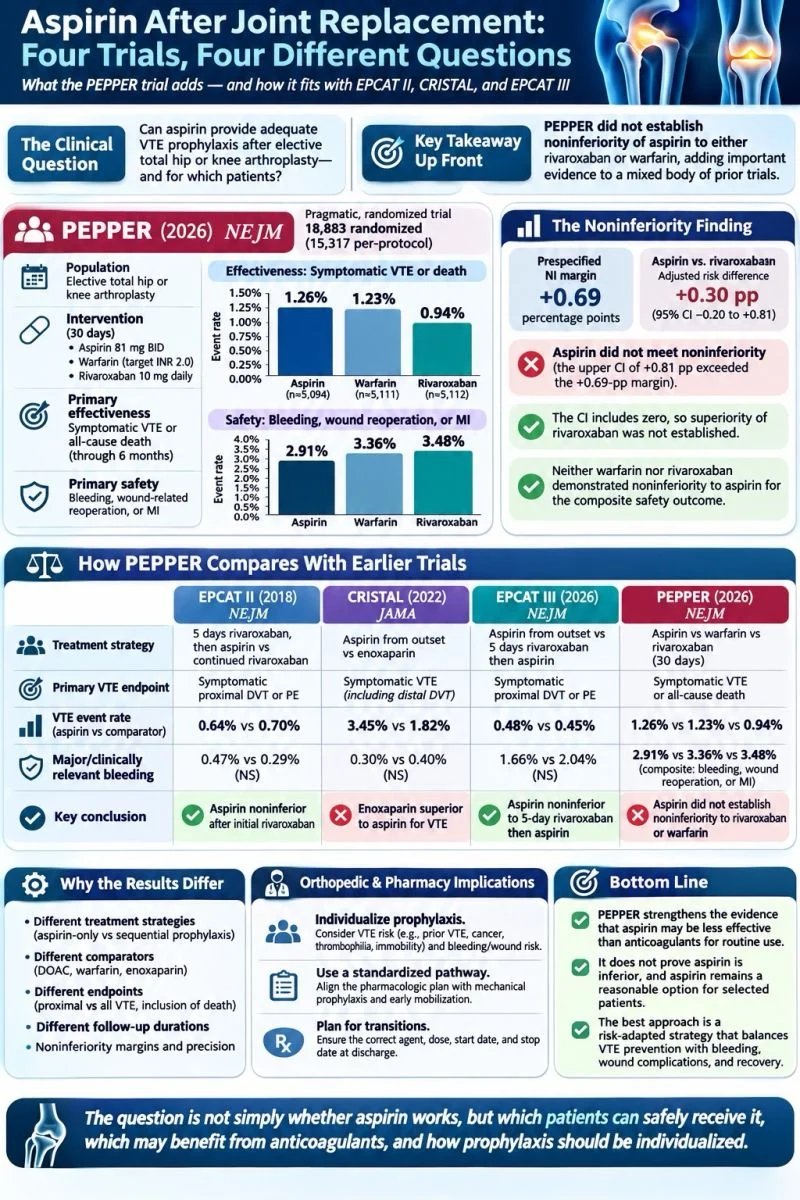
PEPPER | 18,883 randomized patients
Three prophylaxis strategies for 30 days:
- Aspirin 81 mg twice daily
- Warfarin (target INR 2.0)
- Rivaroxaban 10 mg daily
Primary effectiveness outcome: symptomatic VTE or all-cause death through six months.
Per-protocol event rates:
- Aspirin: 1.26 percent
- Warfarin: 1.23 percent
- Rivaroxaban: 0.94 percent
Aspirin did not demonstrate noninferiority to either anticoagulant.
Versus rivaroxaban, the adjusted absolute risk difference was plus 0.30 percentage points (95 percent CI minus 0.20 to plus 0.81), exceeding the prespecified plus 0.69-point noninferiority margin.
Importantly, failure to establish noninferiority is not proof of inferiority.
The orthopedic safety considerations also matter. PEPPER evaluated bleeding, wound-related reoperation, and myocardial infarction in a composite safety endpoint. Neither anticoagulant demonstrated noninferiority to aspirin for that outcome.
How does this fit with earlier trials?
- EPCAT II: Aspirin was noninferior to continued rivaroxaban AFTER five initial days of rivaroxaban.
- CRISTAL: Enoxaparin was superior to aspirin for symptomatic VTE, with much of the difference involving distal DVT.
- EPCAT III: Aspirin from the outset was noninferior to five days of rivaroxaban followed by aspirin for symptomatic proximal DVT or PE.
Four trials. Different strategies. Different endpoints.
The distinctions are clinically important:
- Aspirin-only versus sequential prophylaxis
- Short anticoagulant lead-in versus a full anticoagulant course
- Proximal versus distal DVT
- Noninferiority margins and confidence intervals
- VTE prevention versus bleeding and wound complications
For orthopedic teams and anticoagulation pharmacists, the challenge is balancing thrombosis prevention with surgical recovery.
The question is not simply whether aspirin works.
It is which patients can safely receive aspirin, which may benefit from anticoagulants, and how prophylaxis should be individualized.
PEPPER does not settle the debate.
It reinforces the need for thoughtful patient selection, interdisciplinary protocols, and careful interpretation of randomized evidence.
Should these findings change routine arthroplasty prophylaxis—or strengthen the case for risk-adapted approaches?”
More posts featuring Edward Lee Carter on Hemostasis Today.
-
Nov 16, 2026, 12:14Sophia Delicou: Ensuring Lifelong Health Beyond Stem Cell Transplantation
-
Nov 16, 2026, 11:53Eduardo Ortiz Bello: The Endothelium in Hemostasis and Microcirculation
-
Nov 16, 2026, 11:51Phil Spinella: Advancing Transfusion Medicine Through Collaboration
-
Nov 16, 2026, 11:46Madiha Chowdhury: Behind the Scenes of Blood Transfusion Services
-
Nov 16, 2026, 11:43Nasir Al Allawi: Honouring Excellence in Haematopathology
-
Nov 16, 2026, 11:39Osman El-Maarri: Delete Two Genes from a Cell Line and It Secretes Twice as much Factor VIII
-
Nov 16, 2026, 11:37Chaza Alaji: Unexplained Bruising-Beyond Platelet Counts and Coagulation Tests
-
Nov 16, 2026, 11:33Obed Asumadu: How Can Advanced Laboratory Diagnostics Improve the Detection and Management of Haemophilia?
-
Nov 16, 2026, 11:29Amman Yousaf: Pulmonary Embolism Mortality in Patients With Coagulation Disorders at AHA 2026