


Remi Remakanth: The Role of Transfusion Medicine in HLA Antibody Testing and Transplant Desensitization
Remi Remakanth, HOD and Consultant in Transfusion Medicine and Blood Centre at Lisie Hospital, Medical Advisor at Naruna Health Care, shared John Abraham‘s post on LinkedIn:
“This is an area that I have been increasingly involved in through my work in Transfusion Medicine.
We often talk about DSA in the context of HSCT, but in our practice we have also been seeing its relevance in solid organ transplantation, particularly kidney and liver transplants.
Unlike HSCT, HLA matching and pre-transplant HLA antibody testing are not routinely mandatory for every solid organ transplant, especially in liver transplantation.
But we have come across cases where significant donor-specific antibodies were identified only after looking deeper, and some of these patients subsequently had poor graft outcomes.
This has made us more proactive about doing molecular HLA testing, DSA testing and flow crossmatch in selected high-risk cases rather than looking at compatibility only from the conventional perspective.
We are now also involved in desensitization in these settings, including therapeutic plasma exchange, IVIG and other approaches depending on the clinical situation.
In HSCT, I have been involved in cases requiring a combination of plasma exchange, rituximab, IVIG and donor-derived buffy coat for HLA antigen neutralization, along with serial DSA and crossmatch monitoring.
What I find particularly interesting about these cases is that the MFI number is only one part of the picture. Understanding the antibody specificity, its functional significance and the clinical context is equally important.
It has been a really interesting part of Transfusion Medicine for me — where apheresis, HLA immunology, immunohematology and transplantation all come together.
Definitely an area where close coordination between the transplant and Transfusion Medicine teams can make a real difference.”
John Abraham, Assistant Professor at Christian Medical College and Hospital, shared a post on LinkedIn:
“Desensitisation in HSCT
Part 1: From HLA sensitisation to donor-specific risk
While preparing my presentation on Desensitisation in Haematopoietic Stem Cell Transplantation, I revisited the evolution of literature on donor-specific anti-HLA antibodies (DSA) — from the early observations linking them to graft failure to contemporary consensus recommendations on their detection and management.
Few important lessons:
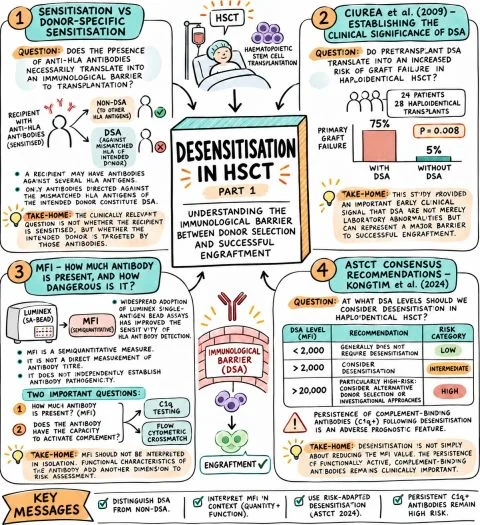
1. Sensitisation is not synonymous with donor-specific sensitisation.
The presence of anti-HLA antibodies does not automatically translate into a barrier to transplantation. What matters is whether these antibodies recognise the mismatched HLA antigens of the intended donor.
This distinction is fundamental because DSA assessment should inform both donor selection and the decision to undertake desensitisation.
The study by Ciurea et al. (2009) provided an important early clinical signal. Primary graft failure occurred in 75% of patients with pretransplant DSA compared with 5% in those without DSA (P = 0.008).
It helped establish DSA as a clinically meaningful immunological barrier rather than merely a laboratory finding.
2. MFI is a starting point, not the entire story.
The introduction of Luminex single-antigen bead assays transformed our ability to detect HLA antibodies. However, MFI remains a semiquantitative measure and does not independently establish antibody pathogenicity.
The more important question is not simply how much antibody is present, but whether it has the functional capacity to activate complement.
This is where C1q testing and flow cytometric crossmatch add another dimension to risk assessment.
3. DSA management needs a risk-adapted approach.
The ASTCT consensus recommendations by Kongtim et al. (2024) provide a useful clinical framework for haploidentical transplantation:
- DSA below 2,000 MFI: generally no desensitisation required.
- DSA above 2,000 MFI: consider desensitisation.
- DSA above 20,000 MFI: particularly high-risk; consider alternative donor selection or investigational approaches.
An equally important observation is that persistence of complement-binding antibodies following desensitisation is associated with adverse outcomes.
References:
- Ciurea SO et al. (2009) – Clinical impact of donor-specific anti-HLA antibodies in haploidentical transplantation.
- Kongtim P et al. (2024) – ASTCT Consensus Recommendations on Testing and Treatment of Donor-Specific Anti-HLA Antibodies in Hematopoietic Cell Transplantation.”
Stay updated with Hemostasis Today.
-
Nov 17, 2026, 23:45Cajetan Reichardt: LAAO vs. OAC in AF – Balancing Nonprocedural Bleeding and Ischemic Stroke Risk
-
Nov 17, 2026, 23:42Brian Tegtmeyer: Expanding Pre-Hospital Administration of Low-Titer O Positive Whole Blood
-
Nov 17, 2026, 23:41Mansi Kala: Advancing Hematology – From Evidence to Clinical Excellence
-
Nov 17, 2026, 23:40Nathan Connell: Registered for the WFH Comprehensive Care Summit 2027 in Prague
-
Nov 17, 2026, 23:38Yaariv Khaykin: Does Reducing AF Burden After Ablation Change the Need for Anticoagulation?
-
Nov 17, 2026, 23:38Amos Gitonga Mbaabu: Strengthening Care and Advocacy for Haemophilia and SCD across Southern Africa
-
Nov 17, 2026, 23:35Muhammad Sameed Altaf: A Decade of Working Together for Thalassemia Awareness and Patient Support
-
Nov 17, 2026, 23:34Ahmed Bennis: Is Aspirin Therapy Enough for VTE Prevention After Arthroplasty?
-
Nov 17, 2026, 15:26Hereditary Hemorrhagic Telangiectasia: The Molecular Connection Between Vascular Malformations and Bleeding