

The Future of Global Hemophilia Care and the Impact of the World Health Assembly Resolution
Hemophilia is a rare inherited bleeding disorder characterized by deficiencies in coagulation factor VIII (hemophilia A) or factor IX (hemophilia B).
Although advances in diagnosis and treatment have significantly improved disease management, access to appropriate care remains unequal worldwide. Many people living with hemophilia and other bleeding disorders remain undiagnosed or lack access to essential medicines, prophylaxis, and specialized healthcare services.
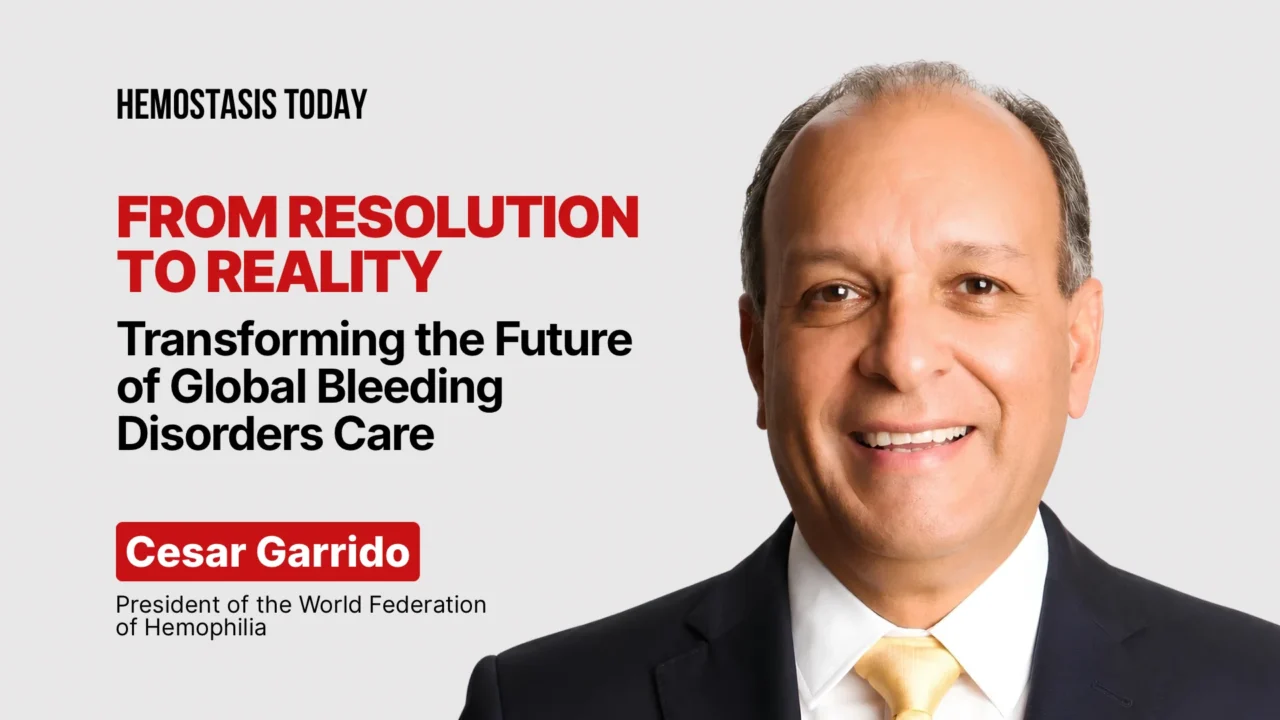
WFH President César Garrido discusses treatment innovation, inequalities in access to care, the significance of the World Health Assembly resolution, and the role of patient advocacy in shaping the future of bleeding disorders care.
Addressing these inequalities requires not only scientific innovation but also international collaboration, stronger healthcare systems, and sustained political commitment.
These challenges and the future of global bleeding disorders care were central themes in an interview with César Garrido, President of the World Federation of Hemophilia (WFH).
Innovation And The Future Of Hemophilia Treatment
Garrido anticipates that progress in hemophilia care will accelerate over the coming decade, supported by scientific advances, stronger clinical evidence, and improved healthcare professional training.
The expanding therapeutic landscape includes bispecific antibodies, rebalancing agents, and standard, extended, and ultra-long half-life recombinant coagulation factor products. Gene therapy also represents an important component of future treatment strategies.
However, the availability of innovative therapies does not automatically translate into equitable access. Ensuring that these developments reach patients in countries with limited healthcare resources remains a major challenge.
Closing The Gap In Diagnosis And Treatment
Early diagnosis and sustainable access to appropriate medicines remain among the most pressing priorities, particularly in low- and middle-income countries.
A considerable gap persists between the estimated number of people living with hemophilia and those who have received a diagnosis. Furthermore, diagnosis must be followed by reliable access to treatment, prophylaxis, and long-term specialized care.
Garrido highlights the WFH Humanitarian Aid Program as an important initiative supporting this effort through medicine donations, prophylaxis, and healthcare professional training. Beyond immediate treatment support, the program helps build local expertise, generate clinical experience, and strengthen advocacy efforts directed toward national healthcare authorities.
The World Health Assembly Resolution And Its Global Significance
A central topic of the interview is the recently adopted World Health Assembly resolution on improving health equity for people with hemophilia and other bleeding disorders.
Adopted by consensus among all 193 WHO Member States, the resolution represents an important international commitment to improving diagnosis, access to medicines, and treatment, regardless of sex or geographical location.
Garrido emphasizes that the next challenge is implementation. National organizations and healthcare leaders must translate this international commitment into practical strategies that reflect the realities of individual countries.
Patient Advocacy Must Influence Policy
Patient participation is essential to improving access to treatment and influencing healthcare decisions. Garrido stresses that the voices of people living with bleeding disorders can help persuade governments and health authorities to assume greater responsibility.
He also highlights the role of patient involvement in procurement processes, noting that collaboration between patients and healthcare professionals has contributed to reductions in medicine prices in Europe.
The newly adopted resolution provides national patient organizations with an additional instrument for advocacy. However, its value will depend on active engagement and continued efforts to influence healthcare policies.
WFH Priorities And Measurable Goals For 2030
The WFH’s strategic priorities include improving standards of care, strengthening national member organizations and treatment centers, expanding international collaboration, improving treatment safety monitoring, and integrating artificial intelligence and big-data approaches into healthcare strategies.
Garrido also identifies specific diagnostic targets for the global bleeding disorders community by 2030:
- 40,000 additional people diagnosed with hemophilia.
- 20,000 additional people diagnosed with von Willebrand disease.
- 35,000 additional women diagnosed with bleeding disorders.
A substantial increase in the number of patients receiving prophylaxis.
These objectives emphasize the importance of identifying people who remain undiagnosed and ensuring that diagnosis leads to appropriate treatment.
Global Awareness Requires Collective Responsibility
The interview highlights an essential message for the international bleeding disorders community: progress cannot be measured by therapeutic innovation alone. It must also be reflected in improved diagnosis, equitable treatment access, and sustainable healthcare systems.
The World Health Assembly resolution provides an important foundation for international action, but governments, healthcare professionals, patient organizations, and international partners must work together to turn its commitments into reality.
As César Garrido emphasizes, the patient’s voice is essential in convincing health authorities and governments. Ensuring that this voice is heard and translated into meaningful policy action will be fundamental to improving care for people with bleeding disorders worldwide.
Watch the full interview on Hemostasis Today TV.
Stay updated with Hemostasis Today.
-
Nov 24, 2026, 14:55Cecilia Kretz: Evaluating Aspirin-Free Antithrombotic Strategies in HeartMate 3 Patients
-
Nov 24, 2026, 14:39Andrija Velevski: Why Oxygen Availability Does Not Guarantee Tissue Oxygenation
-
Nov 24, 2026, 14:27Basyouni Omran: Clinical Guidance on Antiplatelet Use in Acute Ischemic Stroke
-
Nov 24, 2026, 14:07Mohamed Sherif Salem: AHA 2026 Recommendations for Antiplatelet Management in Acute Ischemic Stroke
-
Nov 24, 2026, 13:03Nikolaj Nytofte: Uncovering a Hidden Genetic Cause of Recurrent Venous Thromboembolism
-
Nov 24, 2026, 11:42Claudia Colombo: Early Clinical Outcomes Following Ultrasound-Assisted Thrombolysis in Pulmonary Embolism
-
Nov 24, 2026, 11:08Abuzar Rezaee: Improving Pulmonary Embolism Detection Through Better Data Annotation
-
Nov 24, 2026, 07:01Jesse Solar: Raising Awareness About Blood Clots and Pulmonary Embolism
-
Nov 24, 2026, 06:55Lisa-Marie Müller: Acute Pulmonary Embolism Outcomes in Germany