


Chokri Ben Lamine: Understanding HIT and DITP Through Clinical Features, Diagnosis and Management
Chokri Ben Lamine, Assistant Consultant at King Faisal Specialist Hospital and Research Center, shared a post on X:
”Heparin-Induced Thrombocytopenia (HIT) and Drug-Induced Immune Thrombocytopenia (DITP): High-Yield Clinical Pearls
Ruah Alyamany
Consultant, General Hematology – KFSHRC
Hematology High Yield Review 2026 | Alfaisal University, Riyadh, Saudi Arabia
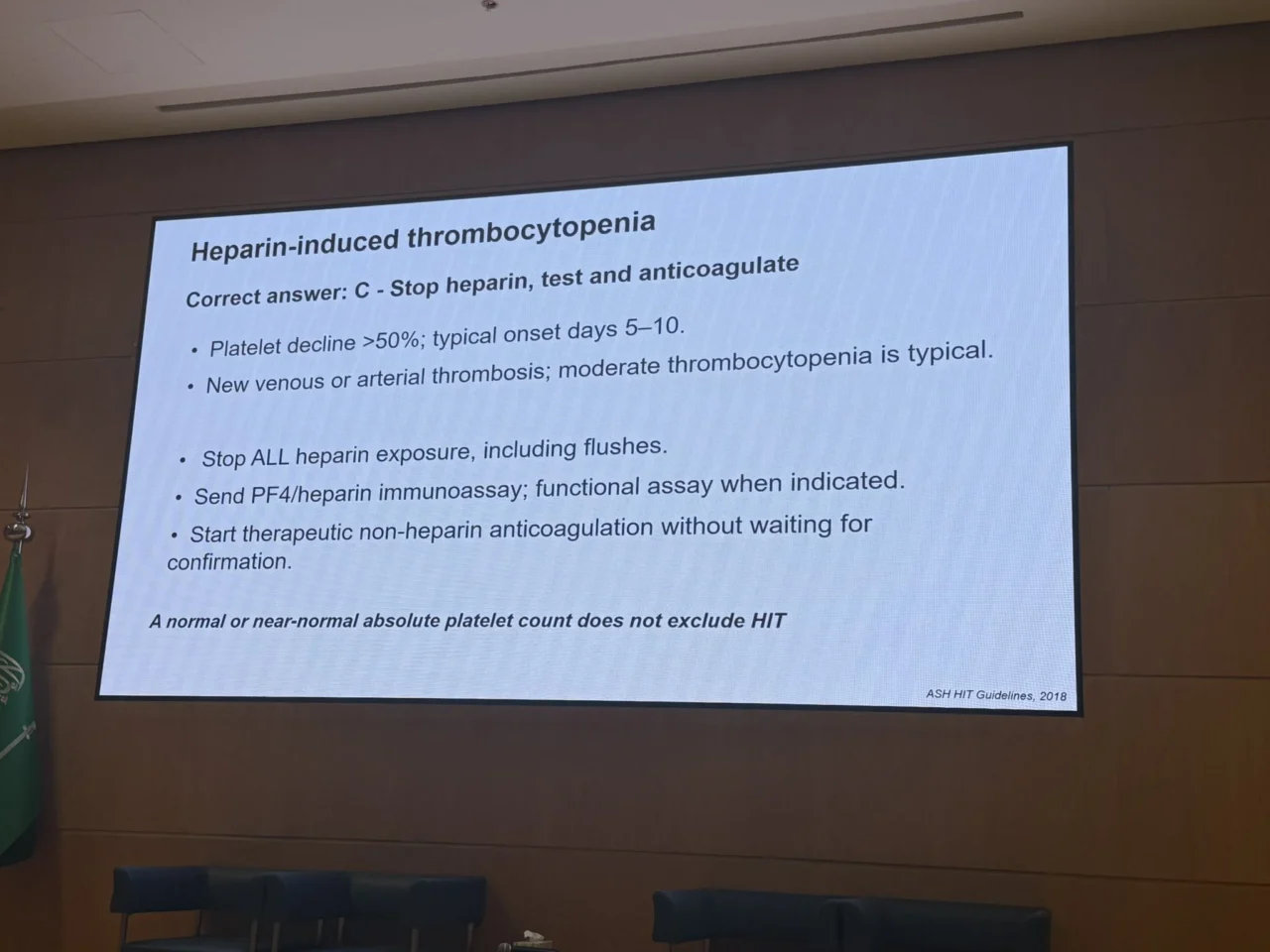
HIT: Thrombocytopenia with a paradoxical thrombotic risk
Platelet-activating IgG antibodies against PF4/heparin complexes trigger platelet activation and excessive thrombin generation.
Platelet decline greater than 50% from baseline, typically 5–10 days after heparin exposure.
A normal absolute platelet count does not exclude HIT.
Both arterial and venous thrombosis may occur.
4Ts Score: Know your pretest probability
1. Thrombocytopenia
2 points: Platelet fall greater than 50%, with nadir at least 20 × 10⁹/L.
1 point: Platelet fall of 30–50% or nadir of 10–19 × 10⁹/L.
0 points: Platelet fall less than 30% or nadir less than 10 × 10⁹/L.
2. Timing
2 points: Days 5–10 or within 1 day with heparin exposure during the preceding 30 days.
1 point: Unclear timing, onset after day 10, or rapid onset with exposure 30–100 days previously.
0 points: Within 4 days without recent exposure.
3. Thrombosis
2 points: New confirmed thrombosis, skin necrosis or systemic reaction following intravenous heparin.
1 point: Suspected, progressive or recurrent thrombosis; non-necrotizing skin lesions.
0 points: No thrombosis.
4. Other causes of thrombocytopenia
2 points: No other apparent cause.
1 point: Possible alternative cause.
0 points: Definite alternative cause.
Interpretation and management
0–3 points: Low probability. Generally, no HIT testing or empirical treatment is indicated.
4–5 points: Intermediate probability. Stop heparin, investigate and initiate non-heparin anticoagulation, with intensity guided by bleeding risk and other indications.
6–8 points: High probability. Stop heparin and immediately initiate therapeutic non-heparin anticoagulation.
Laboratory diagnosis
PF4/heparin immunoassay.
Functional confirmation with serotonin release assay (SRA) or heparin-induced platelet activation assay (HIPA), when indicated.
Important: Stop all heparin exposure, including low-molecular-weight heparin and heparin flushes.
Selecting the appropriate anticoagulant
Argatroban
Direct thrombin inhibitor; intravenous administration; hepatic clearance.
Particularly useful in severe renal impairment.
Reduce the dose in hepatic dysfunction.
Bivalirudin (Angiomax)
Direct thrombin inhibitor; short-acting intravenous administration.
Preferred option during percutaneous coronary intervention in acute HIT.
Renal dose adjustment may be required.
Fondaparinux (Arixtra)
Indirect factor Xa inhibitor; subcutaneous administration; renal clearance.
- Avoid in severe renal impairment (creatinine clearance less than 30 mL/min).
Rivaroxaban (Xarelto) / Apixaban (Eliquis)
Oral direct factor Xa inhibitors.
- Options for selected clinically stable patients.
Warfarin
Contraindicated during acute HIT before platelet recovery.
Initiate only after platelet recovery, usually at least 150 × 10⁹/L, with appropriate anticoagulant overlap.
Premature initiation risks venous limb gangrene and skin necrosis.
Duration of anticoagulation
Isolated HIT
Anticoagulate even without documented thrombosis, at least until platelet recovery; commonly for 4–6 weeks.
HIT with thrombosis (HITT)
Generally 3–6 months of anticoagulation.
Platelet transfusion
Avoid routine platelet transfusions in patients with HIT who are not bleeding.
DITP versus HIT: Do not confuse them!
Drug-Induced Immune Thrombocytopenia (DITP)
Typical onset: 5–10 days.
Platelet nadir: Often less than 20 billion per liter.
Major complication: Bleeding.
Mechanism: Drug-dependent antibodies.
Treatment: Immediately discontinue the offending drug.
IVIG may be considered in severe thrombocytopenia with bleeding or high bleeding risk.
Common offending agents: Quinine, vancomycin, trimethoprim-sulfamethoxazole and certain beta-lactam antibiotics.
Heparin-Induced Thrombocytopenia (HIT)
Typical onset: 5–10 days.
Platelet nadir: Often 20–100 billion per liter․
Major complication: Thrombosis.
Mechanism: Platelet-activating PF4/heparin antibodies.
Treatment: Stop heparin and initiate non-heparin anticoagulation.
Golden Examination Pearl
DITP: Stop the offending drug to prevent or control bleeding.
HIT: Stop heparin and initiate alternative anticoagulation to prevent thrombosis.”
Other posts featuring Chokri Ben Lamine on Hemostasis Today.
-
Nov 28, 2026, 17:14Daniel Jenniches: Anticoagulation Reversal in Traumatic Isolated Parafalcine Subdural Hematoma
-
Nov 28, 2026, 17:12Matthew Hazell: Challenging Unnecessary Transfusion Requests – Empowering Laboratory Professionals
-
Nov 28, 2026, 17:11Sharjeel Haider: Ischemic and Bleeding Outcomes With Prolonged DAPT After PCI
-
Nov 28, 2026, 16:59Mohamed Hemida: Coronary Stent Thrombosis in Cancer Patients Undergoing PCI
-
Nov 28, 2026, 16:45Aravind Palraj։ Low Platelets In Lupus Do Not Always Mean ITP
-
Nov 28, 2026, 15:24Seyed Mohammad Sadegh Pezeshki: Characterizing Platelet Adhesive Dysfunction in Chronic ITP
-
Nov 28, 2026, 14:52Peter A. Everts: PRP Variability and the Path Toward Precision Orthobiologics
-
Nov 28, 2026, 14:12Ahmed Kamal: RBC Morphological Abnormalities – Key Diagnostic Clues in Hematological Disorders
-
Nov 28, 2026, 14:07Hanie Salah: Can Administering 100% Pure Oxygen at 2.5 Times Atmospheric Pressure Actually Reduce Oxidative Damage?