


Anna Oleksiak: The Delicate Balance of Triple Antithrombotic Therapy After PCI
Anna Oleksiak, Cardiologist at National Institute of Cardiology Stefan Cardinal Wyszyński – National Research Institute, shared a post on LinkedIn:
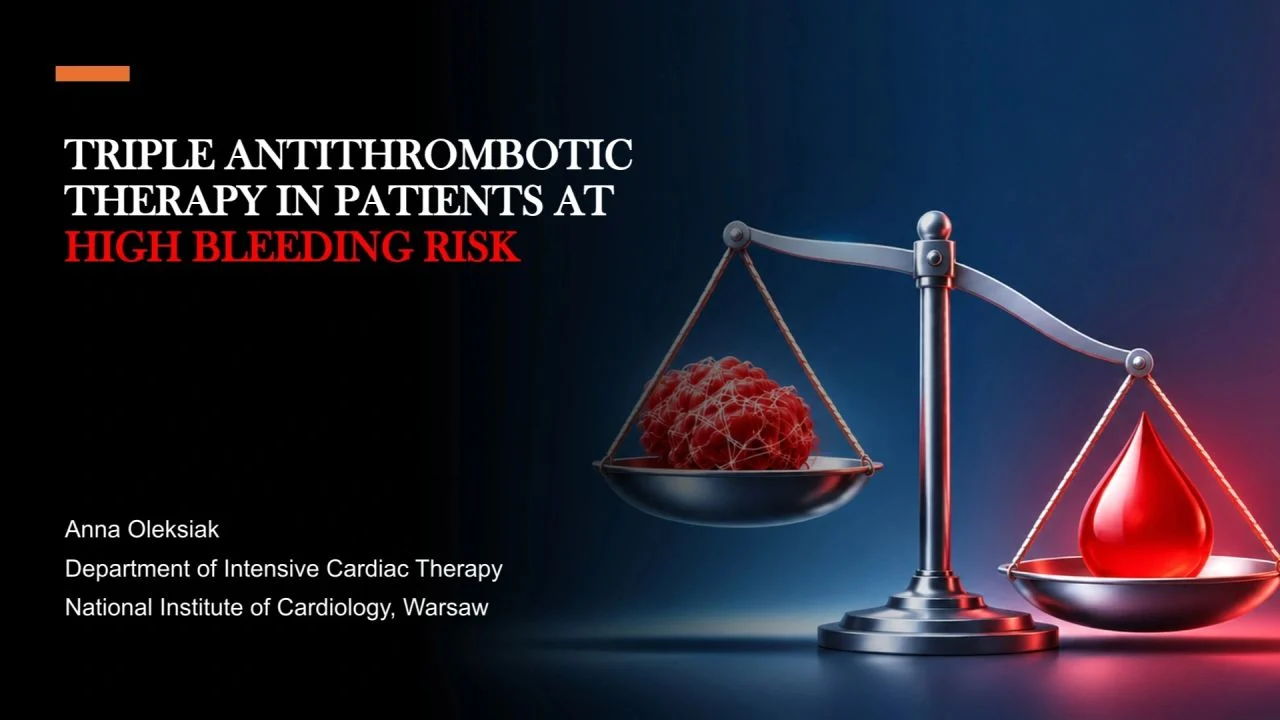
“Triple Antithrombotic Therapy in Patients at High Bleeding Risk: Less Can Be More, but Balance Is Everything.
TAT in patients at high bleeding risk was the topic of my today’s lecture.
Here are my key take-home messages:
1. Assess bleeding risk systematically.
The ARC-HBR criteria should be part of the routine assessment and documentation of every patient with ACS treated with PCI.
Bleeding risk is multifactorial and extends far beyond antithrombotic medications.
2. Keep triple antithrombotic therapy as short as possible.
In patients with ACS requiring long-term oral anticoagulation after PCI, TAT should generally be limited to 7 days, particularly in those at high bleeding risk.
Prolongation up to 1 month may be considered when stent thrombosis risk outweighs bleeding risk.
3. Early aspirin discontinuation is a key bleeding-reduction strategy.
Evidence from WOEST, AUGUSTUS, PIONEER AF-PCI, and RE-DUAL PCI supports minimizing aspirin exposure and transitioning to dual therapy with an oral anticoagulant and a P2Y12 inhibitor, preferably clopidogrel.
4. Choose the right anticoagulant at the right dose.
DOACs are generally preferred over VKAs in eligible patients.
Appropriate dosing, renal and hepatic function, and potential drug–drug interactions must always be carefully reviewed.
High bleeding risk does not automatically justify inappropriate DOAC dose reduction.
5. High bleeding risk does not mean withholding stroke prevention.
The goal is not to avoid anticoagulation but to optimize the balance between thromboembolic protection and bleeding risk.
6. Mechanical circulatory support adds another layer of complexity.
Patients with ACS and CS receiving MCS are particularly vulnerable to bleeding due to platelet dysfunction, acquired von Willebrand syndrome, and consumptive coagulopathy.
Importantly, thrombosis and bleeding can coexist, especially in critically ill patients requiring mechanical circulatory support.
The ultimate take-home message:
The best antithrombotic strategy is not necessarily the most intensive one. It is the one that provides adequate thrombotic protection with the lowest possible bleeding risk.”
Stay updated with Hemostasis Today.
-
Nov 29, 2026, 11:57Mitchell Elkind: Uncovering Potential Benefits of Anticoagulation in Selected ESUS Patients
-
Nov 29, 2026, 10:23Simona Sacco: Finding the Right Time to Restart Anticoagulation After Hemorrhagic Transformation
-
Nov 29, 2026, 10:02Felice Gragnano: The Evolving Evidence for Antithrombotic Therapy After CABG
-
Nov 29, 2026, 09:39Tamer Elalfy: Safe Anticoagulant Interruption and Resumption in Surgical Patients
-
Nov 29, 2026, 06:30Ghufran Ahmad: When Drug Effects Outlast Their Half-Life
-
Nov 29, 2026, 05:54Ceri Rose: Building a Stronger Blood Donor Community
-
Nov 29, 2026, 05:34Seema Dawood: Duffy-Null Status and New Neutrophil Reference Ranges
-
Nov 29, 2026, 05:26Kathaleen Schnur: Empowering Women Through Advocacy in Bleeding Disorders
-
Nov 29, 2026, 05:19Obi Light Ogbonnia: Making Sickle Cell Research Matter to the Lives of Patients