

Abdul Mannan – The RBC Crime Scene: Decoding Inclusions on the Blood Film
Abdul Mannan, Consultant Haematologist at Betsi Cadwaladr University Health Board, posted on LinkedIn:
”The RBC “Crime Scene”: Decoding Inclusions on the Blood Film
As Haematologists, we are essentially detectives. When we look down the microscope, the Red Blood Cells often leave us clues about systemic pathology – we just need to know how to interpret them.
Morphology is the foundation of diagnosis.
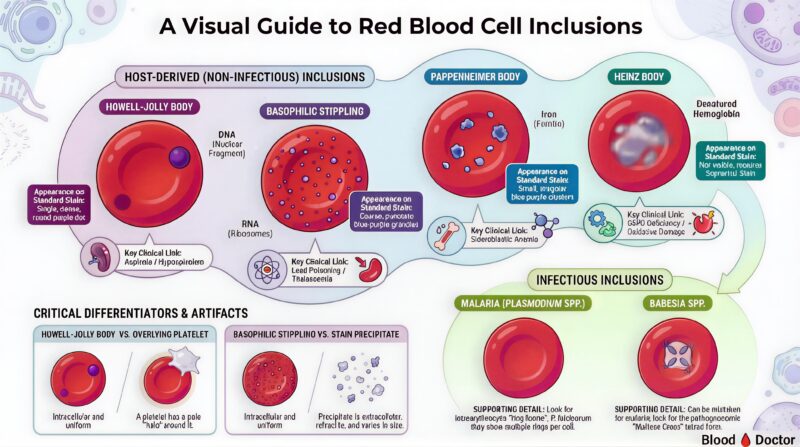
Here is a visual breakdown of the classic RBC inclusions we encounter, and what they represent:
1. Howell-Jolly Bodies (The DNA Remnant)
• Composition: DNA (Nuclear fragment).
• The Clue: Usually indicates the spleen is absent (asplenia) or not functioning (hyposplenism). The spleen usually “bites” these out; without it, they persist.
2. Basophilic Stippling (The RNA Scatter)
• Composition: Precipitated RNA (Ribosomes).
• The Clue: Think distinct toxic insults like Lead Poisoning, or hemoglobin synthesis issues like Thalassemia.
• Pearl: Don’t confuse this with stain precipitate!
3. Pappenheimer Bodies (The Iron Clumps)
• Composition: Iron (Ferritin).
• The Clue: Seen in Sideroblastic Anemia or post-splenectomy.
• Pearl: These tend to cluster, unlike the diffuse scatter of basophilic stippling.
4. Heinz Bodies (The Ghost)
• Composition: Denatured Hemoglobin.
• The Clue: G6PD Deficiency or oxidative damage.
• Pearl: You won’t see these clearly on a standard Wright/Giemsa stain! You need a Supravital Stain to visualize them.
5. The Invaders (Infectious)
• Malaria: Look for the classic ring forms.
• Babesia: Look for the pathognomonic “Maltese Cross” tetrad form.
The Traps (Artifacts)
Always verify before you diagnose. A platelet sitting on top of an RBC can look exactly like a Howell-Jolly body (look for the halo).
Which of these inclusions do you find post-graduates struggle to identify the most?”
Keep up with Hemostasis Today.
-
Oct 20, 2026, 05:11Giuseppe Lippi։ Understanding Liver Test Abnormalities After AAV Gene Therapy
-
Oct 20, 2026, 05:02Sanam Loghavi: Test Your Hematology Knowledge at ASH 2026!
-
Oct 20, 2026, 04:13Ifeanyichukwu Ifechidere: DOACs Are Not the Answer to Every Anticoagulation Question
-
Oct 20, 2026, 04:04Sadia Kamal: Honored to Receive the Outstanding Abstract Award at the 20th Midwest Platelet Conference
-
Oct 20, 2026, 04:03Yu-Hsuan Chen: One Antibody, Two Diseases from FcRn Biology to Clinical Translation
-
Oct 20, 2026, 03:49Domenico Simone Castiello: Rethinking Prolonged DAPT in Multivessel PCI – Insights from the DAPT-MVD Trial
-
Oct 20, 2026, 03:37Rucha Patil: Scaling POC Diagnostics for Haemophilia A and VWD Across India
-
Oct 20, 2026, 03:31Zena Vexler: Targeting Neutrophil Elastase and NETosis to Mitigate Infection-Triggered Childhood Stroke
-
Oct 20, 2026, 03:24Chaza Alaji: Diagnosing Protein C and Protein S Deficiency