


Stuart Diamond: The Mitochondrial Triangle and VO₂ Max
Stuart Diamond, Medical Doctor at Geneva College of Longevity Science, and Co-Founder at Equilux – Unlock Your Biology, posted on LinkedIn:
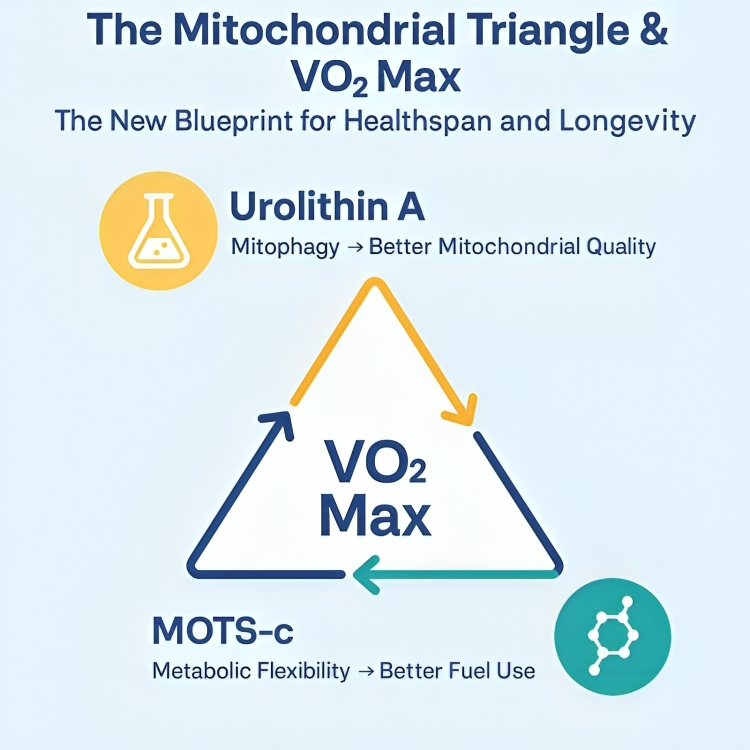
“The Mitochondrial Triangle and VO₂ Max: The New Blueprint for Healthspan, Longevity and the Future of Equilux
In longevity medicine, one metric continues to predict who not only lives longer — but lives better: VO₂ max.
VO₂ max is a direct window into mitochondrial capacity, metabolic flexibility, and cellular resilience.
At Equilux, we think of it as a vital sign of biological youth.
And what’s emerging now is how three mitochondrial interventions — Urolithin A, NAD⁺ optimization, and MOTS-c — work together to strengthen the very systems that VO₂ max measures.
These aren’t random supplements.
They’re part of a coordinated mitochondrial strategy we’re integrating directly into the Equilux clinical framework.
- Urolithin A — Improving Mitochondrial Quality (Equilux: “Reset”)
Urolithin A is one of the only compounds clinically proven in humans to induce mitophagy, the cleanup process that removes dysfunctional mitochondria.
Key evidence:
- Cell Reports Medicine: Improved muscle strength and mitochondrial biomarkers in middle-aged adults.
- JAMA Network Open: Enhanced endurance and mitochondrial gene expression in older adults.
- Nature Aging: Demonstrated age-related improvements in mitochondrial and immune function via mitophagy.
At Equilux, this sits in the “Reset” phase — clearing out the mitochondrial debris that limits energy production, recovery, and VO₂ max potential.
2. NAD⁺ — Fueling the New Mitochondrial Network (Equilux: “Rebuild”)
Once broken mitochondria are cleared, NAD⁺ becomes the limiting factor for:
- Sirtuin activity (SIRT1, SIRT3)
- Mitochondrial biogenesis
- ATP output
- Oxidative metabolism
- Cellular repair and stress tolerance
White-paper-level support:
- A 2024 systematic review highlights NAD⁺ precursors improving mitochondrial density, metabolism, and cellular energetics in humans.
- Research across Nature, Cell Metabolism, and Science confirms NAD⁺ decline is a hallmark of aging — and restoring NAD⁺ restores mitochondrial function.
At Equilux, this is part of the “Rebuild” phase — supporting biogenesis and restoring youthful energetic pathways.
3. MOTS-c — Enhancing Metabolic Flexibility (Equilux: “Optimize”)
MOTS-c is a mitochondrial-encoded peptide that functions like an internal exercise signal.
Key scientific support:
- Nature Communications: Human subjects showed increased MOTS-c levels after acute exercise.
- Journal of Translational Medicine: Described MOTS-c’s role in AMPK activation, insulin sensitivity, fat oxidation, and cellular stress resilience.
- Preclinical data shows dramatic improvements in endurance, metabolic function, and healthspan.
At Equilux, we use MOTS-c in the “Optimize” phase — improving the body’s ability to use oxygen and fuel, directly influencing VO₂ max and metabolic age.”
Stay informed with Hemostasis Today.
-
Sep 23, 2026, 10:30Michael Angers: Advancing Transfusion Safety Through Smarter Laboratory Workflows
-
Sep 23, 2026, 07:28Isabelle Grenier-Pleau: Targeting Von Willebrand Disease to Transform Women’s Health
-
Sep 23, 2026, 07:07Wolfgang Miesbach: Mechanisms of Liver Injury After Hemophilia A Gene Therapy
-
Sep 23, 2026, 06:24Nicolas Gendron: Everolimus and Venous Thromboembolic Risk in Kidney Transplantation
-
Sep 23, 2026, 06:07Hoori Shahwar: Cerebral Venous Sinus Thrombosis Diagnosis and Management
-
Sep 23, 2026, 06:06Advancing Hemophilia Care and Patient Advocacy in Bangladesh – World Federation of Hemophilia
-
Sep 23, 2026, 05:54Bringing the Global Thrombosis and Haemostasis Community Together in 2027 – ISTH
-
Sep 23, 2026, 04:34David Akande: When Sickle Cell Crises Have No Clear Trigger
-
Sep 23, 2026, 04:13Jean Connors: Safety of Heparin Re-Exposure in Patients with Remote HIT