


Andreas Tiede on Antithrombotic Drugs and Their Role in Cancer Progression and Metastasis
Andreas Tiede, Professor, Department of Hematology, Hemostasis, Oncology and Stem Cell Transplantation at Hannover Medical School, shared a post by NEJM Group on LinkedIn, adding:
“I wouldn’t treat cancer patients with aspirin — yet —, but it is worthwhile observing the field of antithrombotic drugs affecting cancer progression and metastasis. Anticoagulants like heparin were sometimes reported to have similar effects.”
Quoting NEJM Group‘s post:
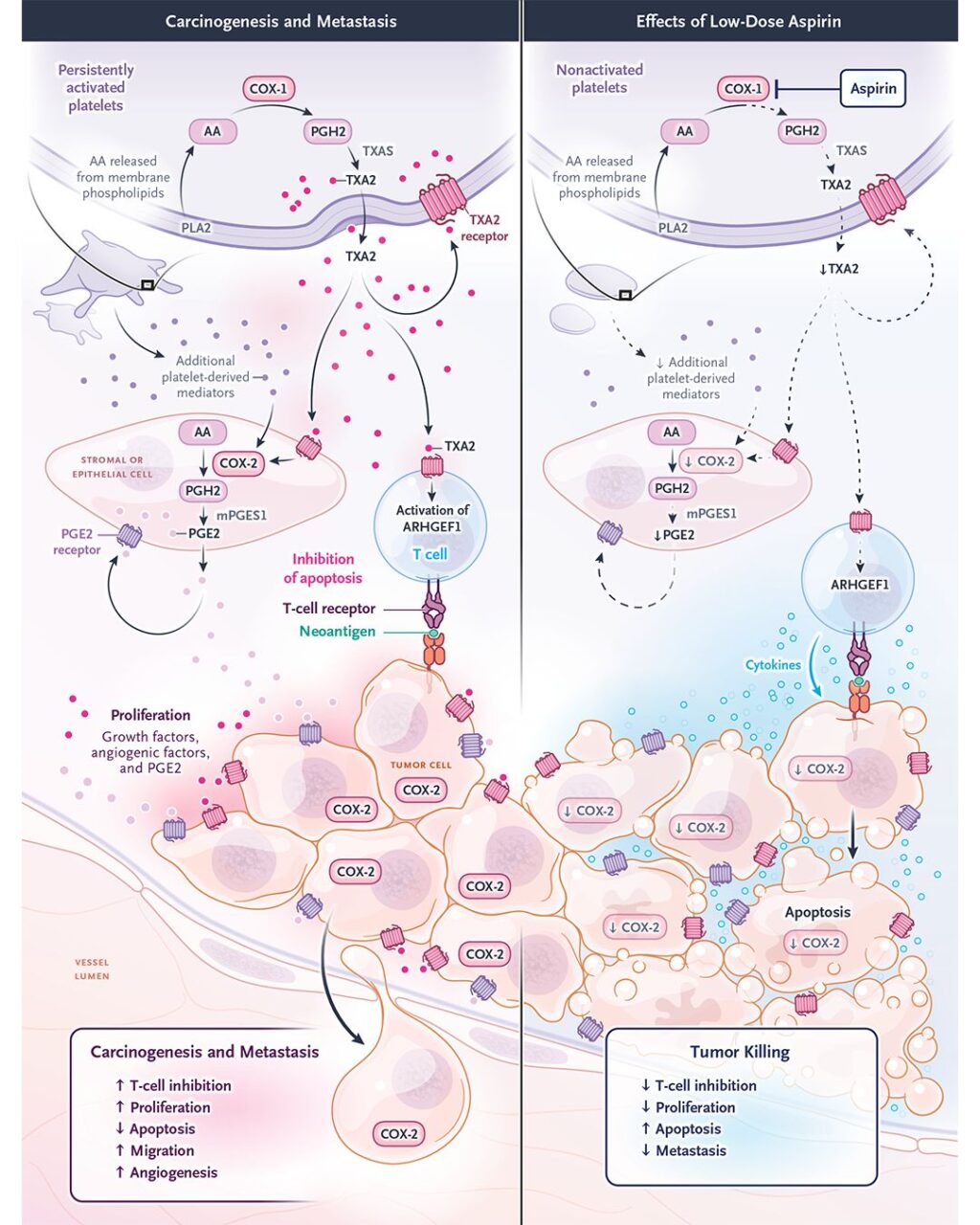
“A new study shows that aspirin enhances antimetastatic immunity by decreasing platelet activation, thereby releasing T cells from suppression by thromboxane A2.
The effects of aspirin on cancer metastasis were first recognized more than 50 years ago. In a seminal study, Gasic and colleagues found that fewer lung metastases developed in mice whose drinking water was supplemented with aspirin than in control mice.
Epidemiologic data support the hypothesis that aspirin prevents cancer, but the design and interpretation of randomized trials have been hampered by a lack of mechanistic understanding.
This is changing. In a recent report, Yang and colleagues describe a previously unrecognized immunosuppressive mechanism that prevents T cells from eliminating cancer metastases.
At the heart of this prometastatic mechanism is a protein called ARHGEF1, which is activated by thromboxane A2 (TXA2), a metabolite of the platelet arachidonic acid pathway. This pathway is inhibited by aspirin through inactivation of cyclooxygenase (COX) enzymes.
Title: Understanding How Aspirin Prevents Metastasis
Authors: Ruth E. Langley, John Burn

Read the full article on the NEJM.
Read also on Hemostasis Today: Eric Topol on How Low-Dose Aspirin May Help Prevent Cancer Metastasis
-
Sep 29, 2026, 03:53Nahrwan Masaoodi: Iron Deficiency Can Exist Without Anemia
-
Sep 29, 2026, 03:38Muhammad Yousaf: Iron Deficiency Beyond Diet
-
Sep 29, 2026, 03:21Parvez Ahmed Chowdhury: Synthesizing Aspirin in the Organic Chemistry Lab
-
Sep 29, 2026, 03:12Ahmed Hamandi: Building the Future of Hematopoietic Transplantation in Iraq
-
Sep 29, 2026, 03:09M V Chandrakanth: Aspirin in CRC – Old Drug, New Precision Oncology?
-
Sep 29, 2026, 03:07Caroline Pothet: Advancing Treatment Development in Sickle Cell Disease and Thalassaemia
-
Sep 29, 2026, 02:53Astha Jain: Thalassemia Care Through a Public Health Lens
-
Sep 29, 2026, 02:50Emma Groarke: Starting a New Career Path in Homeland
-
Sep 28, 2026, 19:14Aditya Sharma: An Outstanding Start to the Final Day of VSS 2026!