


Bianca Rocca: PRECISE-DAPT Score Identifies Bleeding Risk After CABG in Patients With POAF
Bianca Rocca, Editor in Chief at European Heart Journal Cardiovascular Pharmacotherapy, shared on X about a recent article by Mary Rezk et al, published in European Heart Journal – Cardiovascular Pharmacotherapy, adding:
” New in EHJ – CVP
Want something to read during your summer holidays?
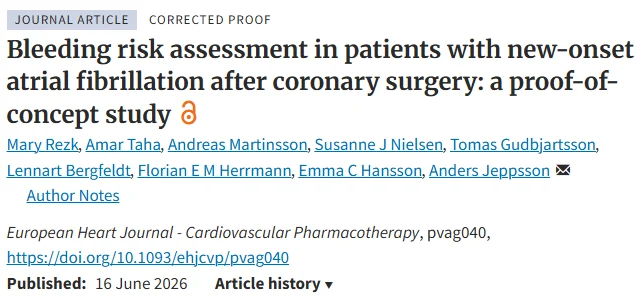
Bleeding risk assessment in patients with new-onset atrial fibrillation after coronary surgery: a proof-of-concept study
Is a bleeding risk score able to identify which patients with post-operative AF after CABG are most likely to bleed after discharge?
Guidelines recommend weighing bleeding risk before starting anticoagulation, but none clearly define how to measure it.
The nationwide Swedish registry cohort included 4,436 patients with POAF after first-time isolated CABG (2009 to 2020) who did not receive oral anticoagulation at discharge, mirroring the therapeutic dilemma a clinician faces at discharge.
The four-item PRECISE-DAPT score (age, creatinine clearance, preoperative haemoglobin, previous bleeding) classified 36% of the patients as high risk.
Major bleeding during the first year occurred in 0.8% of low-risk, 1.9% of moderate-risk and 3.6% of high-risk patients, with a hazard ratio of 4.81 (95% CI 2.59 to 8.96) for high versus low risk.Discrimination was moderate (AUC 0.68) and calibration was good up to a predicted annual risk of about 7%.
This is an observational registry study. Patients on anticoagulation were excluded, so the findings apply to those judged safe to discharge without it, and registry-based definitions will miss bleeds that did not lead to hospitalisation. The score separates risk groups, but whether using it to guide anticoagulation improves outcomes will need prospective, randomized testing.”
Title: Bleeding risk assessment in patients with new-onset atrial fibrillation after coronary surgery: a proof-of-concept study
Authors: Mary Rezk, Amar Taha, Andreas Martinsson, Susanne J Nielsen, Tomas Gudbjartsson, Lennart Bergfeldt, Florian E M Herrmann, Emma C Hansson, Anders Jeppsson
Stay updated on all scientific advances with Hemostasis Today.
-
Sep 21, 2026, 13:21In His Last UNGA, António Guterres Delivers a Urgent Call for Global Unity
-
Sep 21, 2026, 13:14Fatih Mehmet Gul: Are We Moving Faster Than Our Ability to Ask ‘Should We?’
-
Sep 21, 2026, 13:08Sangita Reddy: How Does Our Own Healthcare Journey in India Look Through the Same Lens?
-
Sep 21, 2026, 12:53Conan McIlwrath: Strengthening Haemophilia Care Through International Collaboration
-
Sep 21, 2026, 12:41Tinatin Muradashvili: Advancing Hemophilia Care Through Education and Collaboration
-
Sep 21, 2026, 12:15Kholoud Al Busaidi: Cold Agglutination and Its Impact on CBC and Blood Grouping Results
-
Sep 21, 2026, 11:03Shaurav Bhattacharyya: Honoring the 2026 Lasker Award Winners
-
Sep 21, 2026, 10:41Jamshid Ullah: Recognizing Blood Disorders Through Laboratory Findings
-
Sep 21, 2026, 10:18Mana Alshehri: A New Step Toward Hemophilia B Gene Therapy in Adolescents