

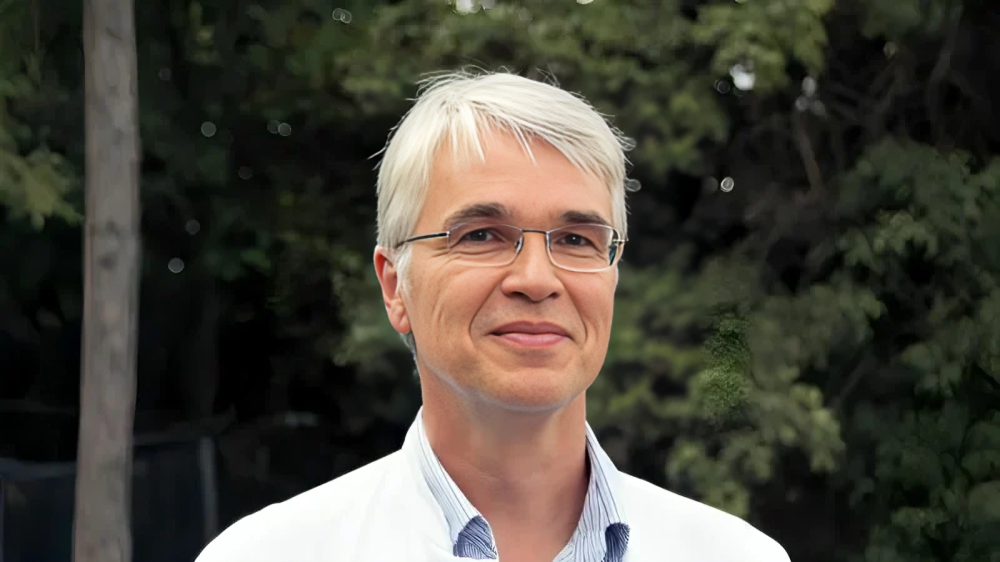
Wolfgang Miesbach: From Daily Pills to Remission after Short‑Course Therapy in ITP
Wolfgang Miesbach, Professor of Medicine at Frankfurt University Hospital, shared on LinkedIn:
”From Daily Pills to Remission after Short‑Course Therapy in ITP.
New data from the phase 3 VAYHIT2 trial in primary immune thrombocytopenia (ITP), presented yesterday at ASH 2025 by Hanny Al-Samkari and published simultaneously in NEJM.
In VAYHIT2, adults with primary ITP and insufficient response or relapse after first‑line steroids were randomized to ianalumab (3 or 9 mg/kg) or placebo, all on background eltrombopag.
A short course of four once‑monthly intravenous infusions of ianalumab led to markedly better disease control and allowed many patients to come off daily therapy while maintaining safe platelet counts.
Key efficacy observations:
· Around half of patients on 9 mg/kg remained in remission at 12 months·
· Higher rates of stable platelet responses during and after eltrombopag taper
Why the mechanism is interesting:
Ianalumab is an anti‑BAFF receptor monoclonal antibody, directly targeting B cells and the autoimmune process that underlies ITP.
By combining B‑cell modulation with a thrombopoietin receptor agonist and then withdrawing both, the strategy aims not only to raise platelets but to reset the immune system and achieve more durable responses off continuous therapy.
What this could mean for practice:
For many years, second‑line ITP treatment has largely meant indefinite daily medication or serial switches between therapies.
A finite, four‑infusion regimen that can induce remission with treatment discontinuation would represent a meaningful shift in how clinicians and patients think about long‑term management and goals of care.
Safety considerations:
The safety profile in VAYHIT2 was broadly consistent with expectations:
· No apparent excess in serious infections despite profound B‑cell depletion
· Neutropenia events were mostly transient and manageable
· Infusion‑related reactions were generally low‑grade and did not lead to treatment discontinuation
Looking ahead:
Further follow‑up, as well as data from ongoing first‑line and later‑line studies, will be crucial to understand the durability of remission, optimal timing of intervention, and how best to position ianalumab within the rapidly evolving ITP treatment landscape.”
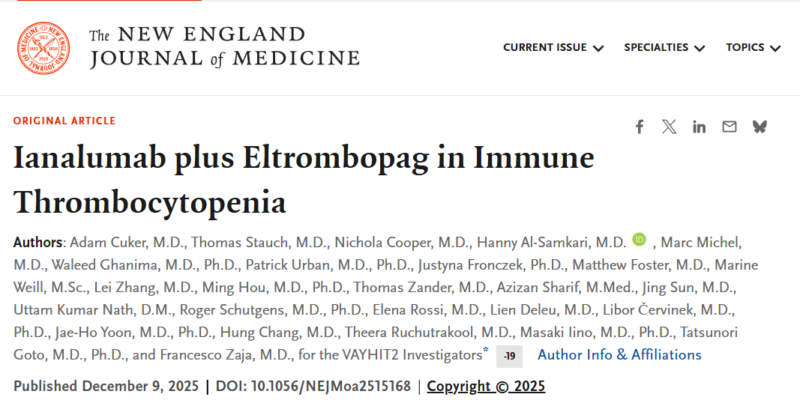
Article: Ianalumab plus Eltrombopag in Immune Thrombocytopenia
Authors: Adam Cuker, Thomas Stauch, Nichola Cooper, Hanny Al-Samkari, Marc Michel, Waleed Ghanima, Patrick Urban, Justyna Fronczek, Matthew Foster, Marine Weill, Lei Zhang, Ming Hou, Thomas Zander, Azizan Sharif, Jing Sun, Uttam Kumar Nath, Roger Schutgens, Elena Rossi, Lien Deleu, Libor Červinek, Jae-Ho Yoon, Hung Chang, Theera Ruchutrakool, Masaki Iino, Tatsunori Goto, Francesco Zaja
Read the full article here.
Stay updated on all scientific advances with Hemostasis Today.
-
Sep 25, 2026, 10:49Shefina S: From Presenting to Hosting at TRANSCON 2026
-
Sep 25, 2026, 10:37Michelle Leona Cecil: Hemophilia Advocacy and the Power of Community
-
Sep 25, 2026, 10:13Michael Baria: Platelet Concentration and PRP Outcomes in Partial Rotator Cuff Tears
-
Sep 25, 2026, 09:49Haley Coleman: Volunteering to Support Hemophilia Awareness
-
Sep 25, 2026, 08:55Hitarth Mehta: BHMS Students Gain Practical Exposure to Haemophilia Diagnosis
-
Sep 25, 2026, 07:25Varun Capoor: How Therapeutic Apheresis and Transfusion Medicine Can Complement Clinical Management in SCD
-
Sep 25, 2026, 07:14Manshi Kesharwani: SAK-GQDs Modulate Thrombus Burden and Endothelial Function in Deep Vein Thrombosis
-
Sep 25, 2026, 06:20Farjah Hassan Algahtani: How Can We Better Identify Patients at Risk of Blood Clots after Metabolic and Bariatric Surgery?
-
Sep 25, 2026, 05:59Carla Lewis: Kids Conquering Sickle Disease Joins Nemours Children’s Hospital for 2nd Annual Awareness Event