

Tareq Abadl: Blood Unit Cross Matching – If Done Incorrectly… the Consequences Can Be Catastrophic
Dr. Tareq Abadl, Medical Laboratory Specialist and Director of the Blood Bank at Dr. Abdelkader Al-Mutawakkil Hospital, shared a post on LinkedIn:
“Before a blood unit reaches the patient… one test stands as the final line of defense!
It’s called Cross Matching
If done incorrectly… the consequences can be catastrophic
What is Cross Matching?
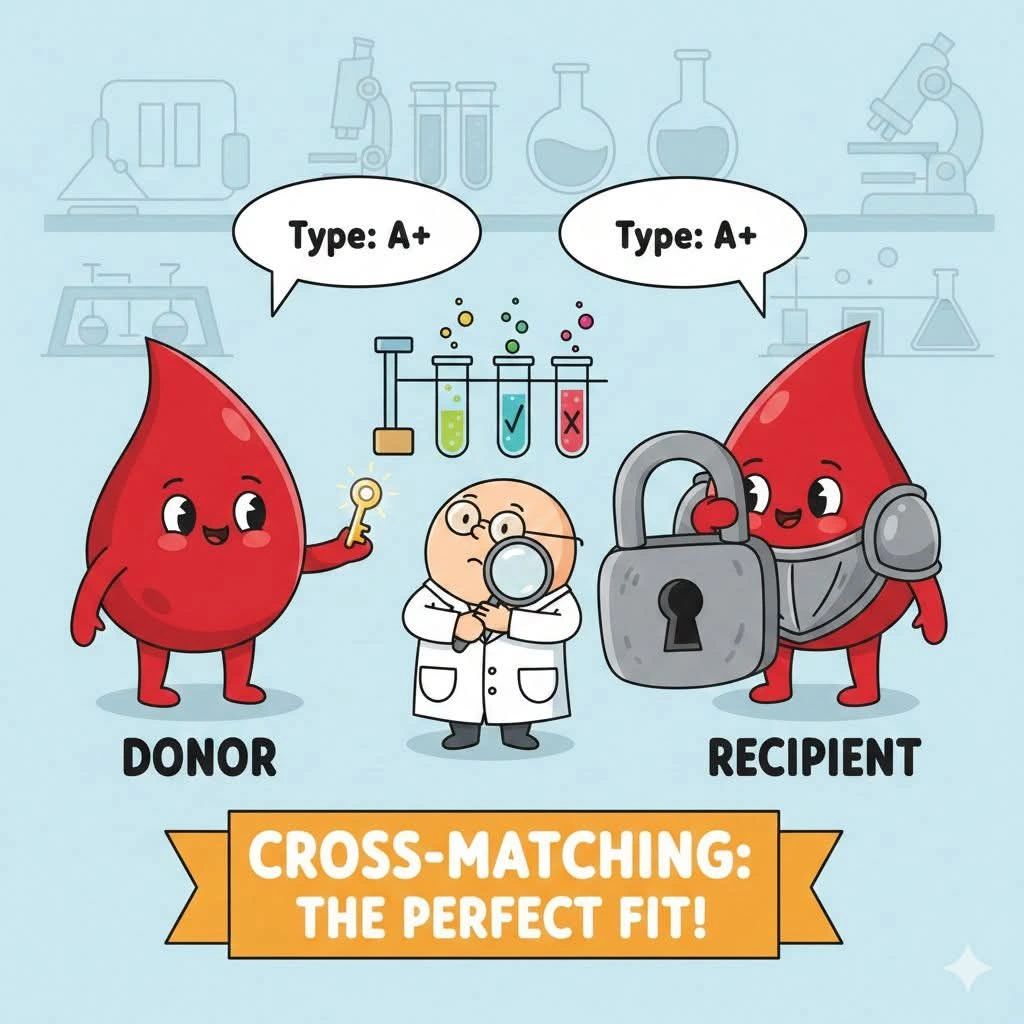
Cross Matching is a mandatory pre-transfusion laboratory test performed before blood transfusion.
Its main goal is to ensure that:
Donor blood is fully compatible with the recipient’s blood
and that no immune reaction will occur that could destroy red blood cells.
Why is Cross Matching critically important?
Failure of compatibility may lead to:
- Acute hemolysis
- Acute transfusion reaction
- Acute renal failure
- Shock
- Death
That’s why blood grouping alone is NOT enough!
Types of Cross Matching
- Major Cross Match (Most Important)
Patient serum + Donor RBCs
Any agglutination or hemolysis = Transfusion strictly prohibited
2. Minor Cross Match (Less commonly used today)
Donor serum + Patient RBCs
Mainly relevant in whole blood transfusion
Steps of Cross Matching (In Detail):
First: Preparatory Steps
- ABO & Rh blood grouping (patient and donor)
- Antibody screening for unexpected antibodies
- Verification of sample integrity and blood unit validity
Second: Testing Phases
- Saline Phase
Mixing donor RBCs with patient serum
Detects ABO incompatibility
Agglutination = Immediate rejection - Incubation Phase (37°C)
Incubation for 15–30 minutes
Detects IgG antibodies - AHG Phase (Coombs Phase)
Addition of Anti-Human Globulin
Most critical phase
No reaction = Compatible
Third: Result Interpretation
Agglutination or Hemolysis → Incompatible
No reaction → Compatible – Ready for transfusion
Common Errors to Avoid
- Hemolyzed or contaminated samples
- Mislabeling or patient identification errors
- Ignoring previous transfusion history
- Skipping or shortening test steps
- Relying on blood group only”
Develop your blood knowledge on Hemostasis Today.
-
Oct 22, 2026, 18:04Basem Goueli: Blood Clots in the NFL
-
Oct 22, 2026, 17:57Syed Ahmed: Viral Triggers of Immune Thrombocytopenia and Thrombosis
-
Oct 22, 2026, 17:49Valerie Tutwiler: Bridging Engineering and Medicine to Advance Thrombosis Research
-
Oct 22, 2026, 17:41Jesus Ardila Novoa: How Patient Education Can Transform Hemophilia Care
-
Oct 22, 2026, 17:30Filipe Gonçalves: Advancing Bleeding Disorder Diagnosis Through Multidisciplinary Collaboration
-
Oct 22, 2026, 17:17Storage Pool Deficiency An Overview of a Rare Platelet Disorder – EHC
-
Oct 22, 2026, 17:10Matthew Hazell: Optimizing the Use of Rare Red Blood Cell Units
-
Oct 22, 2026, 17:03Smita Patil: New Insights Into Platelet Alpha-Granule Secretion
-
Oct 22, 2026, 16:48Ahmed Alotaibi: Rare Rh Phenotype and Severe Fetal Anaemia