


Lena Volland on Ming Y Lim’s Example of Designing Care Models for WGBD Community With Intention
Lena Volland, Founder and CEO of FlowLab, shared on LinkedIn:
”This article by Ming Y Lim et al. is a good example of what happens when care models are intentionally designed rather than inherited uncritically.
The WGBD Clinic of Excellence Model moves beyond simply acknowledging gaps in care for women and girls with bleeding disorders and instead offers a pragmatic, adaptable approach to addressing them from an organizational angle.
What’s especially compelling from an implementation science perspective is that this model doesn’t prescribe a single solution but rather defines core functions while allowing form to vary across settings.
Several strengths stand out:
- Interdisciplinary integration as the default, not the exception, particularly
the intentional pairing of hematology and reproductive health. - Built-in flexibility that recognizes real-world constraints such as staffing,
institutional culture, and resources. - A phased approach to implementation, allowing clinics to begin with care delivery and layer in outcomes measurement and research over time.
- Recognition of education and awareness as implementation strategies, not add-ons.
At the same time, the article points to several important opportunities for the field.
The absence of standardized outcome measures limits the ability to compare clinics, learn across sites, and scale effective practices.
Long-term sustainability remains fragile, often relying on individual champions and unstable funding rather than embedded system support.
And while interdisciplinary models show clear promise, the evidence base is still emerging, particularly the data needed to influence policy, reimbursement, and broader health system adoption.
Importantly, what this model offers is not just better care, but a learning system: one in which clinics generate data, adapt to context, and collectively refine best practices for a historically underserved population.
For those of us working at the intersection of women’s health, chronic conditions, and implementation science, this article is a reminder that equity is not achieved through intention alone but through design, evaluation, and sustained investment.
But perhaps even more so, it underscores that much work remains.
Curious how others are thinking about standardizing outcomes without sacrificing local adaptability.”
Read the full article here.
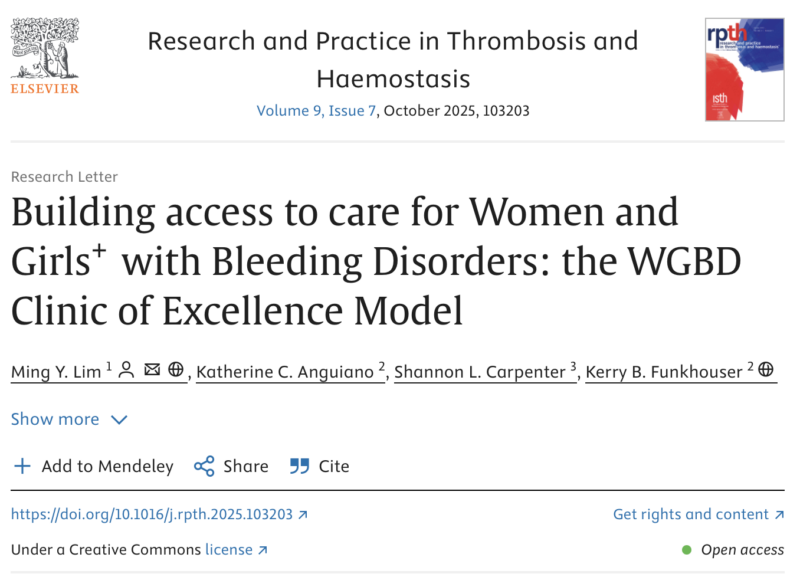
Article: Building access to care for Women and Girls+ with Bleeding Disorders: the WGBD Clinic of Excellence Model
Authors: Ming Y Lim, Katherine C Anguiano, Shannon L Carpenter, Kerry B Funkhouser
Stay updated on all scientific advances with Hemostasis Today.
-
Oct 16, 2026, 18:12Adil Nawaz: Extended Dual Antiplatelet Therapy After Coronary Stenting
-
Oct 16, 2026, 17:50Elad Asher։ STORM-PE Shows Functional Benefits of Thrombectomy
-
Oct 16, 2026, 17:32Shruthi Narayan: STORM-PE and STRIKE-PE Studies Advance Understanding of Recovery After Pulmonary Embolism
-
Oct 16, 2026, 17:22Wolfgang Miesbach։ What a Near-Perfect FISH Score Fails to See
-
Oct 16, 2026, 17:06Troels Wienecke: Connecting Myeloproliferative Disease and Ischemic Stroke
-
Oct 16, 2026, 17:03Only 5 Days Left to Submit Your Research for EAHAD 2027
-
Oct 16, 2026, 16:48Abdul Rahman: Reticulocyte Count and Bone Marrow Activity
-
Oct 16, 2026, 16:44DOAC Adherence in Stroke Patients With Atrial Fibrillation – International Journal of Stroke
-
Oct 16, 2026, 16:22Shannon Farmer: Driving Patient Blood Management Forward in Australia and New Zealand