


Wolfgang Miesbach on Jacob Lund’s Study: How to Define FVIII Bioequivalence
Wolfgang Miesbach, Professor of Medicine at Frankfurt University Hospital, shared on LinkedIn:
”Mim8 and How to Define FVIII Bioequivalence: Significant New Laboratory Data.
In haemophilia A, an important unresolved issue is how much FVIII‑bioequivalent haemostatic activity FVIIIa‑mimetic bispecific antibodies provide at therapeutic levels.
A new study in RPTH Journal by Jacob Lund and co-authors addresses this using calibrated thrombin generation in severe haemophilia A platelet-poor plasma (FVIII <1 %).
Plasma was:
– Spiked with graded FVIII or with Mim8 5 µg/mL and an emicizumab sequence‑identical analogue (SIA) 50 µg/mL.
– Tested under multiple triggers: TF, FXIa, TF+FXIa and FIXa.
– Analysed by fitting FVIII dose–response curves and expressing Mim8/emicizumab‑SIA activity as FVIII in vitro bioequivalence (IU/dL) using peak thrombin, ETP and velocity index.
Results (1 pM TF, clinically relevant condition):
- Approx. 3‑fold higher FVIII bioequivalence for Mim8: ≈42 IU/dL vs ≈14 IU/dL for emicizumab‑SIA.
- Higher thrombin peak at low FIXa, suggesting stronger activity in early haemostasis and in paediatric settings with lower FIX levels.
- Optimised FIXa binding increases FIXa proteolytic activity by >20,000‑fold vs native FIXa.
Critical remarks:
The study illustrates that FVIII “equivalence” of bispecific antibodies is highly dependent on thrombin generation assay design, particularly trigger type/intensity and the parameter selected, and that Mim8 shows higher in vitro FVIII bioequivalence than emicizumab‑SIA at clinically relevant concentrations.
Higher in vitro FVIII bioequivalence ≠ demonstrated superiority in clinical outcomes; FRONTIER2 Phase 3 reported excellent bleed protection, and the extent to which these laboratory differences translate into real‑world clinical benefit remains to be clarified.”
Read the full article here.
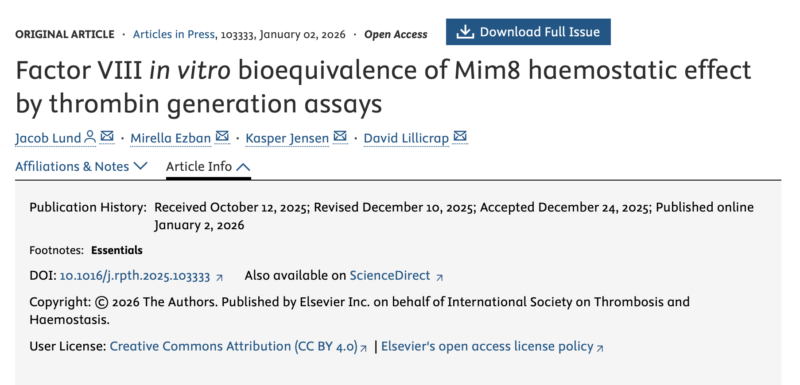
Article: Factor VIII in vitro bioequivalence of Mim8 haemostatic effect by thrombin generation assays
Authors: Jacob Lund, Mirella Ezban, Kasper Jensen, David Lillicrap
Stay updated on all scientific advances with Hemostasis Today.
-
Oct 21, 2026, 10:33Karen Schreiber: Beyond Clinical Outcomes – The Voices of Women with APS
-
Oct 21, 2026, 10:11Tau Braun: Clots Through the Copper-Zinc Model
-
Oct 21, 2026, 09:55Cristina Figueroa Villalba: Celebrating Excellence in Transfusion Medicine
-
Oct 21, 2026, 09:43Ahmad Gharehbaghian: How Can Blood Supplies Be Sustained During a Crisis?
-
Oct 21, 2026, 09:30Adrián Dante De Angelis: Research That Opens New Possibilities for Recurrent iTTP
-
Oct 21, 2026, 09:13Jarod Horobin: Blood 2026 – Connecting Science and People
-
Oct 21, 2026, 08:35Raeeda Gheewala: VTE in Athletes – Risks Beyond the Playing Field
-
Oct 21, 2026, 08:29Andreas Kronbichler: The Changing Landscape of CV Risk in ANCA-Associated Vasculitis
-
Oct 21, 2026, 08:21Pham Quy: Taking Stroke Awareness Beyond Hospitals and Into the Community