


Desapriya Ediriweera: Aspirin and Cancer Prevention – Time to Update the Story
Desapriya Ediriweera, Research Associate at The University of British Columbia, shared a post on LinkedIn:
“Aspirin and Cancer Prevention: Time to Update the Story
For years, clinicians were taught that long‑term low‑dose aspirin could reduce colorectal cancer risk. Much of that belief came from pooled analyses of trials in middle‑aged adults, where benefits emerged only after 10–20 years of continuous use. It was a compelling narrative: a cheap, familiar drug offering both cardiovascular and cancer‑prevention benefits.
But the ASPREE trial and its extended follow‑up have fundamentally shifted that conversation for older adults.
In more than 19,000 healthy seniors (mean age ~75), aspirin showed:
- No reduction in overall cancer incidence
- No reduction in colorectal cancer incidence or mortality
- A 15% increase in cancer‑related mortality
- A possible reduction in melanoma and a possible increase in brain cancer-both based on small numbers
These findings echo a growing body of evidence: starting aspirin late in life does not prevent cancer and may cause harm. Biology makes sense. Older adults have higher rates of occult malignancy, different inflammatory pathways, and greater vulnerability to bleeding and competing risks.
The cardiovascular story has evolved in parallel. Modern trials show minimal primary‑prevention benefit and no mortality advantage for aspirin in most adults without established cardiovascular disease. Bleeding risk rises sharply with age. As a result, major guidelines now recommend against initiating aspirin for primary prevention in adults ≥60.
Where does aspirin still belong?
In secondary prevention-post‑MI, post‑stroke, and established atherosclerotic disease-where benefits remain clear and substantial.
The takeaway is simple and evidence‑based:
Aspirin is no longer a cancer‑prevention strategy for older adults, and its role in primary cardiovascular prevention has narrowed dramatically. Decisions about aspirin should be individualized, grounded in current data, and free from outdated assumptions.
As ASPREE reminds us, long‑held beliefs in medicine must evolve when the evidence does.
REF-Study Finds Surprising Link Between Aspirin in Seniors and Cancer Mortality-Longer follow-up of the ASPREE cohort is warranted, says researcher.”
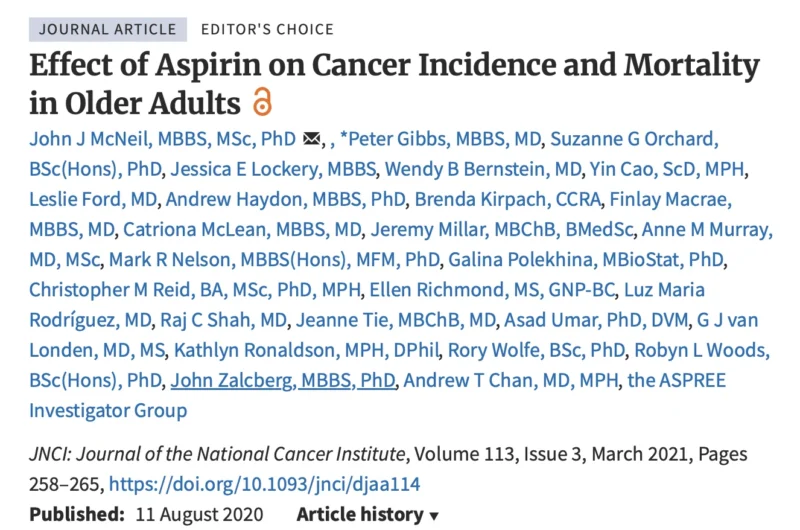
Title: Effect of Aspirin on Cancer Incidence and Mortality in Older Adults
Authors: John J. McNeil, Peter Gibbs, Suzanne G. Orchard, Jessica E. Lockery, Wendy B. Bernstein, Yin Cao, Leslie Ford, Andrew Haydon, Brenda Kirpach, Finlay Macrae, Catriona McLean, Jeremy Millar, Anne M. Murray, Mark R. Nelson, Galina Polekhina, Christopher M. Reid, Ellen Richmond, Luz Maria Rodríguez, Raj C. Shah, Jeanne Tie, Asad Umar, G. J. van Londen, Kathlyn Ronaldson, Rory Wolfe, Robyn L. Woods, John Zalcberg, Andrew T. Chan
Read the Full Article on Journal of the National Cancer Institute
Stay updated with Hemostasis Today.
-
Sep 29, 2026, 03:53Nahrwan Masaoodi: Iron Deficiency Can Exist Without Anemia
-
Sep 29, 2026, 03:38Muhammad Yousaf: Iron Deficiency Beyond Diet
-
Sep 29, 2026, 03:21Parvez Ahmed Chowdhury: Synthesizing Aspirin in the Organic Chemistry Lab
-
Sep 29, 2026, 03:12Ahmed Hamandi: Building the Future of Hematopoietic Transplantation in Iraq
-
Sep 29, 2026, 03:09M V Chandrakanth: Aspirin in CRC – Old Drug, New Precision Oncology?
-
Sep 29, 2026, 03:07Caroline Pothet: Advancing Treatment Development in Sickle Cell Disease and Thalassaemia
-
Sep 29, 2026, 02:53Astha Jain: Thalassemia Care Through a Public Health Lens
-
Sep 29, 2026, 02:50Emma Groarke: Starting a New Career Path in Homeland
-
Sep 28, 2026, 19:14Aditya Sharma: An Outstanding Start to the Final Day of VSS 2026!