


Ney Carter: Key Advances in the 2026 ACC/AHA Guideline on the Management of Dyslipidemia
Ney Carter Borges, Member Cardiologist of Global Physician Association at Cleveland Clinic Florida, shared a post on LinkedIn:
”Key Advances in the 2026 ACC/AHA Guideline on the Management of Dyslipidemia
The 2026 ACC/AHA Guideline on the Management of Dyslipidemia represents a major update in cardiovascular prevention strategies, emphasizing earlier intervention, refined risk assessment, and more aggressive lipid-lowering targets to reduce atherosclerotic cardiovascular disease (ASCVD). The guideline expands the concept of dyslipidemia beyond LDL cholesterol alone, incorporating triglycerides, remnant lipoproteins, and lipoprotein(a) [Lp(a)] as important contributors to residual cardiovascular risk.
One of the most significant updates is the introduction of the PREVENT-ASCVD risk equations, which replace the older pooled cohort equations for estimating cardiovascular risk in adults aged 30–79 years. These equations allow clinicians to categorize individuals into low (<3%), borderline (3–<5%), intermediate (5–<10%), or high (≥10%) 10-year risk, supporting a more personalized discussion regarding preventive therapy.
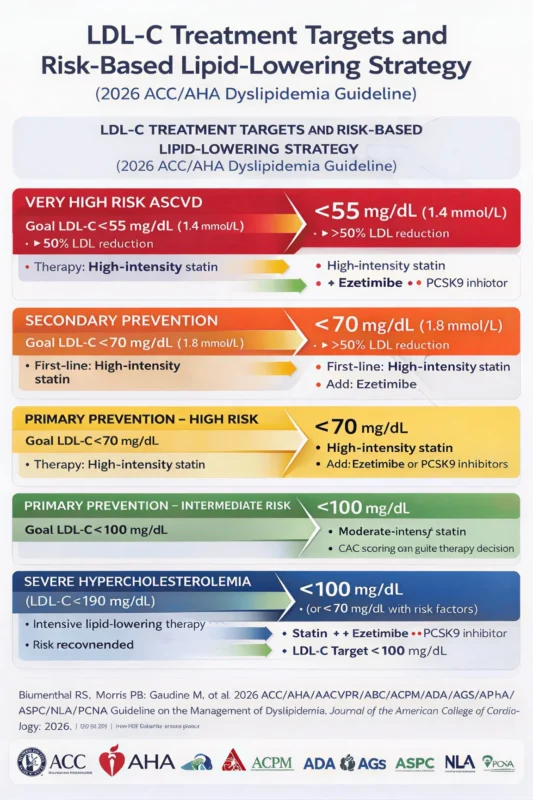
Another important change is the return of explicit LDL-C treatment targets, which complement percentage reduction goals. For secondary prevention in very-high-risk ASCVD, the recommended target is LDL-C <55 mg/dL, reflecting growing evidence that intensive lipid lowering significantly reduces recurrent cardiovascular events. For other ASCVD patients, the recommended target is <70 mg/dL, while in primary prevention, the targets vary depending on risk category.
The guideline also emphasizes earlier detection of atherogenic risk factors. Measurement of Lp(a) is now recommended at least once in all adults, as elevated levels are associated with substantially increased ASCVD risk and may guide intensification of lipid-lowering therapy. Similarly, apolipoprotein B (apoB) measurement can be useful for refining risk assessment, particularly in patients with diabetes, hypertriglyceridemia, or discordant lipid profiles.
Therapeutically, statins remain the foundation of lipid-lowering therapy, but the guideline expands the role of non-statin agents. When LDL targets are not achieved with maximally tolerated statins, clinicians may add ezetimibe, PCSK9 monoclonal antibodies, bempedoic acid, or inclisiran, depending on the clinical context and the degree of additional LDL reduction required.
Imaging strategies are also emphasized. Coronary artery calcium (CAC) scoring is recommended to refine risk stratification when treatment decisions are uncertain, particularly in individuals with borderline or intermediate risk. The extent of CAC can guide both the initiation and the intensity of lipid-lowering therapy.
Overall, the 2026 guideline promotes earlier screening, precision risk assessment, aggressive LDL reduction, and broader use of emerging therapies, aiming to substantially reduce the lifetime burden of ASCVD through proactive lipid management.”
Stay updated with Hemostasis Today.
-
Sep 14, 2026, 20:53YoonHwa An: Rusfertide in Polycythemia Vera – From Clinical Benefit to Strategic Value
-
Sep 14, 2026, 20:52Andres Alberto Mercado Pompa: External Validation of Prognostic Risk Scores in Cerebral Venous Thrombosis
-
Sep 14, 2026, 20:50Balaji Kirushnan: Advancing Regional Citrate Anticoagulation in CRRT – From Experience to Implementation
-
Sep 14, 2026, 20:48Valerie Dehondt: Nutritional Anemia Is Associated With Increased Risk of Severe COPD Exacerbations
-
Sep 14, 2026, 20:46Nupur Choudhury: Exploring AI-Based Detection of Anemia Using Eye and Fingernail Images
-
Sep 14, 2026, 20:44Shamee Shastry: Chart Before You Chase – Diagnosing Drug-Induced Hemolytic Anemia
-
Sep 14, 2026, 20:43David Reiner: Blood Tests That Can Reveal Nutrition Clues
-
Sep 14, 2026, 20:40Giuseppe Biondi Zoccai: Balancing Thrombosis and Bleeding in Acute MI With Hemophilia A
-
Sep 14, 2026, 20:39Kemal Karaagac: Kounis Syndrome as a Possible Cause of Very Late Stent Thrombosis