


Kanishk Kumar: Wiskott-Aldrich Syndrome Pipeline Outlook Report 2026
Kanishk Kumar, Digital Marketing Executive at DelveInsight Business Research LLP, shared a post on LinkedIn:
”DelveInsight’s ‘Wiskott-Aldrich Syndrome – Pipeline Insight, 2026’ report provides an extensive analysis of more than 5 companies and over 5 investigational drugs advancing through the Wiskott-Aldrich Syndrome (WAS) treatment pipeline. The report features detailed drug profiles spanning both clinical and preclinical development stages, offers therapeutic assessments categorized by product type, development phase, route of administration, and molecular classification, and identifies inactive pipeline candidates within the WAS space.
Explore the comprehensive insights by DelveInsight and stay ahead in understanding the Wiskott-Aldrich Syndrome Treatment Landscape
Key Highlights from the Wiskott-Aldrich Syndrome Pipeline Report
- DelveInsight’s WAS pipeline analysis uncovers a promising development landscape with more than 5 active companies progressing over 5 therapeutic candidates aimed at Wiskott-Aldrich Syndrome treatment.
- Leading Wiskott-Aldrich Syndrome Companies include Orchard Therapeutics – U.S. , Genethon , and other key organizations actively advancing novel therapeutic approaches in this space.
- Promising Wiskott-Aldrich Syndrome Pipeline Therapies include OTL-103 and additional investigational agents currently undergoing clinical evaluation.
- Companies with drug candidates in mid-to-advanced stages of development—specifically Phase III and Phase II—include Orchard Therapeutics plc, Genethon, and others.
- Pharmaceutical companies and academic institutions are collaboratively working to identify challenges and uncover opportunities that could meaningfully shape Wiskott-Aldrich Syndrome research and development. Therapies currently under investigation are centered on innovative approaches designed to treat and improve outcomes for patients with WAS.
- Stay informed about the cutting-edge advancements in Wiskott-Aldrich Syndrome treatments. Download for updates and be a part of the revolution in Rare Disease Care Wiskott-Aldrich Syndrome Clinical Trials Assessment
Wiskott-Aldrich Syndrome Disease Overview
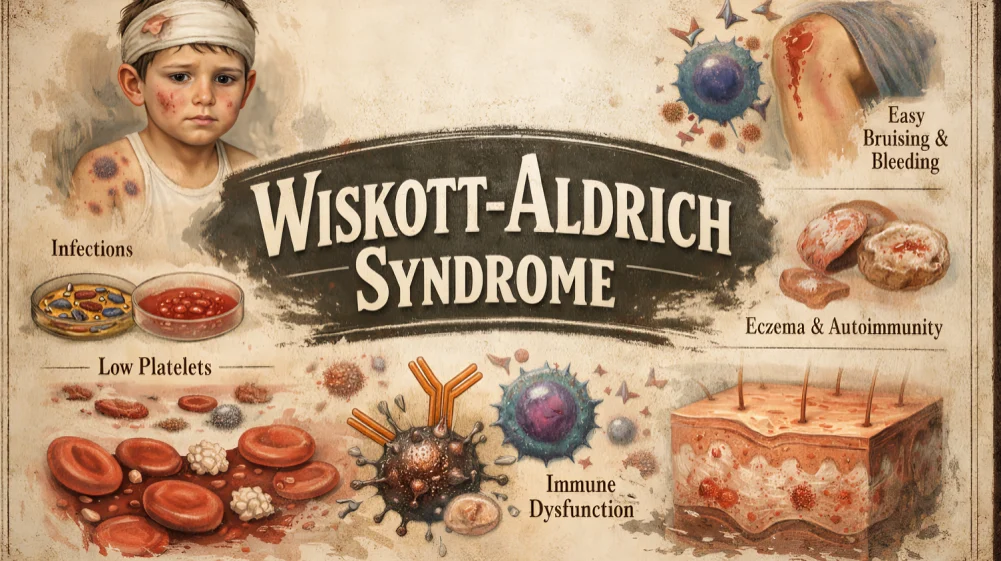
Wiskott-Aldrich Syndrome (WAS) is a rare X-linked disorder defined by a characteristic medical triad of microthrombocytopenia, eczema, and recurrent infections. The condition results from mutations in the WAS gene, located on the short arm of the X chromosome (Xp11.4-p11.21). As a rare disorder, WAS has an incidence rate of fewer than 1 in 100,000 individuals and affects males almost exclusively.
Signs and Symptoms
Due to impaired immune system function and a diminished ability to form blood clots, individuals with WAS may present with a range of clinical manifestations, including:
- Purpura and petechiae
- Eczema
- Skin infections such as cellulitis and impetigo
- Bloody diarrhea
- Mucosal bleeding
- Intracranial hemorrhage, which can be life-threatening
Diagnosis
The diagnosis of Wiskott-Aldrich Syndrome is established through a combination of family history assessment, physical examination, and laboratory investigations. Key diagnostic findings include severe thrombocytopenia with characteristically small platelet size despite a typically normal megakaryocyte count, along with abnormal antibody production patterns. Confirmation of diagnosis is achieved through measurement of WAS protein levels—which are absent or significantly reduced—and genetic testing.
Current Treatment Approaches
At present, hematopoietic stem cell transplantation (HSCT) remains the only curative treatment option available for Wiskott-Aldrich Syndrome. Symptomatic management includes:
- Infection management: Immunoglobulin replacement therapy or oral antibiotic administration
- Severe eczema treatment: Topical therapies or short-course systemic corticosteroids
- Gene therapy: Currently under clinical investigation and represents a potentially transformative treatment option for the future
Learn how the Wiskott-Aldrich Syndrome market will evolve and grow in the coming years Wiskott-Aldrich Syndrome Market Outlook and Forecast
Spotlight on Emerging Wiskott-Aldrich Syndrome Drug Candidates
OTL-103 – Orchard Therapeutics plc
OTL-103, developed by Orchard Therapeutics, is an ex vivo autologous gene therapy under investigation for the treatment of Wiskott-Aldrich Syndrome. The therapy utilizes a modified viral vector to deliver a functional copy of the WAS gene into the patient’s own cells, aiming to restore normal protein expression and correct the underlying genetic defect. OTL-103 is currently in Phase III clinical trials and has been granted Orphan Drug designation for Wiskott-Aldrich Syndrome, underscoring its significance as a potentially groundbreaking treatment approach.
Genethon – Gene Therapy Programs
Genethon is actively advancing gene therapy-based therapeutic strategies for Wiskott-Aldrich Syndrome, leveraging its deep expertise in gene transfer technologies and rare genetic disease research. The organization’s investigational programs are focused on developing curative approaches that address the root genetic cause of WAS, potentially offering long-term clinical benefits to patients with this debilitating condition.
Additional product details and comprehensive drug profiles are provided in the full report.
Learn more about Wiskott-Aldrich Syndrome drug development opportunities in our groundbreaking research and development analysis Wiskott-Aldrich Syndrome Unmet Needs
Key Wiskott-Aldrich Syndrome Companies
Orchard Therapeutics – U.S. , Genethon, and other pharmaceutical and biotechnology organizations advancing novel therapeutics in the Wiskott-Aldrich Syndrome pipeline.
Pipeline Coverage by Development Phase
DelveInsight’s report encompasses approximately 5+ products across various clinical development stages, including:
- Late-stage products (Phase III)
- Mid-stage products (Phase II and Phase I/II)
- Early-stage products (Phase I/II and Phase I)
- Preclinical and Discovery-stage candidates
- Discontinued and Inactive candidates
Therapeutic Assessment by Route of Administration
Pipeline products are classified across multiple delivery methods, including:
- Subcutaneous
- Intravenous
- Oral
- Intramuscular
Therapeutic Assessment by Molecule Type
Wiskott-Aldrich Syndrome pipeline candidates span several molecular categories, including:
- Small molecules
- Natural metabolites
- Monoclonal antibodies
Therapeutic Assessment by Product Type
Pipeline drugs are categorized by therapy approach:
- Monotherapy
- Combination
- Mono/Combination
Stay informed about how emerging therapies are transforming the future of Wiskott-Aldrich Syndrome treatment Wiskott-Aldrich Syndrome Market Drivers and Barriers, and Future Perspectives
Report Scope
- Geographic Coverage: Global
- Wiskott-Aldrich Syndrome Companies: Orchard Therapeutics – U.S. , Genethon, and others
- Wiskott-Aldrich Syndrome Pipeline Therapies: OTL-103 and additional investigational candidates
- Therapeutic Assessment by Product Type: Monotherapy, Combination, Mono/Combination
- Therapeutic Assessment by Clinical Stage: Discovery, Preclinical, Phase I, Phase II, Phase III
For a detailed overview of the latest research findings and future development plans, access the full Wiskott-Aldrich Syndrome Pipeline Report Wiskott-Aldrich Syndrome Emerging Drugs and Companies
Table of Contents
- Introduction
- Executive Summary
- Wiskott-Aldrich Syndrome: Overview
- Causes
- Mechanism of Action
- Signs and Symptoms
- Diagnosis
- Disease Management
- Pipeline Therapeutics
- Comparative Analysis
- Therapeutic Assessment
- Wiskott-Aldrich Syndrome – DelveInsight’s Analytical Perspective
- In-depth Commercial Assessment
- Wiskott-Aldrich Syndrome companies’ collaborations, Licensing, Acquisition – Deal Value Trends
- Wiskott-Aldrich Syndrome Collaboration Deals
- Late Stage Products (Phase III)
- Pre-clinical and Discovery Stage Products
- Inactive Products
- Wiskott-Aldrich Syndrome Key Companies
- Wiskott-Aldrich Syndrome Key Products
- Wiskott-Aldrich Syndrome – Unmet Needs
- Wiskott-Aldrich Syndrome – Market Drivers and Barriers
- Wiskott-Aldrich Syndrome – Future Perspectives and Conclusion
- Wiskott-Aldrich Syndrome Analyst Views
- Appendix
About DelveInsight
DelveInsight is a premier healthcare-focused market research and consulting firm dedicated to delivering high-quality market intelligence and strategic analysis that supports well-informed business decisions. Supported by a team of experienced industry specialists with deep expertise across the life sciences and healthcare sectors, DelveInsight offers customized research solutions and actionable insights to organizations worldwide. Connect with us to access accurate, real-time intelligence that positions you ahead of the growth curve.”
Stay updated with Hemostasis Today.
-
Sep 30, 2026, 01:52Javed Anees: DADA2 – When a Young Stroke Is More Than a Stroke
-
Sep 30, 2026, 01:51How a Venous Thrombus Becomes Revascularized – ISTH
-
Sep 29, 2026, 22:45Victor Agunyego: Paracetamol – The Most Common Drug We Underestimate
-
Sep 29, 2026, 22:42Nova Sinclair: Advancing the Future of Hematology – Meet Our 2027 Organizing Committee
-
Sep 29, 2026, 22:41Lorenz Räber: Intracoronary Imaging in PCI – Why, When, How, and Which Modality?
-
Sep 29, 2026, 22:31Selma Turkovic: Pleased to Deliver the Opening Presentation at Kingston Hospital
-
Sep 29, 2026, 22:31Miguel Teran: Ultrasound and Simulation in Arterial Blood Sampling
-
Sep 29, 2026, 22:28Mohammad Refaei: Navigating Your Career in Hematology From Training to Practice
-
Sep 29, 2026, 22:27Matteo Foschi: 10 Clinical Pearls for Antithrombotic Therapy in Secondary Stroke Prevention