


Ney Carter Borges: Does APOC3 Inhibition Translates into Structural Coronary Plaque Modification
Ney Carter Borges, Member Cardiologist of Global Physician Association at Cleveland Clinic Florida, shared a post on LinkedIn:
“APOC3 Inhibition with Olezarsen and Coronary Atherosclerosis
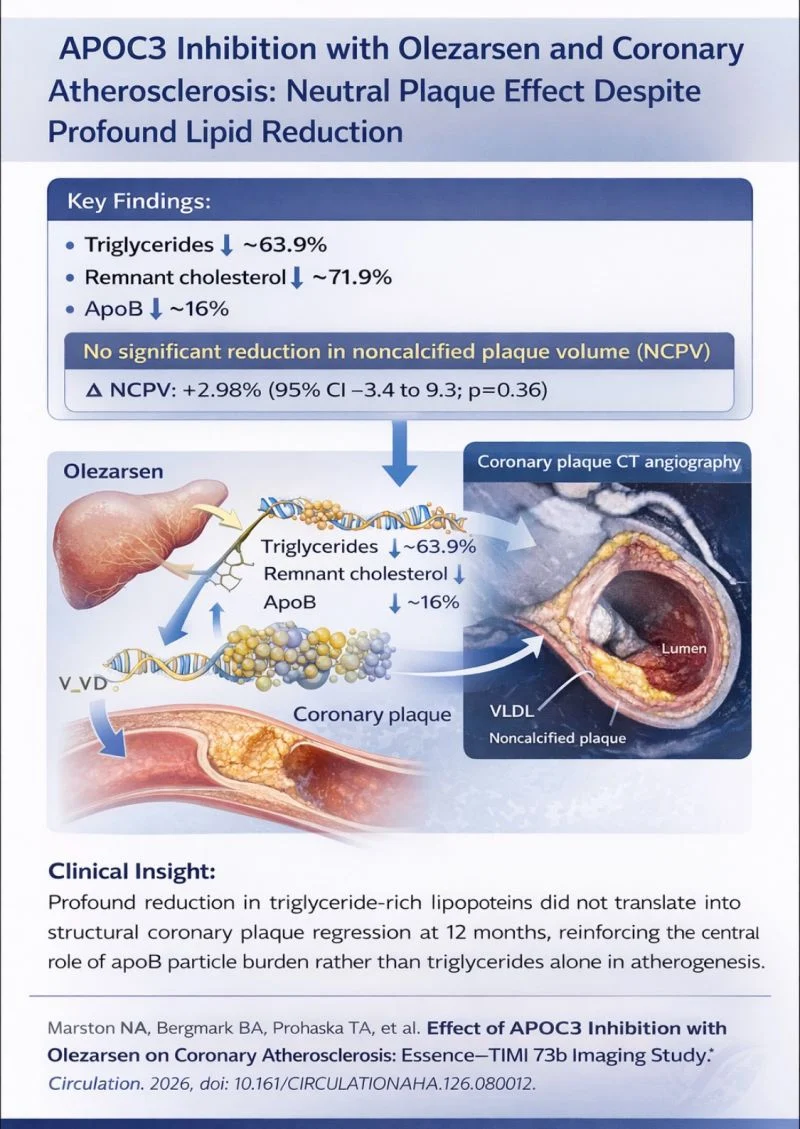
The Essence – TIMI 73b imaging substudy evaluated whether intensive triglyceride-rich lipoprotein reduction with olezarsen translates into structural coronary plaque modification.
In this randomized, placebo – controlled trial, 468 patients with moderate hypertriglyceridemia and established or high cardiovascular risk underwent serial coronary CT angiography over 12 months.
Olezarsen produced profound lipid changes, including a 63.9% reduction in triglycerides, 71.9% reduction in remnant cholesterol, and a 16% decrease in apolipoprotein B (apoB), without affecting LDL cholesterol.
Despite these robust metabolic effects, the primary endpoint – percent change in noncalcified plaque volume (NCPV) – was not significantly different compared with placebo (Δ +2.98%; 95% CI −3.4 to 9.3; p equals 0.36).
Similarly, no meaningful differences were observed across secondary plaque components, including low-attenuation and total plaque volumes.
These findings highlight a critical mechanistic insight:
Substantial triglyceride and remnant cholesterol reduction alone may be insufficient to induce measurable short – term plaque regression, particularly when apoB lowering is modest.
Given that apoB reflects the total burden of atherogenic particles, the results reinforce its central role in atherosclerosis progression.
Longer – term outcome trials are required to determine whether APOC3 inhibition confers clinical cardiovascular benefit despite neutral imaging findings.”
More posts featuring Ney Carter Borges on Hemostasis Today.
-
Oct 10, 2026, 17:58Archo Farzana Batool: Exploring Medical Writing Through an Article on Iron Deficiency Anemia
-
Oct 10, 2026, 17:53Assessing Frailty in Adults With Hemophilia – JTH
-
Oct 10, 2026, 17:52Fatma Sadeghi: Reducing Maternal Health Inequalities Through Nursing Advocacy
-
Oct 10, 2026, 17:50Grzegorz Hensler: How Apheresis Transformed Blood Cell Separation and Collection
-
Oct 10, 2026, 17:47Hemant K Sharma: Japan’s Universal Artificial Blood Research – A Potential Breakthrough in Transfusion Medicine
-
Oct 10, 2026, 17:40John Strouse: Learning About Bleeding Disorders and Sickle Cell Disease at FWGBD
-
Oct 10, 2026, 17:34Mae Caime: Speaking at the Annual Women’s Retreat for the Hemophilia Community in Florida
-
Oct 10, 2026, 17:30Chokri Ben Lamine: PNH beyond the Textbook Triad
-
Oct 10, 2026, 17:29Ruah Alyamany: Thrombosis and Anticoagulation in Hematological Malignancies at SOHO KSA 2026