


Tareq Abadl: Coombs Test Explained in a Simple and Clear Way
Tareq Abadl, Medical Laboratory Specialist and Director of the Blood Bank at Dr. Abdelkader Al-Mutawakkil Hospital, shared a post on LinkedIn:
”Coombs Test
…the blood cell detective!
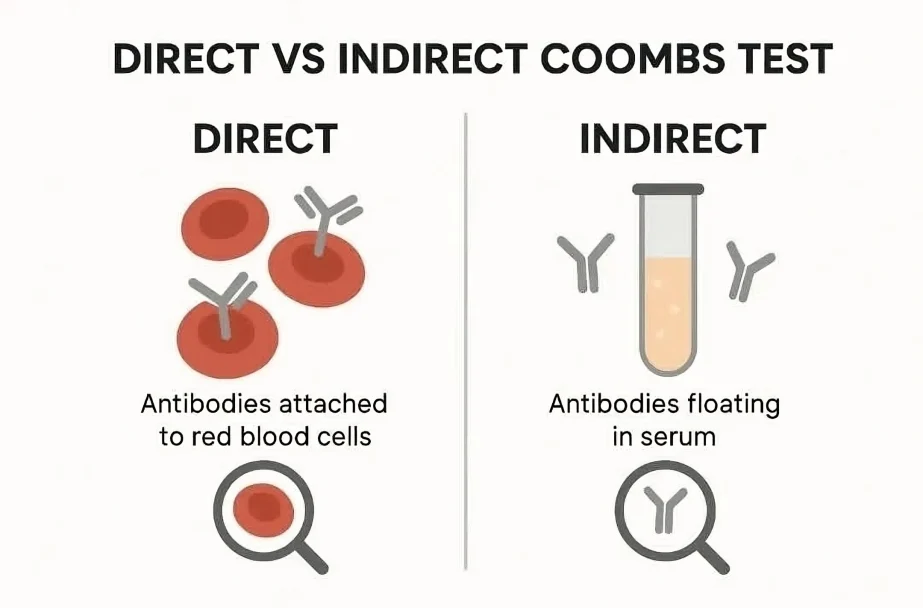
In our lab, we have a famous detective called the Coombs Test. His main job is to uncover the presence of antibodies attacking red blood cells.
It’s not a simple case, because he has two investigation methods:
Direct Coombs Test
(the detective at the crime scene):
Steps:
- Take a blood sample from the patient.
- Wash the red blood cells to remove plasma or free antibodies.
- Add a reagent called Anti-human globulin.
- If antibodies or complement are stuck on the surface of red blood cells then Agglutination occurs (clumping of RBCs).
Used in cases like:
- Autoimmune hemolytic anemia.
- Transfusion reactions.
- Hemolytic disease of the newborn.
A positive result means: ‘the crime has already happened’, meaning antibodies are bound to RBCs and destroying them.
Indirect Coombs Test
(the detective among the suspects):
Steps:
- Take the patient’s serum (plasma).
- Add reagent red blood cells with known composition.
- If antibodies are present in the serum, they bind to the added RBCs.
- Add Anti-human globulin reagent.
- If agglutination occurs, it means free antibodies are present in the serum.
Commonly used in:
- Cross-matching before blood transfusion to ensure compatibility.
- Antenatal screening for mothers to detect antibodies that may affect the fetus.
A positive result means: ‘there are hidden criminal intentions’ meaning antibodies in the serum that could cause future problems.
Key difference:
- Direct test focuses on crimes that already happened.
- Indirect test focuses on potential crimes in the future.
Both rely on the same principle:
Using Anti-human globulin reagent to detect antibodies, with results shown as agglutination.”
Other posts featuring Tareq Abadl on Hemostasis Today.
-
Oct 20, 2026, 22:59Building Effective Patient Advocacy Through Collaboration Between Patients and Clinicians – EHC
-
Oct 20, 2026, 21:22Intezar Mehdi: When Prolonged Bleeding May Indicate an Underlying Bleeding Disorder
-
Oct 20, 2026, 21:06Nandini Pethe: Sharing My Experience as a Caregiver in the HOPE Factor Resource Guide
-
Oct 20, 2026, 16:51Suzan Nakasendwa: A Growing Stroke Challenge in Uganda
-
Oct 20, 2026, 16:38Steve Moon: How Does Smoking Cessation Duration Affect Ischemic Stroke Risk
-
Oct 20, 2026, 16:25Cedrice Mentor: Reducing Platelet Wastage Through Cold Storage
-
Oct 20, 2026, 16:09Thirunavukkarasu Angappan: Can a Purified Fibrinogen Concentrate Replace Cryoprecipitate
-
Oct 20, 2026, 16:01Kalyan Roy: Platelet Conservation Through Evidence-Based Transfusion Practice
-
Oct 20, 2026, 15:28Stacy E. Croteau: 33 Countries, One Mission – Better Bleeding Disorder Care