

Alisha Tuck: Navigating the First Trimester with Ultrasound and Anticoagulation Management
Alisha Tuck, Obstetrics and Gynecology Sonographer at Sonopartners, LLC, shared a post on LinkedIn:
“Navigating the First Trimester: Ultrasound and Anticoagulation Management
The first trimester is a critical window for patients with known thrombophilias or clotting disorders.
For these individuals, the physiological changes of pregnancy – which naturally induce a hypercoagulable state – intersect with preexisting risks, necessitating a high-stakes balance of anticoagulation therapy.
As Sonographers, we are the ‘eyes’ of the clinical team, providing the diagnostic data that guides these delicate management decisions.
Scanning Considerations and Patient Care
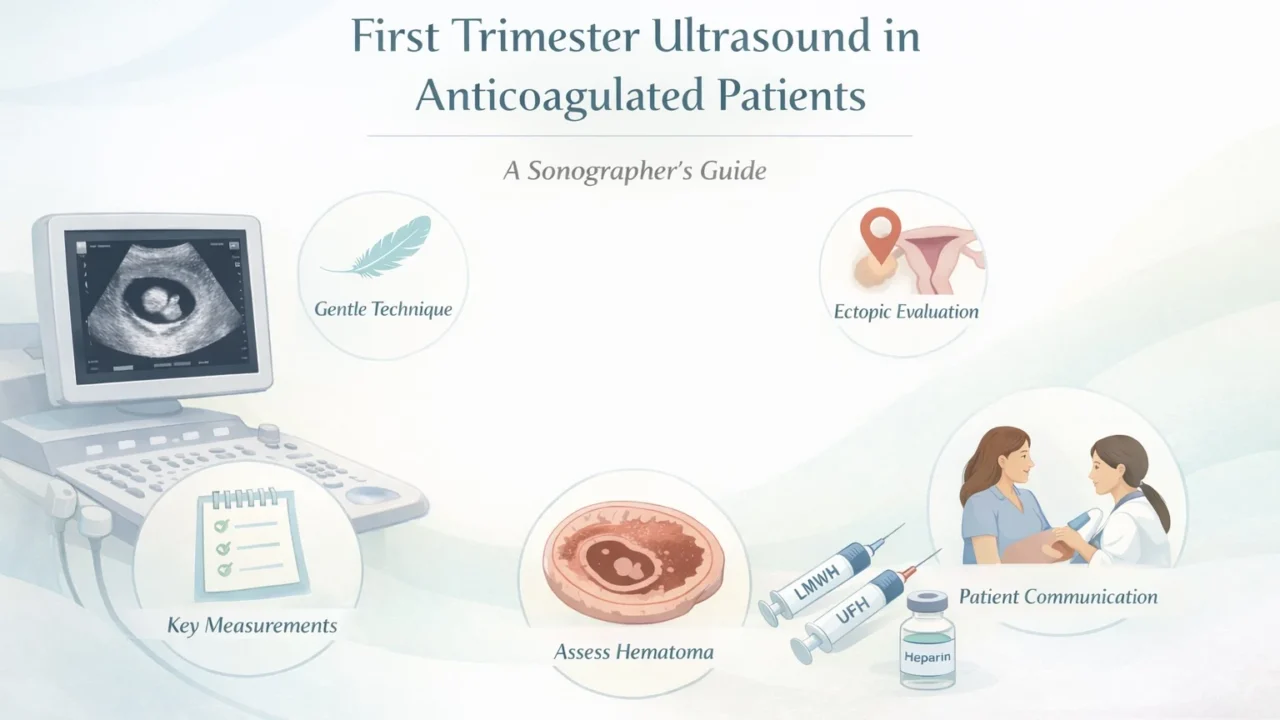
- Gentle Technique: If a subchorionic hemorrhage is present, use a gentle touch with the endovaginal transducer to minimize patient discomfort and avoid aggravating any active bleeding.
- The ‘Double Check’ for Ectopic: Patients with clotting disorders may have undergone fertility treatments (IVF), increasing the risk of heterotopic or ectopic pregnancies. Always sweep the adnexa thoroughly, even if an intrauterine pregnancy (IUP) is confirmed.
- Patient Communication: These patients are often highly anxious. While we cannot provide a diagnosis, maintaining a calm, professional demeanor and confirming that we are ‘taking all necessary measurements for the doctor to review’ can be incredibly grounding.
Summary Checklist for the Sonographer
- Gestational Sac-Location, Shape, Mean Sac Diameter. Rule out ectopic; assess for ‘low implantation’
- Yolk Sac- Presence and Diameter. Early indicator of pregnancy health
- CRL -Best measurement of 3 Critical for future growth monitoring
- Hematoma-Size (cm), Location, % of sac perimeter. Guides anticoagulant dosing adjustments
- Adnexa- Ovaries, free fluid, or masses. Rule out hemorrhage or secondary complications
Conclusion
Sonographers play a pivotal role in the multidisciplinary care of the high-risk obstetric patient.
By providing meticulous documentation of the early pregnancy and any associated perigestational bleeding, we allow the clinical team to tailor anticoagulation therapy – optimizing the safety of both the mother and the developing embryo.”

Stay updated with Hemostasis Today.
-
Oct 19, 2026, 17:44Paul Riley: Moderating a Webinar on Anticoagulation Monitoring
-
Oct 19, 2026, 16:36Christopher Pittman: Blood Clot Prevention Cannot End at Hospital Discharge
-
Oct 19, 2026, 16:13Javier M. Floren: When Immune Cells Move With Their Environment
-
Oct 19, 2026, 16:04Hussnain Javaid: New EHA Guidelines for HbSC Disease Management
-
Oct 19, 2026, 15:50Deep Madkaiker: A New Academic Opportunity in Transfusion Medicine at ACTREC
-
Oct 19, 2026, 15:19Why Hematologists Should Care About Diminished Ovarian Reserve in SCD – ASH Education
-
Oct 19, 2026, 14:16Hyperfibrinolysis as an Underrecognized Cause of Bleeding
-
Oct 19, 2026, 13:36Shobhna Ladva: Aspen Pharma EME Raises Awareness of Blood Clot Risks During Hormonal Transitions
-
Oct 19, 2026, 13:11Giulia Furnari: Connecting With Global Hematology Experts at IACH 2026