


Tijjani Balas: The End of ‘Type O Negative’ Shortages? – A New Era in Blood Transfusion
Tijjani Balas, Medical Doctor at Doma Hospital, shared a post on LinkedIn:
“The End of ‘Type O Negative’ Shortages? A New Era in Blood Transfusion
Every doctor knows this moment.
A patient is crashing.
You call for blood.
‘Get O negative. Now.’
It is the universal donor. It buys time. It saves lives. But it is also limited, expensive to store, and often unavailable when you need it most.
That may soon change.
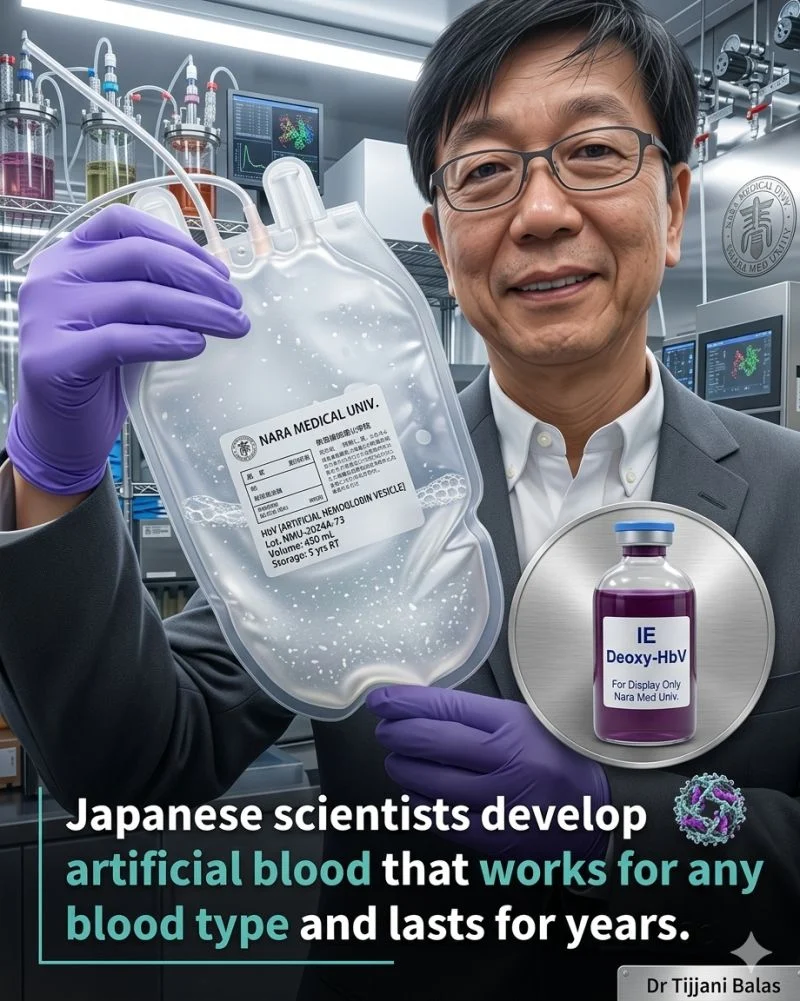
Researchers at Nara Medical University are developing a blood substitute that removes the need for blood typing altogether.
At the center of this work is Hemoglobin Vesicles.
These are tiny particles that carry purified hemoglobin inside a lipid shell.
They deliver oxygen like red blood cells, but without the surface antigens that define blood groups.
- No A, B, AB, or O.
- No Rh factor.
- No cross matching.
Why this matters in real practice
Blood transfusion today depends on compatibility.
Even with ABO blood group system matching, risks remain.
In emergencies, delays cost lives.
This new approach changes the equation.
- Universal use, no matching required
- Lower risk of immune reactions
- Immediate deployment in emergencies
Storage is where this gets interesting.
Donated blood has limits.
Red cells last about 42 days under refrigeration
Cold chain failure leads to wastage
Rural and low resource settings struggle with access
Hemoglobin vesicles offer a different model.
Stable for up to 2 years at room temperature
Up to 5 years under refrigeration
Easier transport and stockpiling
That alone could transform emergency medicine in places where infrastructure is weak.
What about the color?
Unlike whole blood, this solution often appears purple or magenta in concentrated form.
That is due to the purified hemoglobin and how it interacts with light outside the red cell environment.
- It looks unusual.
- It functions the same.
Where are we now Early human trials are ongoing.
Phase I studies have focused on safety and tolerability.
Further trials aim to confirm effectiveness in real clinical settings.
If results hold, broader clinical use could emerge within this decade.
What this means for you as a clinician. Think beyond tertiary hospitals.
Road traffic accidents on Nigerian highways
Postpartum hemorrhage in rural clinics
Conflict and disaster zones
Access to safe, ready to use oxygen carrying fluid, without typing or storage constraints, changes response time.
And response time is survival.
The real question Science is moving fast.
But adoption depends on trust, regulation, and cost.
Would patients accept ‘synthetic blood’?
Will systems adopt it at scale?
What is your take?
Breakthrough or long road ahead?”
Stay updated with Hemostasis Today.
-
Oct 21, 2026, 00:51Prateek Meena: The F. A. T. R. N. Mnemonic for Recognizing TTP
-
Oct 20, 2026, 23:51Registration Is Open for WFH CCS 2027 – World Federation of Hemophilia
-
Oct 20, 2026, 23:44Edward Lee Carter: AF in Nursing Homes – When Stroke Risk Scores Tell Only Part of the Story
-
Oct 20, 2026, 22:59Building Effective Patient Advocacy Through Collaboration Between Patients and Clinicians – EHC
-
Oct 20, 2026, 21:22Intezar Mehdi: When Prolonged Bleeding May Indicate an Underlying Bleeding Disorder
-
Oct 20, 2026, 21:06Nandini Pethe: Sharing My Experience as a Caregiver in the HOPE Factor Resource Guide
-
Oct 20, 2026, 16:51Suzan Nakasendwa: A Growing Stroke Challenge in Uganda
-
Oct 20, 2026, 16:38Steve Moon: How Does Smoking Cessation Duration Affect Ischemic Stroke Risk
-
Oct 20, 2026, 16:25Cedrice Mentor: Reducing Platelet Wastage Through Cold Storage