


Tareq Abadl: Can Vitamin C Trick a Glucose Reading?
Tareq Abadl, Medical Laboratory Specialist and Director of the Blood Bank at Dr. Abdelkader Al-Mutawakkil Hospital, shared a post on LinkedIn:
”Can Vitamin C Trick a Glucose Reading?
In clinical biochemistry and medical laboratory science, not every ‘high glucose’ result reflects a patient’s true blood sugar level.
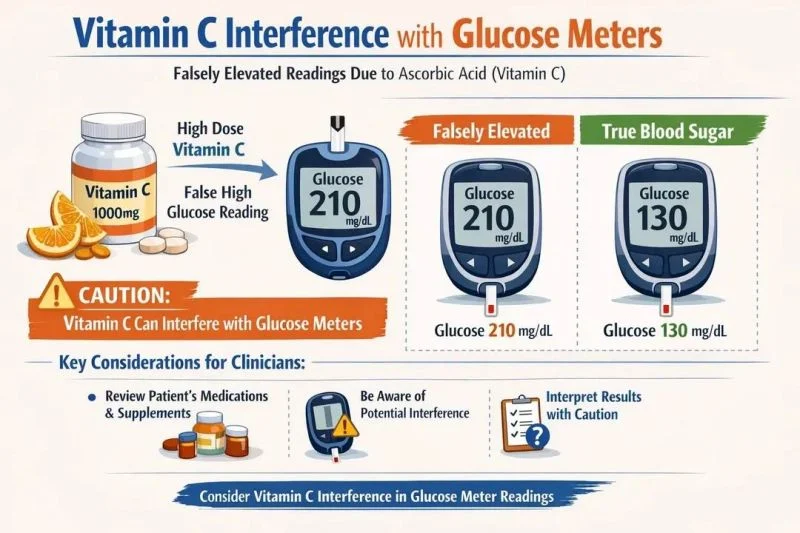
Ascorbic acid (vitamin C) can interfere with some point-of-care glucose meters and continuous glucose monitoring (CGM) systems, leading to falsely elevated glucose readings on certain devices.
The ADA 2026 Standards of Care highlight an important point:
Clinicians should always consider medication and substance interference-including vitamin C-when interpreting glucose results.
Why does this matter?
Because a falsely high glucose value can lead to:
- Incorrect clinical interpretation
- Unnecessary or inappropriate treatment
- Potential risk to the patient
In fact, hospital evaluations have shown that 2 out of 3 glucose meters tested produced falsely elevated readings when vitamin C levels increased.
Lab Takeaway: Think Beyond the Number
When a glucose result doesn’t match the clinical picture, ask:
- Is the patient taking high-dose vitamin C or receiving IV ascorbic acid?
- Is the device known to be susceptible to interference?
- Should the result be confirmed with laboratory plasma glucose or a different method?
Guidance for CGM systems also notes that high doses of vitamin C may falsely elevate readings-confirmation is recommended when values don’t match symptoms.”
Other posts featuring Tareq Abadl on Hemostasis Today.
-
Oct 24, 2026, 16:57Pall T. Onundarson: Fiix Prothrombin Time Advancing Precision in Anticoagulation Management
-
Oct 24, 2026, 16:42Mark-Anthony Johnson: Blood Type Awareness and Emergency Transfusion
-
Oct 24, 2026, 16:27Pedro Perez: Florida’s Push to Strengthen VTE Prevention
-
Oct 24, 2026, 16:23Kathleen Freson: Human Cell Models Advance Research into Rare Platelet Disorders
-
Oct 24, 2026, 16:18Victor Daniel: Deep Learning for Automated Platelet Classification
-
Oct 24, 2026, 16:08Paula Alonso-Frías: Human Umbilical Cord Blood Platelet-Rich Plasma for Endometrial Regeneration
-
Oct 24, 2026, 16:00Fatma Ebeid: Ain Shams University Hosts TIF Experts for Collaborating Center Evaluation
-
Oct 24, 2026, 15:52Mazen A. Juratli: Platelet-Derived Extracellular Vesicles as Potential Predictors of Survival in Liver Cancer
-
Oct 24, 2026, 14:28Satyam Arora: Umbilical Cord Blood for Neonatal Transfusions