


Jim Hoffman: The Role of Neutrophil Extracellular Traps in Central Nervous System Infections
Jim Hoffman, Former Technical Advisor at Cygnus Technologies, LLC, shared Dorit Reiss’s post on LinkedIn:
“Are Neutrophil Extracellular Traps in the central nervous system truly hindering bacterial clearance during pneumococcal meningitis, as proposed by Linder et al?
Too many NETs being hyperactivated and not being cleared have been proposed by Linder et al to impair NET clearance from the CFS and CNS during the pathogenesis of pneumococcal meningitis.
I am curious to know if removing NETs extracorporeally from the blood circulation can help the innate immune system better clear NETs and offending meningitis pathogens from the CSF and CNS of our most vulnerable patients.
This could be a good animal model Köckritz-Blickwede et al 2016 to demonstrate/determine this using the extracorporeal blood purification therapies offered by ExThera Medical and Santersus AG, known to deplete extracellular chromatin and pathogens.
Furthermore, do NETotic-NETs also facilitate the spread of infection and protect pathogens from antimicrobial therapies, similar to how they are known to protect tumor cells from anticancer therapies and facilitate CTC metastasis?
Is innate phagocytic-clearance being similarly compromised during the pathogenesis of severe meningitis as it has been observed during cancer metastasis, by simply having too many NETs in circulation and perhaps other extracellular chromatin released into the blood by other cell types?
‘A rat model of pneumococcal meningitis further revealed neutrophil recruitment and NET formation in the CSF.
The presence of NETs in the CSF compartment was found to promote pneumococcal survival and dissemination into other organs.
Degradation of NET-associated DNA using DNase I resulted in the clearance of bacteria from the brain, lungs, spleen and blood of infected animals.
This was because DNase treatment increased oxidative burst and phagocytosis in neutrophils co-incubated with pneumococci.
Our data indicate that NET formation in the CSF during pneumococcal meningitis might be detrimental to the host and that degrading these structures using DNase I leads to enhanced bacterial clearance from the brain.’ Linder et al.
Linder et al: also injected DNase intravenously, which could have significantly reduced circulating NETs ‘Given that intravenous injection is a more convenient and safer route of administration than intrathecal injection in a clinical setting, we also investigated the effects of intravenous (i.v.) DNase treatment in the rat model in a randomized, double-blinded manner.
Intravenous DNase treatment also reduced bacterial loads in the homogenates of brain, lungs and spleen, and blood plasma (Fig. 4a).
Intravenous DNase cleared NETs from the CSF (Fig. 4b, c, Supplementary Figure 7),’
Linder et al: also observed that heparin in addition to DNase, which has an extremely high affinity for histones and other NET associated proteins, helped degrade NETs in CFS.”
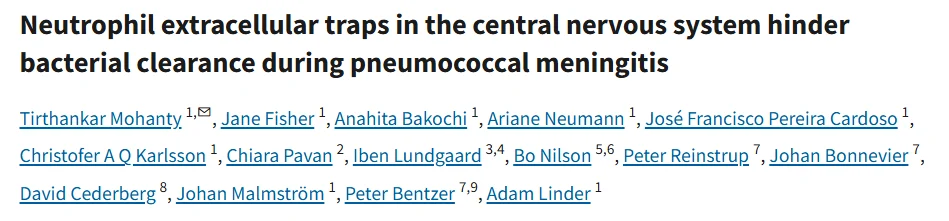
Title: Neutrophil extracellular traps in the central nervous system hinder bacterial clearance during pneumococcal meningitis
Authors: Tirthankar Mohanty, Jane Fisher, Anahita Bakochi, Ariane Neumann, José Francisco Pereira Cardoso, Christofer A Q Karlsson, Chiara Pavan, Iben Lundgaard, Bo Nilson, Peter Reinstrup, Johan Bonnevier, David Cederberg, Johan Malmström, Peter Bentzer, Adam Linder
Read the Full Article on Nature Communications.
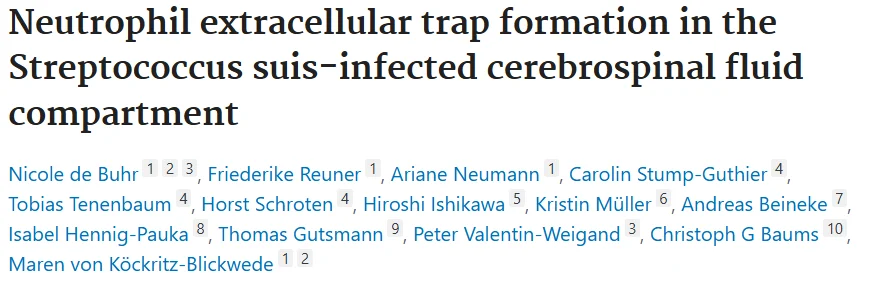
Title: Neutrophil extracellular trap formation in the Streptococcus suis-infected cerebrospinal fluid compartment
Authors: Nicole de Buhr, Friederike Reuner, Ariane Neumann, Carolin Stump-Guthier, Tobias Tenenbaum, Horst Schroten, Hiroshi Ishikawa, Kristin Müller, Andreas Beineke, Isabel Hennig-Pauka, Thomas Gutsmann, Peter Valentin-Weigand, Christoph G Baums, Maren von Köckritz-Blickwede
Read the Full Article on Cellular Microbiology.
Dorit Reiss, Professor of Law at UC Law San Francisco, shared a post on LinkedIn:
“Outbreaks of bacterial meningococcal disease in England and recent cases in students in New Zealand have raised awareness of this serious and life-threatening disease.
The disease is caused by the bacterium Neisseria meningitidis and presents as meningitis or blood poisoning (septicaemia).
Meningitis is an inflammation of the membranes that cover the brain and spinal cord (meninges), while septicaemia affects the whole body through the presence of bacteria in the blood stream.
Both can be also be caused by other infectious agents, but bacterial meningococcal disease is the most severe form.
Infants, children and young adults are at higher risk.
While the disease is largely preventable through vaccination, only one vaccine is currently on the national immunisation schedule in Aotearoa New Zealand.
As part of ongoing research to explain the recent cases, we compared the meningococcal strains involved in both countries and explored the significance of people who carry the bacterium but don’t develop symptoms or disease.”
Stay updated on all scientific advances Hemostasis Today.
-
Sep 20, 2026, 12:11Giacomo Buso: Silent Atherosclerosis Begins Earlier Than Expected
-
Sep 20, 2026, 12:0310 Posts Not to Miss This Week
-
Sep 20, 2026, 11:27Edward Lee Carter: Prasugrel Dosing Matters in P2Y12 Inhibitor Comparisons After PCI
-
Sep 20, 2026, 09:51Ceasovschih Alexandr: A Closer Look at Lipid Disorders in CKM Syndrome
-
Sep 20, 2026, 09:05World Stroke Academy: Can Adjunct IAT Improve Tissue Reperfusion?
-
Sep 20, 2026, 06:46Neeraj Songara: From Donated Blood to Engineered Therapeutics
-
Sep 20, 2026, 06:24Louise St. Germain Bannon: Improving Awareness and Care for Women Across the Lifespan
-
Sep 20, 2026, 05:17Maxime Dely: When ABO Compatibility Isn’t Enough for Safe Transfusion
-
Sep 20, 2026, 04:54William Aird: What Does a Complete History and Physical Really Mean?