

Abdul Mannan: The Clinical Pattern That Should Make You Think of VEXAS
Abdul Mannan, Consultant Haematologist at Betsi Cadwaladr University Health Board, shared a post on LinkedIn:
“VEXAS Series – 3 LinkedIn Posts
POST 1 of 3 – VEXAS: The Big Picture
An older man. Fever. Ear chondritis. Macrocytic anaemia. Cytopenia.
Rheumatology refers him to haematology.
Haematology refers him back.
Everyone is partly right. No one has the full answer.
Until you look at his bone marrow.
That’s VEXAS. And it’s sitting in your clinic right now.
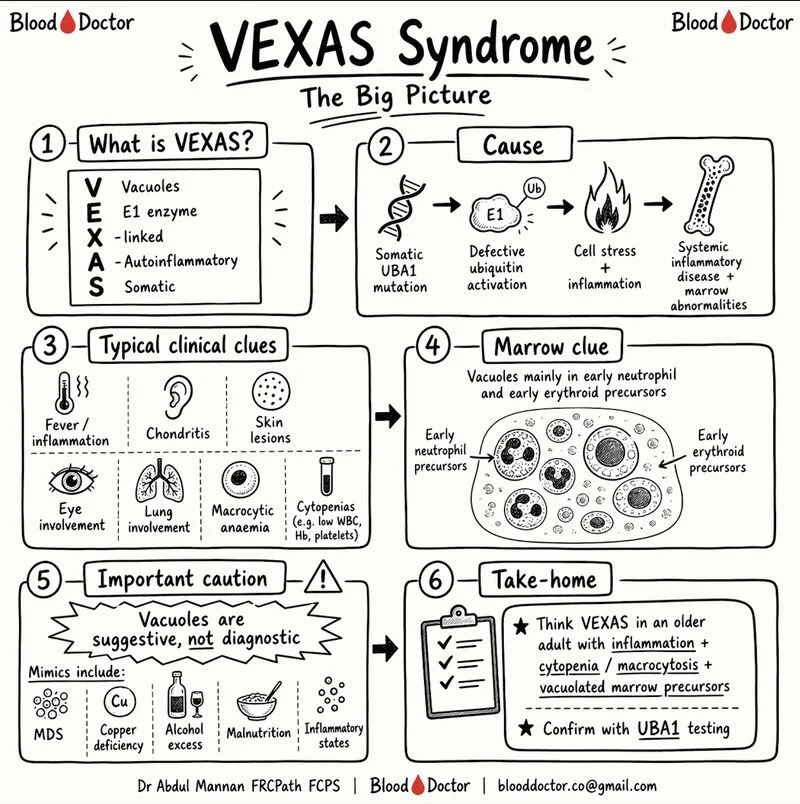
VEXAS stands for:
- Vacuoles
- E1 enzyme
- X-linked
- Autoinflammatory
- Somatic
It’s caused by a somatic mutation in the UBA1 gene – the gene that runs the ubiquitin system, the cell’s own protein clean-up mechanism.
When UBA1 fails, cells accumulate stress.
Inflammation ignites.
And the bone marrow starts showing visible damage.
Here’s what to look for clinically:
- Fever and recurrent systemic inflammation
- Chondritis — ears and nose
- Skin lesions
- Eye involvement
- Lung disease
- Macrocytic anaemia with low WBC and/or platelets
And on the bone marrow:
- Vacuoles in early neutrophil precursors
- Vacuoles in early erythroid precursors
One thing every haematologist must know: vacuoles are suggestive, not diagnostic.
MDS, copper deficiency, alcohol excess, malnutrition, and active inflammation can all produce the same picture.
The clinical signal is this: older adult plus inflammation plus cytopenia plus macrocytosis plus vacuolated marrow precursors.
Confirm with UBA1 testing.
This is Part 1 of my 3-part VEXAS series.
Tomorrow: how to use marrow morphology as a practical triage tool.
Have you diagnosed VEXAS in your centre? I’d love to hear your experience.”
Other posts from Abdul Mannan on Hemostasis Today.
-
Sep 25, 2026, 13:32Gevorg Yaghjyan: Low Drug Levels, Higher Cardiovascular Risk in Lupus
-
Sep 25, 2026, 12:53Bastu Odoka: What Happened to Blood Donation?
-
Sep 25, 2026, 12:43Thomas Dayspring: Reshaping the Biology of Atherosclerotic Plaques with New Therapies
-
Sep 25, 2026, 12:14Garima Sharma: Community Clinical Linkages for Better Postpartum Cardiovascular Care
-
Sep 25, 2026, 10:49Shefina S: From Presenting to Hosting at TRANSCON 2026
-
Sep 25, 2026, 10:37Michelle Leona Cecil: Hemophilia Advocacy and the Power of Community
-
Sep 25, 2026, 10:13Michael Baria: Platelet Concentration and PRP Outcomes in Partial Rotator Cuff Tears
-
Sep 25, 2026, 09:49Haley Coleman: Volunteering to Support Hemophilia Awareness
-
Sep 25, 2026, 08:55Hitarth Mehta: BHMS Students Gain Practical Exposure to Haemophilia Diagnosis