

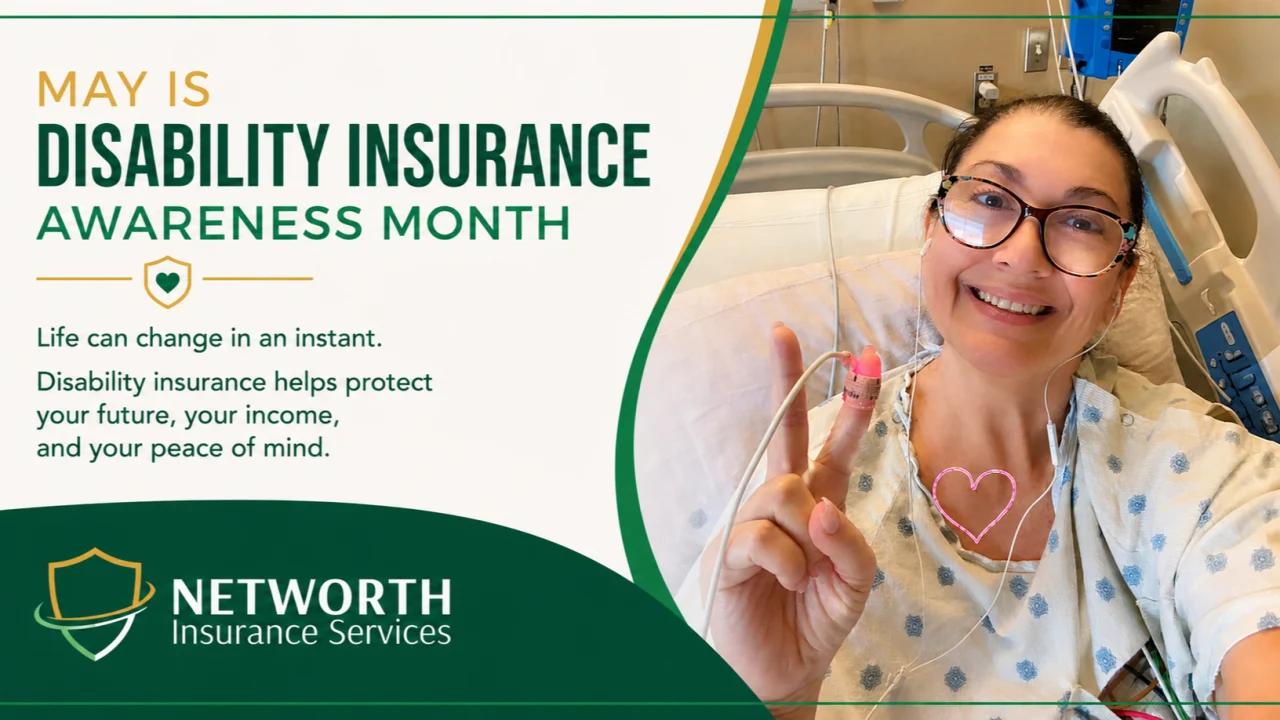
Serena Miranda: Why My Stroke Recovery Made Disability Insurance Personal
Serena Miranda, Realtor at Realty of America, shared on LinkedIn:
”March 10 changed the way I view health, income, and business forever.
After my stroke, there was a time I couldn’t even handle 10 minutes on my phone or computer… and my work depends on both.
That was a wake-up call.
May is Disability Insurance Awareness Month, and I wrote a personal LinkedIn article about recovery, invisible disability, and why protecting your income is a conversation too many people delay.
If you’re self-employed, a business owner, or the person your household depends on financially – this matters.
Read the article below and let me know what stood out to you most.
On March 10th, my life changed.
I experienced a stroke. In my case, recovery has been a blessing – but the experience opened my eyes in a way no textbook, policy brochure, or sales training ever could.
Like many people, I understood strokes as something serious.
What I did not fully appreciate was how even a TIA (Transient Ischemic Attack), often called a ‘mini stroke,’ can have real and lasting effects.
Many medical professionals consider any event that disrupts blood flow to the brain a form of brain injury because brain tissue is affected, even when symptoms improve quickly.
That truth hit home for me.
Because when you are self-employed, a business owner, or the key person behind your company… your health is not just personal.
It is operational. It is financial. It impacts everyone connected to your work.
What Is a TIA – and Why It Still Matters?
What many people do not understand about stroke or even a TIA is that recovery is not always dramatic on the outside – but it can be deeply disruptive on the inside.
There was a period where I could not tolerate even 10 minutes on my computer or phone without feeling mentally exhausted, overstimulated, or needing to stop.
Think about that for a moment.
My J.O.B. is 90% computer and phone.
Client communication, Quotes, Emails, Applications, Marketing, Follow-up, Research, and Serving people.
So when I could not function on those two tools, that was not just an inconvenience.
That was a work disability.
It may not look like someone in a cast. It may not come with crutches or visible wounds. But when your brain cannot handle the core tasks your income depends on, that is real disability.
Luckily, I listened to my body.
I took the time needed to let my brain recover. I reduced stress. I stepped back when necessary. I gave healing the respect it deserved.
And thankfully, my recovery has been fairly quick.
Buuuuut…
What if it had not been?
What if recovery took 6 months? What if concentration never fully returned?
What if screen time triggered symptoms long-term?
What if I was the only income source?
That is exactly why this conversation matters.
Disability insurance is not just about catastrophic injuries. It can be about protecting your income during the season when your body, or brain needs time to heal.
Especially for the self-employed, business owners, Realtors, contractors, and anyone whose livelihood depends on being mentally sharp and digitally active.
Sometimes disability looks like not being able to do the work everyone assumes you can do.
And that is why I am speaking up this May.
According to the American Stroke Association, a TIA is caused by a temporary blockage of blood flow to the brain and is a warning sign that a future stroke may occur.
TIAs should always be treated as a medical emergency.
Even when symptoms resolve, many people experience:
- Brain fog
- Fatigue
- Anxiety
- Memory disruption
- Reduced focus
- Slower processing speed
- Emotional stress about recurrence
For a self-employed person, these symptoms can directly affect income-producing ability.
If My Stroke Had Been More Debilitating…
This is the question that May’s Disability Insurance Awareness Month has me asking more deeply:
What if my stroke had left me unable to work for 3 months? 6 months? A year?
As a self-employed business owner, there is often no HR department stepping in with benefits. No automatic paycheck. No employer-funded disability plan.
If I had been significantly impaired, these areas would need immediate attention:
1. Household Income Protection
Mortgage or rent Utilities Food Insurance premiums Daily living expenses
2. Business Continuity
Client communication Renewals Sales pipeline Marketing momentum Licensing deadlines Vendor relationships
3. Key Person Risk
Many small businesses rely heavily on one person: the owner.
If that person cannot function at full capacity, revenue may stall quickly.
4. Recovery Time Without Financial Panic
Healing requires rest, appointments, therapy, and mental bandwidth.
Stress over money can slow recovery.
Why Disability Insurance Matters More Than Many Realize
People often insure:
- Their home
- Their car
- Their phone
- Their life
But forget to insure the asset that pays for all of it:
Your Ability to Earn Income
According to LIMRA, many working Americans live paycheck to paycheck or would face financial hardship quickly if income stopped.
Disability insurance helps replace a portion of income during a covered illness or injury.
A Realistic Protection Plan for the Self-Employed
If you own a business or work for yourself, here are five conversations worth having now:
1. Personal Disability Income Coverage
Could you replace income if you could not work?
2. Emergency Cash Reserves
Do you have 3–6 months of true expenses saved?
3. Delegation Plan
Who can step in if you cannot?
4. Access plus Password Continuity
Can someone manage urgent business items if needed?
5. Family Conversation
Does your spouse or partner know where everything is?
What My Recovery Taught Me
I am grateful for healing.
I am grateful for perspective.
And I am more committed than ever to helping people understand that insurance is not fear-based planning—it is confidence-based planning.
No one expects a stroke. No one schedules disability. No one plans to be unable to work.
But wise people plan anyway.
This May, Have the Conversation That Matters
If you are self-employed, a business owner, a contractor, Realtor, consultant, or professional whose income depends on you showing up – Please do not put this conversation aside.
Ask: If something happened to me tomorrow, would my family and business be protected?
If the answer is ‘I’m not sure,’ that is where the conversation starts.
I’m Here to Help
May is Disability Insurance Awareness Month, and I’m using my story to bring awareness to something many people avoid until it is too late.
If you would like a simple, no-pressure conversation about protecting your income and your future, message me directly.”
Stay updated with Hemostasis Today.
-
Sep 30, 2026, 01:52Javed Anees: DADA2 – When a Young Stroke Is More Than a Stroke
-
Sep 30, 2026, 01:51How a Venous Thrombus Becomes Revascularized – ISTH
-
Sep 29, 2026, 22:45Victor Agunyego: Paracetamol – The Most Common Drug We Underestimate
-
Sep 29, 2026, 22:42Nova Sinclair: Advancing the Future of Hematology – Meet Our 2027 Organizing Committee
-
Sep 29, 2026, 22:41Lorenz Räber: Intracoronary Imaging in PCI – Why, When, How, and Which Modality?
-
Sep 29, 2026, 22:31Selma Turkovic: Pleased to Deliver the Opening Presentation at Kingston Hospital
-
Sep 29, 2026, 22:31Miguel Teran: Ultrasound and Simulation in Arterial Blood Sampling
-
Sep 29, 2026, 22:28Mohammad Refaei: Navigating Your Career in Hematology From Training to Practice
-
Sep 29, 2026, 22:27Matteo Foschi: 10 Clinical Pearls for Antithrombotic Therapy in Secondary Stroke Prevention