


Islam Arid: A Practical Guide to ECMO in Modern Intensive Care
Islam Arid, Registered Nurse (IMU) at Memorial Hermann Health System, shared a post on LinkedIn:
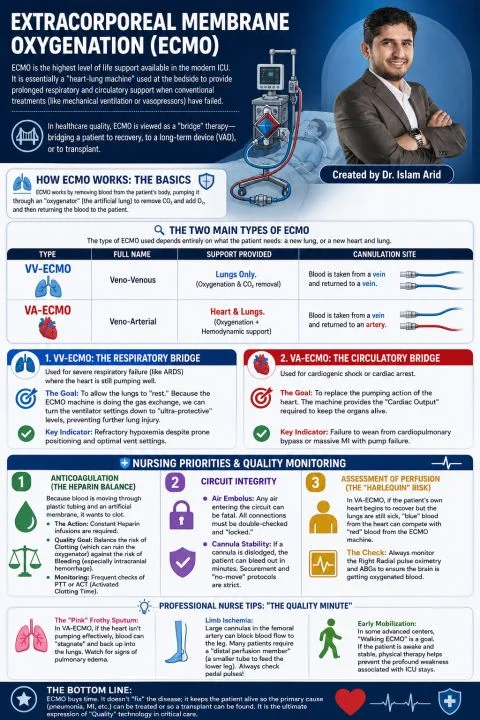
“Extracorporeal Membrane Oxygenation (ECMO) is the highest level of life support available in the modern ICU.
It is essentially a ‘heart-lung machine’ used at the bedside to provide prolonged respiratory and circulatory support when conventional treatments (like mechanical ventilation or vasopressors) have failed.
How ECMO works: The basics
ECMO works by removing blood from the patient’s body, pumping it through an ‘oxygenator’ (the artificial lung) to remove CO2 and add O2, and then returning the blood to the patient.
The two main types of ECMO
The type of ECMO used depends entirely on what the patient needs: a new lung, or a new heart and lung.
Type full name support provided cannulation site
- VV-ECMO Veno-Venous Lungs Only. (Oxygenation & CO_2 removal) Blood is taken from a vein and returned to a vein.
- VA-ECMO Veno-Arterial Heart & Lungs. (Oxygenation + Hemodynamic support) Blood is taken from a vein and returned to an artery.
1. VV-ECMO: The respiratory bridge
Used for severe respiratory failure (like ARDS) where the heart is still pumping well.
- The Goal: To allow the lungs to ‘rest.’Because the ECMO machine is doing the gas exchange, we can turn the ventilator settings down to ‘ultra-protective’ levels, preventing further lung injury.
- Key Indicator: Refractory hypoxemia despite prone positioning and optimal vent settings.
2. VA-ECMO: The circulatory Bridge
Used for cardiogenic shock or cardiac arrest.
- The Goal: To replace the pumping action of the heart. The machine provides the ‘Cardiac Output’ required to keep the organs alive.
- Key Indicator: Failure to wean from cardiopulmonary bypass or massive MI with pump failure.
Nursing priorities and quality monitoring
Managing an ECMO patient is a highly specialized task involving a ‘doubled’ nursing focus: the patient and the circuit.
1. Anticoagulation (the Heparin balance)
Because blood is moving through plastic tubing and an artificial membrane, it wants to clot.
- The Action: Constant Heparin infusions are required.
- Quality Goal: Balance the risk of Clotting (which can ruin the oxygenator) against the risk of Bleeding (especially intracranial hemorrhage).
- Monitoring: Frequent checks of PTT or ACT (Activated Clotting Time).
2. Circuit integrity
- Air Embolus: Any air entering the circuit can be fatal. All connections must be double-checked and ‘locked.’
- Cannula Stability: If a cannula is dislodged, the patient can bleed out in minutes. Securement and ‘no-move’ protocols are strict.
3.Assessment of perfusion (the “Harlequin” risk)
In VA-ECMO, if the patient’s own heart begins to recover but the lungs are still sick, ‘blue’ blood from the heart can compete with ‘red’ blood from the ECMO machine.
The Check: Always monitor the Right Radial pulse oximetry and ABGs to ensure the brain is getting oxygenated blood.”
Stay updated with Hemostasis Today.
-
Sep 25, 2026, 16:26Gemma Postil: AI Tools in Modern Health Research
-
Sep 25, 2026, 16:01Mostafa Hammam: When aPTT Correction Is Not the End
-
Sep 25, 2026, 15:50Adam Boruchov: Registration Is Open For The 2026 New England Hematologic Diseases Symposium
-
Sep 25, 2026, 15:23Bringing Hope and Treatment Access to Morocco’s Hemophilia Community – World Federation of Hemophilia
-
Sep 25, 2026, 15:22Alejandro González Veliz: Targeting Atherosclerosis Before the First Event
-
Sep 25, 2026, 15:00Sarah Richardson: Finding Strength Through Bleeding Disorders Advocacy
-
Sep 25, 2026, 14:54James Fildes: Modeling Device Related Thrombosis in Multi Organ Systems
-
Sep 25, 2026, 14:51Platelet Metabolic Reprogramming: How Cellular Energy Drives Thrombosis
-
Sep 25, 2026, 14:46Thomas Maxwell: From Hemophilia Shame to Strength – Walking for Bleeding Disorders