


Ifeanyichukwu Ifechidere: Why DIC is the Condition That Humbles even the Most Experienced Scientists
Ifeanyichukwu Ifechidere, Specialist Biomedical Scientist at Sheffield Teaching Hospitals NHS Foundation Trust, shared a post on LinkedIn:
“Two patients. Both with DIC on their charts.
One was bleeding from every line site.
The other had just thrown a massive PE.
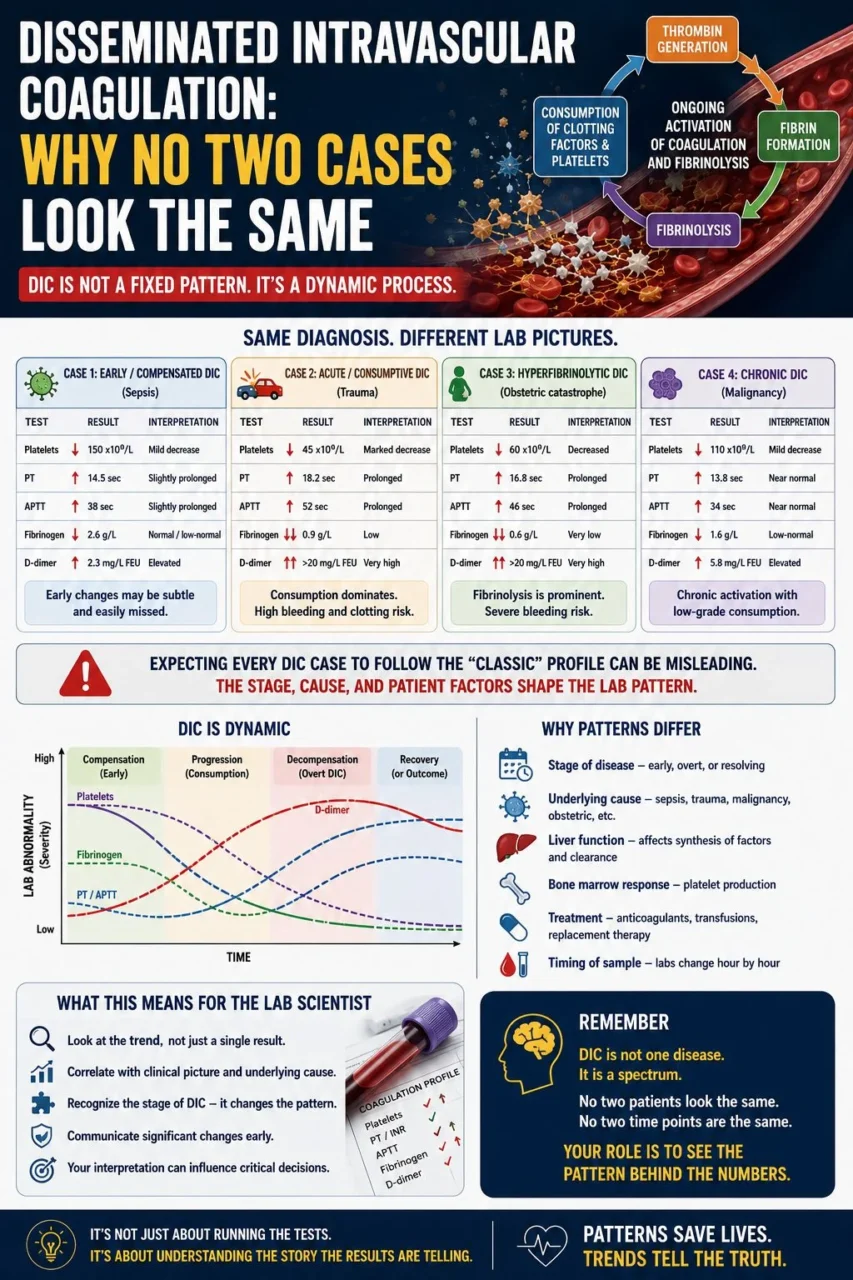
Same diagnosis. Completely different coagulation results.
This is why DIC is the condition that humbles even the most experienced scientists — because no two cases ever look the same.
DIC is not a disease. It’s a process.
It is triggered — by sepsis, obstetric catastrophe, malignancy, trauma.
The trigger shapes the phenotype you see on the coagulation screen.
DIC is the simultaneous, dysregulated activation of coagulation and fibrinolysis.
But these two processes don’t always move at the same speed — and that’s why the laboratory picture shifts so dramatically between patients.
Pattern 1: The Bleeding Patient
Classic consumptive coagulopathy.
Platelets falling. Fibrinogen depleted. PT and APTT prolonged. D-dimer markedly elevated.
The system has been driven so hard that clotting factors and platelets are exhausted. The patient bleeds because nothing remains to form a stable clot.
This is the pattern mostly taught in textbooks about DIC presentation.
It represents one end of a spectrum — not the whole picture.
Pattern 2: The Thrombotic Patient
Early compensated DIC looks entirely different.
Platelets mildly reduced or within range. Fibrinogen normal or even elevated — it is an acute phase reactant, and in sepsis, production can temporarily outpace consumption.
PT and APTT only mildly deranged.
But D-dimer is elevated. Fibrin is being laid down in the microvasculature.
The patient is clotting silently and systemically — while the standard coagulation screen offers dangerous false reassurance.
The Fibrinogen Trap
This catches people most often.
Fibrinogen returns at 3.2 g/L — within reference range. The team is reassured.
What that result doesn’t show:
Fibrinogen was 5.8 g/L on admission. It has fallen by nearly half in 18 hours.
A single fibrinogen value in DIC is almost meaningless. The trajectory is everything.
Serial sampling is not optional — it is the only way to see the direction of travel before the cliff edge arrives.
What dynamic monitoring looks like:
- Serial FBC, PT, APTT, fibrinogen, D-dimer — minimum 6-hourly in acute DIC
- Interpret fibrinogen as a trend, never a standalone value
- Apply the ISTH overt DIC scoring system — no single marker is sufficient alone
- Always correlate with clinical phenotype — a bleeding patient with a ‘normal’ APTT still demands urgent review
DIC moves through phases. The laboratory picture at any given moment reflects only where the patient is in that process.
Miss the trajectory and you miss the diagnosis.
Our role isn’t just to report the number.
It’s to recognise the pattern, flag the trend, and communicate urgency before the screen normalises into catastrophe.
What’s the most complex DIC presentation you’ve encountered?”
Other posts featuring Ifeanyichukwu Ifechidere on Hemostasis Today.
-
Nov 17, 2026, 23:45Cajetan Reichardt: LAAO vs. OAC in AF – Balancing Nonprocedural Bleeding and Ischemic Stroke Risk
-
Nov 17, 2026, 23:42Brian Tegtmeyer: Expanding Pre-Hospital Administration of Low-Titer O Positive Whole Blood
-
Nov 17, 2026, 23:41Mansi Kala: Advancing Hematology – From Evidence to Clinical Excellence
-
Nov 17, 2026, 23:40Nathan Connell: Registered for the WFH Comprehensive Care Summit 2027 in Prague
-
Nov 17, 2026, 23:38Yaariv Khaykin: Does Reducing AF Burden After Ablation Change the Need for Anticoagulation?
-
Nov 17, 2026, 23:38Amos Gitonga Mbaabu: Strengthening Care and Advocacy for Haemophilia and SCD across Southern Africa
-
Nov 17, 2026, 23:35Muhammad Sameed Altaf: A Decade of Working Together for Thalassemia Awareness and Patient Support
-
Nov 17, 2026, 23:34Ahmed Bennis: Is Aspirin Therapy Enough for VTE Prevention After Arthroplasty?
-
Nov 17, 2026, 23:33Remi Remakanth: The Role of Transfusion Medicine in HLA Antibody Testing and Transplant Desensitization