


Milad Abdalla: Elevating Phlebotomy Standards – Why Order of Draw and Blood Cultures Matter
Milad Abdalla, Medical Laboratory Technologist at Al Yalayis Government Transactions Center, shared a post on LinkedIn:
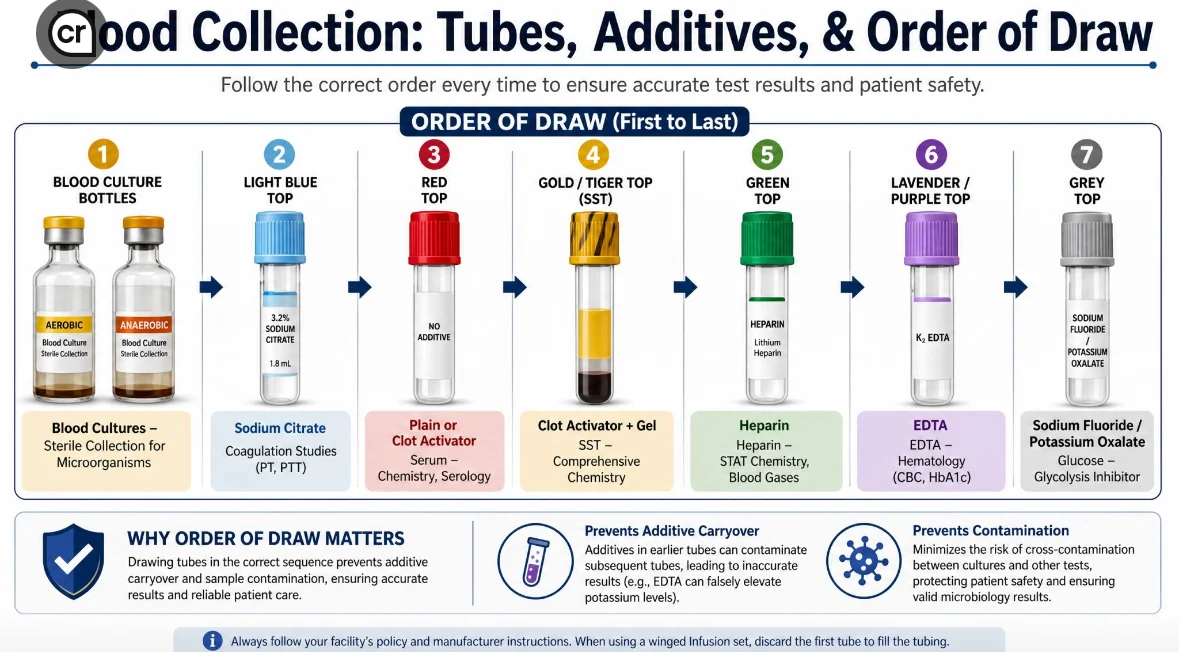
“Elevating Phlebotomy Standards – Why Order of Draw and Blood Cultures Matter
Accurate diagnostics start long before the sample reaches the analyzer. The pre‑analytical phase – especially the Order of Draw and proper Blood Culture collection – remains one of the most critical determinants of result integrity.
Why It Matters?
Additive carryover can alter results, delay diagnosis, and compromise patient safety. That’s why the CLSI sequence is the global benchmark for preventing contamination and ensuring reliable outcomes.
CLSI Order of Draw (Simplified)
- Blood Cultures — Always first to maintain sterility and avoid additive interference.
- Light Blue – Citrate — Coagulation tests requiring precise 1:9 ratio.
- Serum Tubes – Red/Gold/SST — Chemistry, serology, immunology.
- Green – Heparin — STAT chemistry and blood gases.
- Lavender – EDTA — CBC, HbA1c; collected late to avoid metal chelation interference.
- Grey – Fluoride/Oxalate — Glucose and lactate; strong inhibitors, so always last.
Blood Cultures – The First Line in Infection Diagnosis
Their accuracy depends on:
- Strict aseptic technique
- Correct blood volume
- Drawing them before any other tube
Key Takeaways
- Sterility first — Blood cultures always lead the sequence.
- Prevent additive carryover — Follow CLSI strictly.
- Volume accuracy — Especially for coagulation and cultures.
- Continuous competency — Phlebotomy excellence is a global responsibility.
By mastering these fundamentals, we elevate diagnostic accuracy and strengthen patient safety across healthcare systems worldwide.”
Stay updated with Hemostasis Today.
-
Oct 25, 2026, 19:55Giacomo Buso: LIPLEG Provides the Strongest Evidence to Date on Lipedema Treatment
-
Oct 25, 2026, 19:54Nicholas Lee: ASH Program Connects Trainees and Faculty With Mentors for Career Development
-
Oct 25, 2026, 19:53World Thrombosis Day Raises Blood Clot Awareness at Italian Airports
-
Oct 25, 2026, 19:49Tahsim Anwar: A Six-Year Analysis of Adverse Events in Therapeutic Apheresis
-
Oct 25, 2026, 19:37William Wallace: More than 1 in 3 People with Parkinson’s Were Low in B6
-
Oct 25, 2026, 19:36Andrés Felipe Escobar González: Individualized Treatment Strategies for HMB in BDUC
-
Oct 25, 2026, 19:34Christophe Nougier: Returning to Burundi for the WFH-Supported Twinning Project
-
Oct 25, 2026, 19:29Bogda Koczwara: Pre-Existing and New CVD in Patients With Cancer Are Associated With Higher Mortality
-
Oct 25, 2026, 19:23Özlem Turan: Advancing Care for Women and Girls With Bleeding Disorders at the European Parliament