


Davide Massimi: A Bloodless Approach to Third Space Endoscopy
Davide Massimi, Endoscopy Consultant at Humanitas Research Hospital, shared Endoscopy Journal‘s post on LinkedIn:
“Underwater 3d space endoscopy finds its true fulfillment in underwater coagulation.
This is more than a technique: it’s the logical completion of underwater 3d space endoscopy.
If we already dissect underwater, why surface to manage vessels?
Underwater coagulation keeps the entire procedure in one continous setting:
- one field: saline immersion and continuous irrigation
- one device: no switching to hemostatic forceps, just knife
- one electrosurgical setting: no ESU mode changes required, just play with saline irrigation and knife flushing
The result is a third space endoscopy that is safe, effective, efficient and, bloodless”
Endoscopy Journal shared a post on LinkedIn about a recent article by Antonio Capogreco et al., published in Endoscopy, adding:
“Vessel coagulation in third-space endoscopy: a RCT
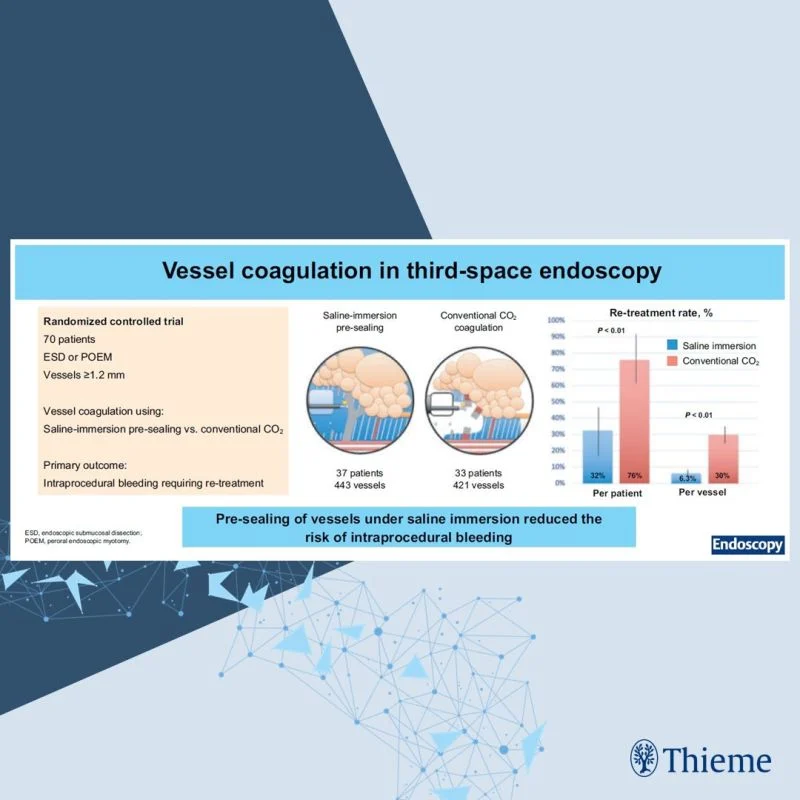
In a randomized controlled trial, 70 patients undergoing third-space endoscopy (endoscopic submucosal dissection or peroral endoscopic myotomy) underwent prophylactic management of submucosal vessels grater than or equal to 1.2mm with either saline-immersion pre-sealing or conventional coagulation under carbon dioxide insufflation.
Intraprocedural bleeding was significantly reduced in the saline-immersion group, both per-patient (32.4% vs. 75.8%) and per-vessel (6.3% vs. 29.9%), with less need for coagulation forceps and shorter coagulation time.
Future studies should evaluate generalizability and cost–effectiveness across different operators and settings.”
Title: Vessel coagulation in third-space endoscopy: a randomized controlled trial
Authors: Antonio Capogreco, Roberta Maselli, Davide Massimi, Ludovico Alfarone, Roberto de Sire, Emanuela Morenghi, Loredana Correale, Luca Brandaleone, Elisabetta Mastrorocco, Maritalia Simone, Chiara Morelli, Marco Spadaccini, Markus Enderle, Nermin Salkic, Pradeep Bhandari, Romain Legros, Jérémie Jacques, Cesare Hassan, Alessandro Repici
Stay updated on all scientific advances with Hemostasis Today.
-
Oct 17, 2026, 12:21Jalen Hurts Sidelined by a Superficial Blood Clot: What to Know
-
Oct 17, 2026, 09:33Robert Lookstein: Mechanical Thrombectomy Shows Functional Benefits in Intermediate-High-Risk PE
-
Oct 17, 2026, 09:18Sarra Hmidi: Tunisia Highlights Thrombosis Prevention on World Thrombosis Day
-
Oct 17, 2026, 09:05Addressing the Hidden Burden of Bleeding Disorders in Women – Hemophilia Society Mumbai Chapter
-
Oct 17, 2026, 08:49Maria Magnusson: Karolinska Experts Explore Gene Therapy in Sickle Cell Disease and Hemophilia
-
Oct 17, 2026, 04:07Weihao Li: Global HEPATIC Registry Findings on Post-Transplant Arterial Thrombosis
-
Oct 17, 2026, 03:56Ghaith Abu-Zeinah: ASH Publishes 2026 Guidelines for Myelofibrosis Management in Blood Advances
-
Oct 17, 2026, 03:48Tristan Siokos: Why Vascular Occlusion Is More Than Just Clots – Breakdown of the 8 Pathways
-
Oct 17, 2026, 02:36Archil Jaliashvili: Oxygen Transport in Capillaries