


Cristina Pecorilla: PSG6 and A New Approach to Cancer-Associated Thrombosis
Cristina Pecorilla, Doctoral Researcher at the University of Helsinki, shared on LinkedIn about a recent article she and her colleagues co-authored, published in Redox Biology, adding:
”How often have you cut yourself while chopping some vegetables?
Every time you get a small cut, tiny cell fragments in your blood called platelets rush to the wound, stick together, and seal it.
This process saves your life every day without you maybe noticing it.
But platelets can also work against you.
In cancer patients, tumors hijack platelet behaviour to protect themselves, grow new blood vessels, and spread to other organs.
The result is a dangerous cycle: cancer promotes blood clotting, while platelet activation and coagulation can support tumor progression and metastasis.
This cancer associated thrombosis is among the most common non-cancer causes of death in cancer patients and is a major complication of malignancy.
What if we could interrupt this cycle at its source?
Our latest article introduces PSG6: a mitochondria-targeted molecule that shows promising dual activity.
It inhibits platelet aggregation without increasing bleeding risk, while also selectively reducing cancer cell viability.
In fact, platelets depend heavily on mitochondrial energy to activate.
By designing a compound that accumulates specifically inside mitochondria and inhibits Complex I, we can interfere with platelet function at its metabolic roots.
This work brought together chemistry, cell biology, pharmacology, and computational modelling: Science at its best!”
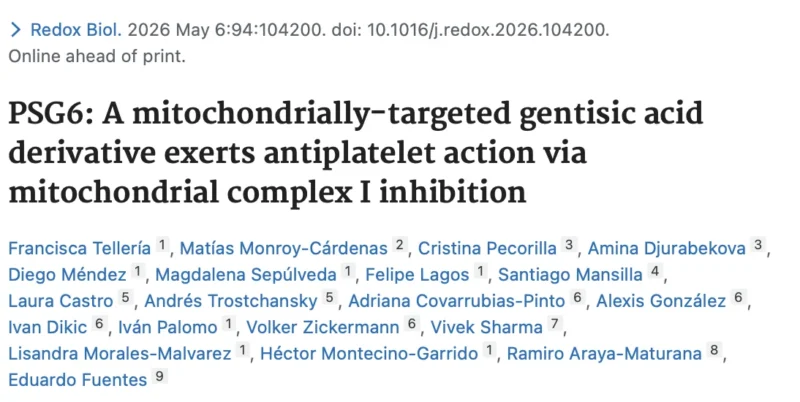
Title: PSG6: A mitochondrially-targeted gentisic acid derivative exerts antiplatelet action via mitochondrial complex I inhibition
Authors: Francisca Tellería, Matías Monroy-Cárdenas, Cristina Pecorilla, Amina Djurabekova, Diego Méndez, Magdalena Sepúlveda, Felipe Lagos, Santiago Mansilla, Laura Castro, Andrés Trostchansky, Adriana Covarrubias-Pinto, Alexis González, Ivan Dikic, Iván Palomo, Volker Zickermann, Vivek Sharma, Lisandra Morales-Malvarez, Héctor Montecino-Garrido, Ramiro Araya-Maturana, Eduardo Fuentes
Stay updated on all scientific advances with Hemostasis Today.
-
Oct 20, 2026, 16:51Suzan Nakasendwa: A Growing Stroke Challenge in Uganda
-
Oct 20, 2026, 16:38Steve Moon: How Does Smoking Cessation Duration Affect Ischemic Stroke Risk
-
Oct 20, 2026, 16:25Cedrice Mentor: Reducing Platelet Wastage Through Cold Storage
-
Oct 20, 2026, 16:09Thirunavukkarasu Angappan: Can a Purified Fibrinogen Concentrate Replace Cryoprecipitate
-
Oct 20, 2026, 16:01Kalyan Roy: Platelet Conservation Through Evidence-Based Transfusion Practice
-
Oct 20, 2026, 15:28Stacy E. Croteau: 33 Countries, One Mission – Better Bleeding Disorder Care
-
Oct 20, 2026, 15:19Teresa Barnes: What Does a Pulmonary Embolism Mean for Jalen Hurts?
-
Oct 20, 2026, 15:04Laura S.: Could Speaking Up Prevent Maternal Deaths from Thrombosis?
-
Oct 20, 2026, 14:44Pete Stibbs: VTE in Professional Athletes – When Fitness Is Not Enough