


Sudhir Kumar: Homocysteine as An Overlooked Blood Test That May Reveal Important Health Risks
Sudhir Kumar, Professor and Head of Department of Neurology at Apollo Hospitals, shared on LinkedIn:
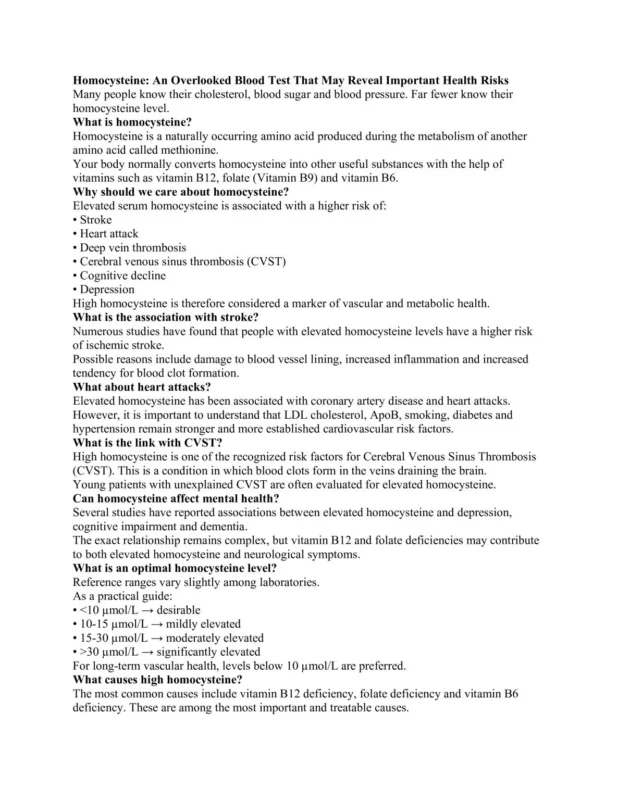
”Homocysteine: An Overlooked Blood Test That May Reveal Important Health Risks
Many people know their cholesterol, blood sugar and blood pressure. Far fewer know their homocysteine level.
What is homocysteine?
Homocysteine is a naturally occurring amino acid produced during the metabolism of another amino acid called methionine.
Your body normally converts homocysteine into other useful substances with the help of vitamins such as vitamin B12, folate (Vitamin B9) and vitamin B6.
Why should we care about homocysteine?
Elevated serum homocysteine is associated with a higher risk of:
- Stroke
- Heart attack
- Deep vein thrombosis
- Cerebral venous sinus thrombosis (CVST)
- Cognitive decline
- Depression
High homocysteine is therefore considered a marker of vascular and metabolic health.
What is the association with stroke?
Numerous studies have found that people with elevated homocysteine levels have a higher risk of ischemic stroke.
Possible reasons include damage to blood vessel lining, increased inflammation and increased tendency for blood clot formation.
What about heart attacks?
Elevated homocysteine has been associated with coronary artery disease and heart attacks.
However, it is important to understand that LDL cholesterol, ApoB, smoking, diabetes and hypertension remain stronger and more established cardiovascular risk factors.
What is the link with CVST?
High homocysteine is one of the recognized risk factors for Cerebral Venous Sinus Thrombosis (CVST). This is a condition in which blood clots form in the veins draining the brain.
Young patients with unexplained CVST are often evaluated for elevated homocysteine.
Can homocysteine affect mental health?
Several studies have reported associations between elevated homocysteine and depression, cognitive impairment and dementia.
The exact relationship remains complex, but vitamin B12 and folate deficiencies may contribute to both elevated homocysteine and neurological symptoms.
What is an optimal homocysteine level?
Reference ranges vary slightly among laboratories.
As a practical guide:
- Less than 10 µmol/L – desirable
- 10-15 µmol/L – mildly elevated
- 15-30 µmol/L – moderately elevated
- More than 30 µmol/L – significantly elevated
For long-term vascular health, levels below 10 µmol/L are preferred.
What causes high homocysteine?
The most common causes include vitamin B12 deficiency, folate deficiency and vitamin B6 deficiency.
These are among the most important and treatable causes.”
Stay updated with Hemostasis Today.
-
Sep 15, 2026, 15:00Sarah Wachtman: Modeling AAV-Based Gene Therapy for Hemophilia A Using Pediatric Liver Organoids
-
Sep 15, 2026, 15:00Ashenafi Tazebew Amare: From Blood Donation to Innovation and Patient Access
-
Sep 15, 2026, 14:56Glanzmann Thrombasthenia Beyond Platelet Transfusion
-
Sep 15, 2026, 14:55Christina Pohlman: The Hidden Complexity of Warfarin Therapy in APS
-
Sep 15, 2026, 14:44Consuela A. Albright: Building a More Connected Sickle Cell Care System
-
Sep 15, 2026, 14:43Andrew Jackson: Cyanosis as a Clue to Central Venous Obstruction
-
Sep 15, 2026, 14:43Andy Darlington: Randomized Evidence for Catheter-Based Treatment of Intermediate-High-Risk PE
-
Sep 15, 2026, 14:31Yaozhi Wang: AI Increased Incidental Pulmonary Embolism Detection
-
Sep 15, 2026, 14:30Moe Alsumidaie: Mitapivat Challenges the Transfusion-Centric Model of Thalassaemia Care