


Nassim Emteir: Interpreting TSAT with Ferritin to Guide Iron Deficiency Diagnosis and Treatment
Nassim Emteir, Senior Physician in Internal Medicine, Emergency Medicine, and Intermediate Care at Gesundheitszentrum Fricktal AG, shared a post on LinkedIn:
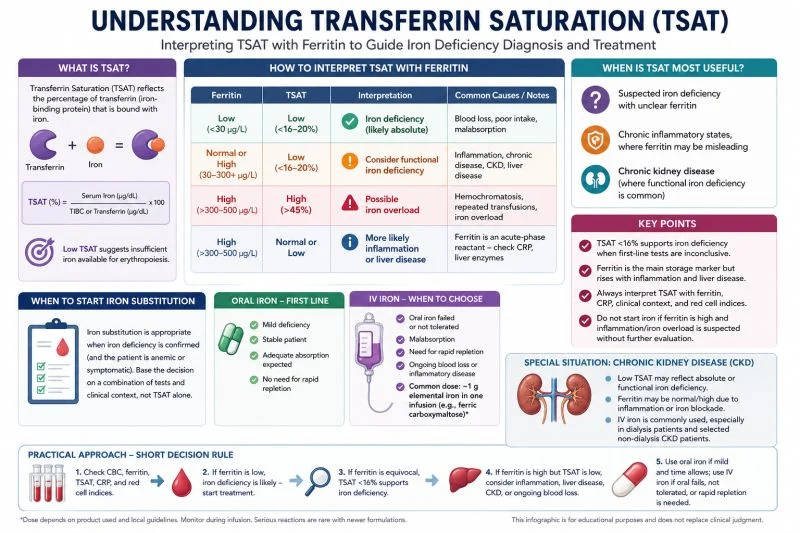
“Transferrin saturation (TSAT) is a practical marker of how much circulating transferrin is actually loaded with iron, and it is most useful when interpreted alongside ferritin and inflammation markers rather than alone.
Serum iron by itself is too variable to guide decisions well, but TSAT can help support iron deficiency when ferritin is equivocal, especially if TSAT is below about 16–20%.
Ferritin remains the main storage marker, but it is an acute-phase reactant and can be falsely elevated in inflammation or liver disease, so a ‘normal’ or high ferritin does not always exclude iron deficiency.
What TSAT means clinically
TSAT is calculated from serum iron and transferrin or total iron-binding capacity and reflects the proportion of transferrin binding sites occupied by iron. Low TSAT suggests insufficient available iron for erythropoiesis.
In practice, TSAT is most helpful in 3 situations:
- suspected iron deficiency with unclear ferritin
- chronic inflammatory states, where ferritin may be misleading
- chronic kidney disease, where functional iron deficiency is common
A TSAT below 16% supports iron deficiency when first-line tests are inconclusive. Some settings use a threshold below 20% as a screening cutoff, but this is less specific.
How to interpret TSAT with ferritin
TSAT should not be interpreted in isolation.
The most useful paired approach is:
- Low ferritin with low TSAT: strongly suggests absolute iron deficiency
- Normal and high ferritin with low TSAT: consider inflammation, liver disease, chronic kidney disease, or functional iron deficiency
- High ferritin with high TSAT: raises concern for iron overload
- High ferritin with normal and low TSAT: often reflects inflammation or liver disease rather than true iron excess
Because ferritin rises with inflammation and liver injury, adding C-reactive protein and liver enzymes often makes interpretation more reliable.
When to start iron substitution
Iron substitution is appropriate when there is evidence of iron deficiency, usually in a patient with anemia or persistent major fatigue after confirming iron status with a combination of tests rather than TSAT alone. In general practice, treatment is usually started when iron deficiency is supported by ferritin, TSAT, red cell indices, and the clinical context.
Full evaluation of iron status is recommended in anemia and in persistent major fatigue.
For route of replacement:
- Oral iron is usually first-line when deficiency is present and the patient is stable, absorption is expected to be adequate, and rapid repletion is not necessary.
- IV iron is preferred when oral iron has failed, is not tolerated, malabsorption is likely, faster repletion is needed, or there is ongoing blood loss/inflammatory disease limiting oral effectiveness.”
Stay updated with Hemostasis Today.
-
Sep 29, 2026, 19:00Caitlin Raymond: Can Artificial Blood Solve Blood Supply Shortages?
-
Sep 29, 2026, 18:51Chaza Alaji: Dyslipidemia, Thrombosis and the DIC Diagnostic Trap
-
Sep 29, 2026, 17:31Rajnikant Patel: Bridging Ayurvedic Concepts and Modern Toxin-Mediated Disease
-
Sep 29, 2026, 17:13Nicholas Lang։ A Meaningful Case of Immune Thrombocytopenia
-
Sep 29, 2026, 16:55Ayatullah Gamal Wahab: When the CBC Lies
-
Sep 29, 2026, 16:35Jonathan Douxfils: Navigating the VTE Risk Continuum in Reproductive Medicine
-
Sep 29, 2026, 16:35Chaima Rajeh: Types of Anemia and Their Laboratory Features
-
Sep 29, 2026, 16:27Scott Isaacs: How GLP-1 RAs Target Systemic Inflammation to Drive Cardio, Autoimmune, and Gut Health
-
Sep 29, 2026, 16:21Yitshak Kreiss: From Treating Patients to Defining the Standard of Knowledge