


Pall T. Onundarson: Questioning the Dogma of VKA Management
Pall T. Onundarson, Professor Emeritus at Landspitali University Hospital, shared Edward Lee Carter‘s post on LinkedIn:
”Fortunately, there are people such as Edward Lee Carter that are willing to question the dogma in VKA management – and that warfarin management and outcomes can be fiixed…by replacing the old prothrombin time with a more appropriate test.”
Edward Lee Carter, Clinical Pharmacist Practitioner at U.S. Department of Veterans Affairs, shared a post on LinkedIn:
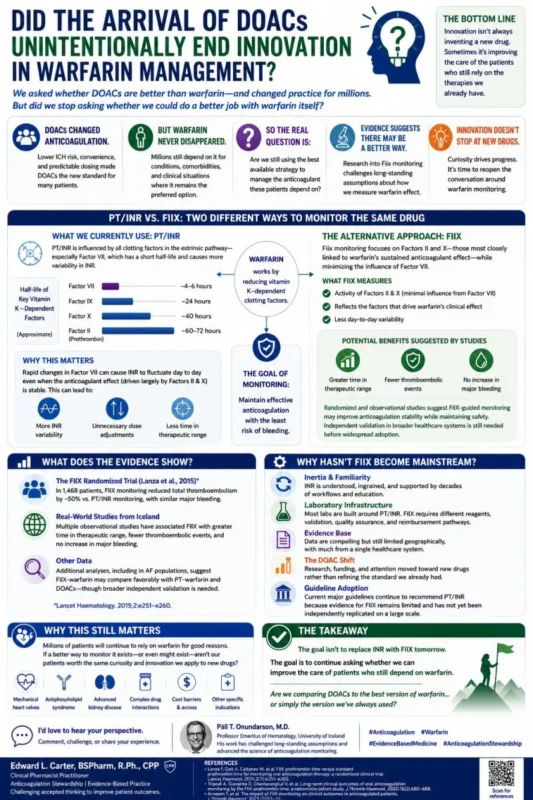
”Did the arrival of DOACs unintentionally end innovation in warfarin management?
That question has been on my mind recently.
Over the past decade, anticoagulation research has understandably focused on DOACs.
They have transformed care for millions of patients and represent one of the greatest advances in cardiovascular medicine.
But while our attention shifted to developing better drugs…
Did we stop trying to make warfarin itself better?
Warfarin hasn’t disappeared.
Millions of patients still depend on it because of:
- Mechanical heart valves
- Antiphospholipid syndrome
- Advanced kidney disease
- Cost considerations
- Drug interactions
- Other clinical situations where it remains the preferred therapy
Yet we continue to monitor it using PT/INR, a test developed nearly a century ago that was never designed specifically to measure warfarin’s pharmacodynamic effect.
That is where the work of Professor Emeritus of Hematology Dr. Pall T. Onundarson, M.D. deserves another look.
His research, together with colleagues studying Fiix-guided monitoring, asked a simple but important question:
If we can improve the way we monitor warfarin, can we improve patient outcomes without changing the drug itself?
The randomized Fiix trial suggested that monitoring Factors II and X while minimizing the influence of Factor VII reduced thromboembolic events without increasing major bleeding.
Subsequent observational studies from Iceland have continued to support that concept, although broader independent validation is still needed before widespread adoption.
Whether Fiix ultimately becomes the future is almost beside the point.
The bigger question is this:
Why did innovation in warfarin monitoring largely slow once DOACs arrived?
Innovation isn’t always inventing a new medication.
Sometimes it’s questioning long-held assumptions.
Sometimes it’s improving the care of patients who still rely on therapies we already have.
As pharmacists, physicians, laboratorians, and researchers, perhaps we should ask ourselves:
Are we comparing DOACs to the best version of warfarin…or simply the version we’ve always used?
I’d love to hear perspectives from clinicians, laboratorians, and researchers.
Is it time to reopen the conversation around warfarin monitoring?”
Stay updated with Hemostasis Today.
-
Oct 6, 2026, 02:59Preventing Hospital Associated Venous Thromboembolism – Thrombosis Canada
-
Oct 6, 2026, 02:42Treatment of Iron Deficiency With and Without Anemia – American Society of Hematology
-
Oct 6, 2026, 02:36Mouna Sassi: When Clinical and Laboratory Perspectives Meet in Thrombosis Care
-
Oct 6, 2026, 02:35Lucia Stefanini: Platelet Dysfunction and Oxidized Phospholipids in MASLD
-
Oct 6, 2026, 02:18Pablo Corral: Association of Lp(a) With Coronary Atherosclerosis and CV Events
-
Oct 5, 2026, 22:55Steve Humphreys: A Big Thank You to BSHT for Providing Me With a Recent Skills Exchange Award
-
Oct 5, 2026, 22:52William McKeown: Great to Be in Istanbul for the Opening of the EHC 2026
-
Oct 5, 2026, 22:48Laura Quintas Lorenzo: A New Approach to Healthcare for von Willebrand Disease at EHC 2026
-
Oct 5, 2026, 22:46Anas Zayad: Pleased to Share Our New Review on Thrombosis in SCD and Beta Thalassemia