


Muhammad Salman Babar: Why Vitamin B12 Treatment Can Lower Potassium
Muhammad Salman Babar, General Practitioner and Senior Medical Officer at Zahida Shaheen Hospital, shared a post on LinkedIn:
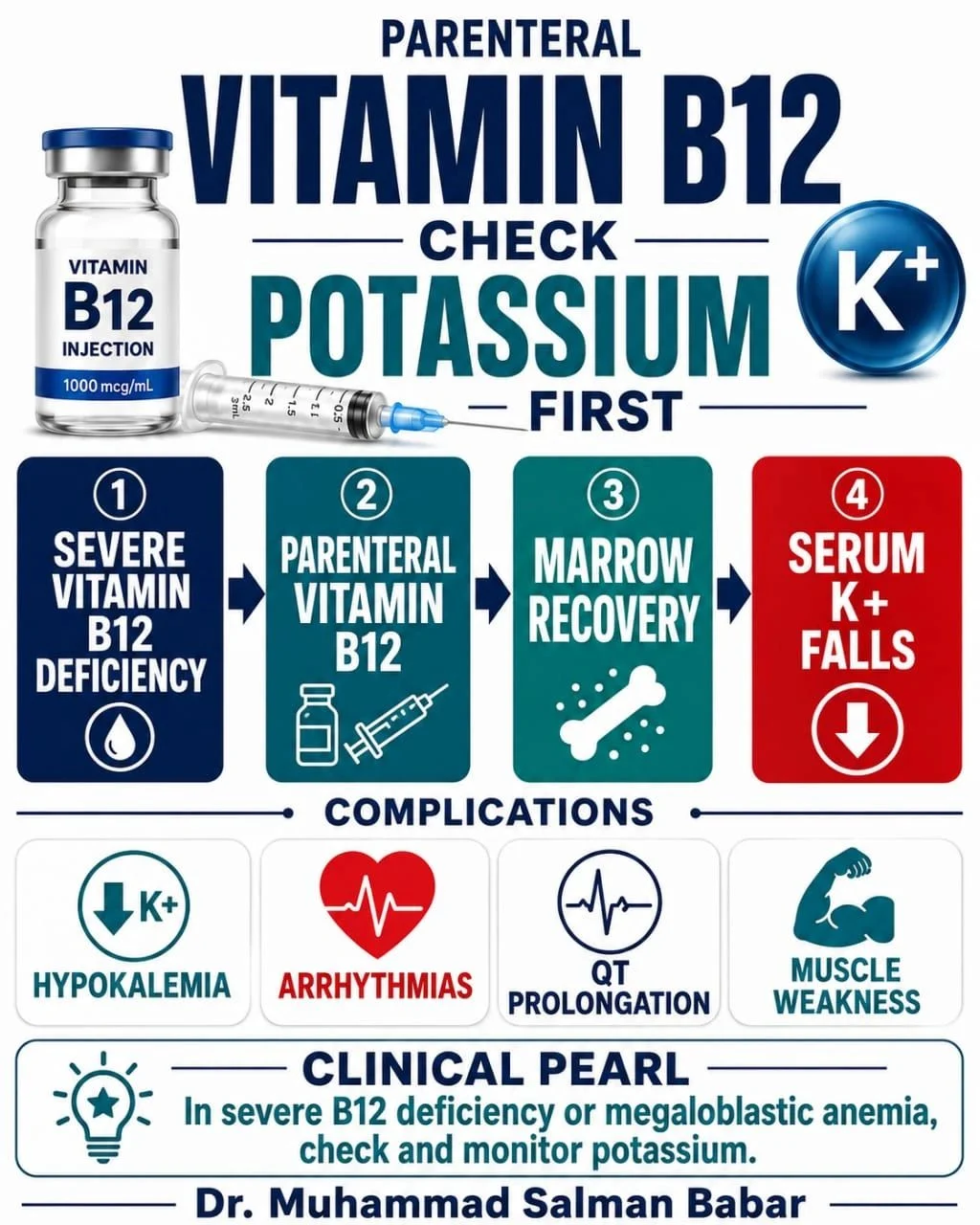
“Most doctors remember to replace vitamin B12. Far fewer remember what vitamin B12 replacement can do to potassium.
The danger isn’t the vitamin. It’s what happens after the bone marrow wakes up.
In patients with severe vitamin B12 deficiency – especially those with megaloblastic anemia – successful treatment rapidly reactivates the bone marrow.
As red blood cell production accelerates, potassium shifts into newly forming cells, causing serum potassium levels to fall.
The result?
A patient who appeared stable before treatment may develop clinically significant hypokalemia within days.
That can lead to:
- Muscle weakness
- QT prolongation
- Cardiac arrhythmias
- In severe cases, cardiovascular instability
Why does this happen?
Vitamin B12 doesn’t lower potassium directly.
It restores effective hematopoiesis.
As the marrow suddenly starts producing large numbers of new blood cells, intracellular potassium uptake increases, reducing circulating serum potassium.
This is a classic example of a treatment-related physiological shift, not a drug side effect.
Clinical Pearl
This doesn’t mean every patient receiving a routine B12 injection needs potassium monitoring.
But if you’re treating severe vitamin B12 deficiency or megaloblastic anemia, remember to:
- Check baseline potassium if clinically appropriate.
- Monitor patients at higher risk for electrolyte disturbances.
- Correct hypokalemia promptly if it develops.
Sometimes, the biggest complication isn’t the disease itself.
It’s the body’s remarkable recovery after treatment begins.”
Stay updated with Hemostasis Today.
-
Oct 12, 2026, 13:58Francisco Chacón-Lozsán: Catastrophic Antiphospholipid Syndrome A Rapidly Progressive Multiorgan Thrombotic Emergency
-
Oct 12, 2026, 12:50Nawsherwan Mohammad: Study Examines Thrombotic Events in Patients with Polycythemia Vera in Iraq
-
Oct 12, 2026, 12:30Chanakya Nayudu: Looking Beyond Blood Clots – Patient-Reported Outcomes in Antiphospholipid Syndrome
-
Oct 12, 2026, 12:12Jean-Jacques Kiladjian: Improving Treatment Strategies with JAK Inhibitors in Myelofibrosis
-
Oct 12, 2026, 12:04Chloe Homich: AABB Annual Meetings – Building Connections and Advancing Transfusion Medicine
-
Oct 12, 2026, 11:51Daniel Sop: Sickle Cell Research Takes Center Stage at ASCAT 2026
-
Oct 12, 2026, 10:36PAI-1 Inhibition as a New Strategy for Enhancing Fibrinolysis and Clot Resolution
-
Oct 12, 2026, 07:39Emmanuel J Favaloro: 100 Years of von Willebrand Disease and the Importance of Local Diagnosis and Management
-
Oct 12, 2026, 07:39Post-Stroke Fatigue Trajectories – 38% Recovered at 12 Months, While 16% Developed New Fatigue – International Journal of Stroke