

Cancer-Associated Arterial Thromboembolism: Redefining the Thrombotic Burden in Oncology
The ISTH 2026 Congress featured important advances in thrombosis research with the potential to shape future clinical practice.
Among the standout presentations was a landmark population-based analysis evaluating arterial thromboembolism (ATE) in patients with newly diagnosed cancer.
Using the Epic Cosmos electronic health record network, investigators analyzed nearly 1.7 million patients, making this one of the largest contemporary real-world studies ever performed in the field of cancer-associated thrombosis.
For decades, research has focused primarily on venous thromboembolism (VTE) as the hallmark thrombotic complication of malignancy. International guidelines, risk assessment models, and clinical trials have concentrated on preventing deep vein thrombosis and pulmonary embolism.
In comparison, arterial thromboembolism (ATE) – including myocardial infarction and ischemic stroke—has received far less attention despite its serious clinical consequences.
The findings presented at ISTH 2026 challenge this traditional view and suggest that arterial thrombosis should be recognized as an important component of cancer-associated thrombosis rather than simply a secondary cardiovascular complication.
A Unique Real-World Analysis
One of the greatest strengths of the study was its scale and diversity.
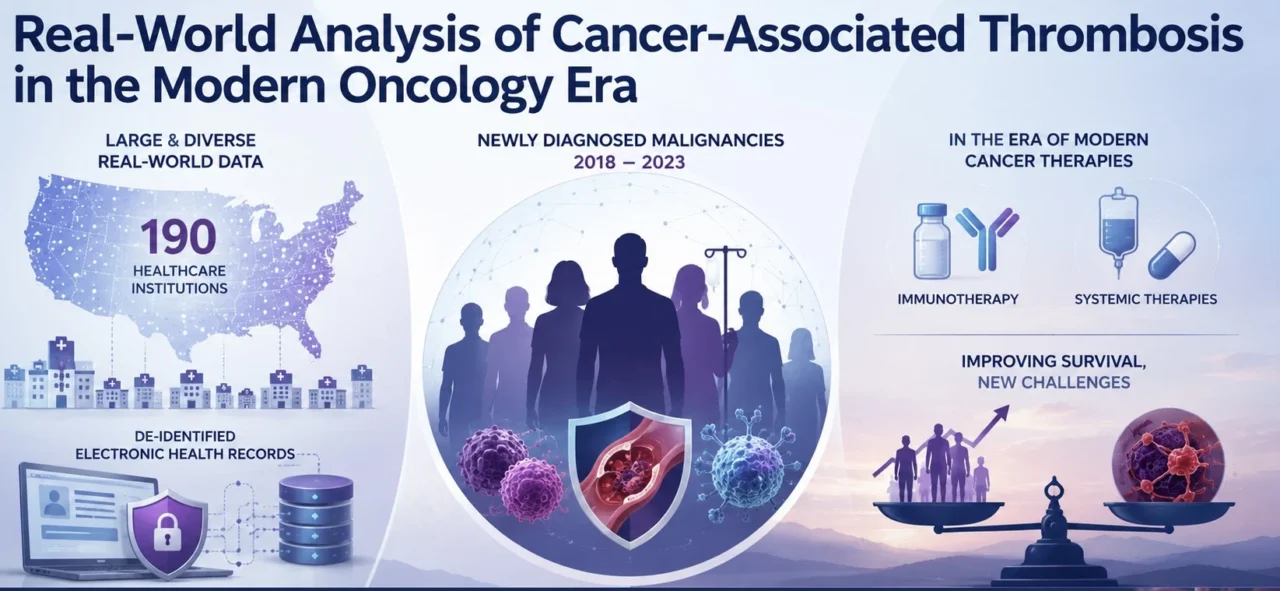
The Epic Cosmos platform combines de-identified electronic health records from 190 healthcare institutions, capturing patients treated in routine clinical practice rather than highly selected clinical trial populations.
Investigators identified patients with newly diagnosed malignancies between 2018 and 2023.
This allowed them to evaluate thrombotic risk in the era of immunotherapy and modern systemic cancer treatments.
The study provides a contemporary picture of cancer-associated thrombosis and reflects the changing landscape of oncology, where improving survival has also created new challenges related to cardiovascular complications.
Arterial Thrombosis Is More Common Than Previously Appreciated
One of the most important findings was the frequency of arterial thromboembolic events.
The cumulative five-year incidence exceeded 4.9%, demonstrating that arterial thrombosis is not a rare complication in patients with cancer. Investigators also observed a gradual increase in incidence during the study period.
As patients live longer, they remain exposed to cancer-related and treatment-related prothrombotic factors for extended periods. This may partly explain the increasing burden of arterial complications.
These findings have important implications for everyday practice. While clinicians routinely assess the risk of venous thrombosis, arterial risk assessment remains uncommon. The results suggest that this approach may need to change.
Cancer Type Plays a Major Role
The study also showed that arterial thromboembolic risk varies considerably between different malignancies.
Patients with acute leukemia, lung cancer, upper gastrointestinal cancers, and pancreatic cancer had the highest incidence of arterial thromboembolism. In contrast, breast, uterine, and testicular cancers were associated with substantially lower rates.
Importantly, cancer type remained an independent predictor of arterial thrombosis even after adjustment for age and cardiovascular comorbidities.
These findings suggest that tumor biology contributes directly to thrombogenesis. Differences in inflammation, endothelial injury, coagulation activation, and treatment exposure may all influence the development of arterial thrombosis.
The Impact of Modern Cancer Therapies
The study also examined the relationship between contemporary cancer treatments and arterial thrombosis.
Patients with metastatic disease and those receiving immune checkpoint inhibitors experienced significantly higher rates of arterial thromboembolism.
This finding is particularly relevant because immunotherapy has transformed cancer treatment across many tumor types. However, its cardiovascular and thrombotic effects are still being defined.
Future cardio-oncology research will likely focus on how immune activation, inflammation, endothelial dysfunction, and coagulation interact during immune-based cancer therapy.
Arterial Thrombosis and Survival
Beyond the incidence of arterial events, the study highlighted their impact on patient survival.
The occurrence of arterial thromboembolism was associated with an approximately 3.4-fold increase in adjusted mortality, even after accounting for multiple clinical variables.
This suggests that arterial thrombosis is more than a complication of advanced disease. It may also serve as a powerful marker of poor prognosis.
Whether arterial thrombosis directly contributes to mortality or reflects more aggressive cancer biology remains uncertain. Nevertheless, its occurrence should prompt careful multidisciplinary evaluation.
Implications for Clinical Practice
The findings reflect the growing importance of cardio-oncology, where oncologists, hematologists, and cardiologists work together to improve patient outcomes.
The study raises several important questions for future research. Should arterial thrombotic risk become part of routine cancer-associated thrombosis assessment? Could patients with high-risk malignancies benefit from personalized cardiovascular prevention? Should biomarkers of endothelial injury and inflammation be incorporated into future prediction models?
Although these questions remain unanswered, this large real-world analysis provides an important foundation for future prospective studies and may help shape future clinical guidelines.
Looking Ahead
The investigators acknowledged several limitations, including reliance on electronic health records for mortality reporting, exclusion of peripheral arterial disease from the ATE definition, and limited information regarding smoking history and certain treatment exposures.
Despite these limitations, the study delivers a clear message. Arterial thromboembolism is a substantial and underrecognized complication of cancer. It is more common than previously appreciated, varies significantly across different malignancies, and is associated with markedly worse survival.
As cancer care continues to evolve, these findings are likely to influence future research, risk prediction models, and multidisciplinary management strategies.
Expanding thrombotic risk assessment beyond venous events may become an important step toward improving outcomes for patients with cancer.
Written by Heghine Khachatryan, MD, PhD, Editor-in-Chief at Hemostasis Today.
Stay Updated with the Latest ISTH 2026 Updates on Hemostasis Today.
-
Oct 12, 2026, 10:36PAI-1 Inhibition as a New Strategy for Enhancing Fibrinolysis and Clot Resolution
-
Oct 12, 2026, 07:39Emmanuel J Favaloro: 100 Years of von Willebrand Disease and the Importance of Local Diagnosis and Management
-
Oct 12, 2026, 07:39Post-Stroke Fatigue Trajectories – 38% Recovered at 12 Months, While 16% Developed New Fatigue – International Journal of Stroke
-
Oct 12, 2026, 07:28Beth Sara: IBMS Specialist Portfolio Achievement and a New Role in Transfusion Practice
-
Oct 12, 2026, 07:28Abdul Mannan: PCC vs. aPCC – The Small ‘a’ That Changes Emergency Management
-
Oct 12, 2026, 07:20Mokhtar Tazik: Improving Access to Plasma Derived Medicines Through Awareness, Interest and Accessibility
-
Oct 12, 2026, 07:08Larissa Chastain: Partnering to Transform Anticoagulation Management Through INR Self-Testing
-
Oct 12, 2026, 06:57Saiful Islam: Laboratory Spot Check – Microcytic Anemias and The Thalassemia Spectrum
-
Oct 12, 2026, 06:45Nick Lenamon: Stroke Awareness at Any Age Recognizing the Signs and Acting FAST