


Jordan Agay: Why We Need to Track the Neurological Costs of Anemia
Jordan Agay, Public Health and Bioinformatics Student at The George Washington University and Clinical Product Strategy and Feedback Intern at hc1, shared a post on LinkedIn:
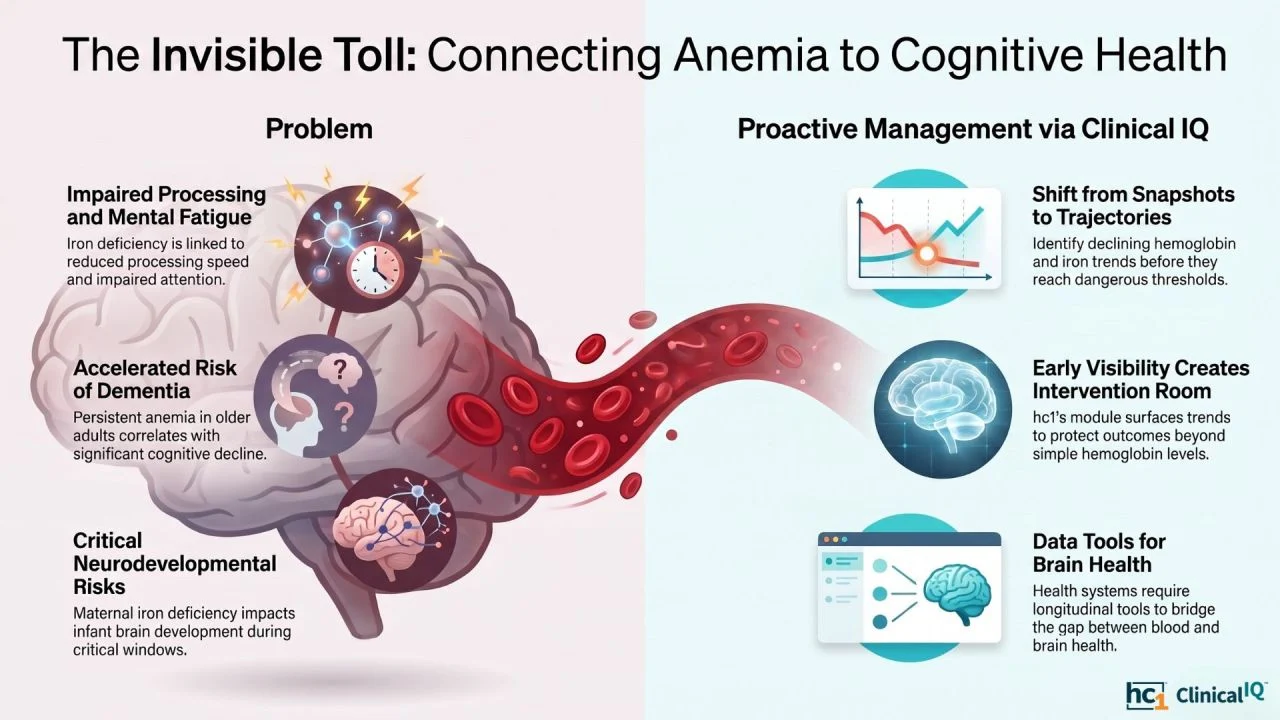
“Anemia’s most visible effects are physical. Its least visible may be neurological.
Iron deficiency, with or without anemia, is associated with impaired attention, reduced processing speed, and cognitive fatigue.
In older adults, persistent anemia correlates with accelerated cognitive decline and increased dementia risk.
In pregnant women, iron deficiency during pregnancy is associated with measurable neurodevelopmental impacts in the infant.
These are not rare outcomes.
They are poorly tracked and underrecognized effects of a condition that often goes unmanaged for months.
The challenge is that cognitive effects do not appear on a lab panel.
But the lab trends that predict them do, if someone is looking at the trajectory rather than the snapshot.
hc1’s Clinical IQ Anemia Management Module tracks hemoglobin and iron status longitudinally across patient encounters, surfacing declining trends before they reach thresholds that already signal significant physiological impact.
That earlier visibility is what creates room to intervene and potentially protect outcomes that extend well beyond hemoglobin levels.”
Stay updated with Hemostasis Today.
-
Sep 20, 2026, 12:11Giacomo Buso: Silent Atherosclerosis Begins Earlier Than Expected
-
Sep 20, 2026, 12:0310 Posts Not to Miss This Week
-
Sep 20, 2026, 11:27Edward Lee Carter: Prasugrel Dosing Matters in P2Y12 Inhibitor Comparisons After PCI
-
Sep 20, 2026, 09:51Ceasovschih Alexandr: A Closer Look at Lipid Disorders in CKM Syndrome
-
Sep 20, 2026, 09:05World Stroke Academy: Can Adjunct IAT Improve Tissue Reperfusion?
-
Sep 20, 2026, 06:46Neeraj Songara: From Donated Blood to Engineered Therapeutics
-
Sep 20, 2026, 06:24Louise St. Germain Bannon: Improving Awareness and Care for Women Across the Lifespan
-
Sep 20, 2026, 05:17Maxime Dely: When ABO Compatibility Isn’t Enough for Safe Transfusion
-
Sep 20, 2026, 04:54William Aird: What Does a Complete History and Physical Really Mean?