


Abdul Mannan: Why Quantitative FXIII Testing Matters
Abdul Mannan, Consultant Haematologist at Betsi Cadwaladr University Health Board, shared a post on LinkedIn:
“Your patient bled abnormally.
PT, APTT, and platelets all came back normal.
Coag screen closed the case?
Not so fast.
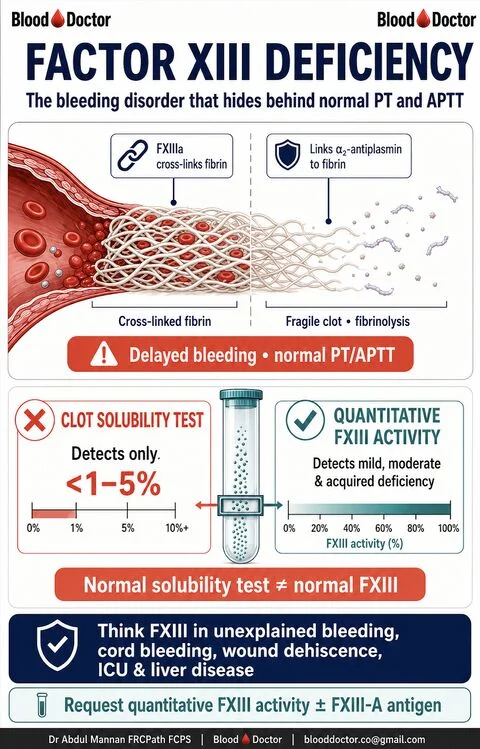
A 2010 UCL and Great Ormond Street paper makes an uncomfortable point: the clot solubility test, still the most widely used FXIII screen, only detects activity below 1 to 5 percent.
It misses mild, moderate, heterozygous, and acquired deficiency entirely.
Here’s what matters:
- Acquired FXIII deficiency is common, not rare. 21 percent of general hospital inpatients and 52 percent of paediatric ICU patients fall below the normal range.
- PT, APTT, and TT stay normal in FXIII deficiency. You have to actively think to request it.
- The fix is a quantitative chromogenic (ammonia release) assay, not clot solubility. CV of 2 to 4 percent, and it covers the full range rather than just the severe end.
- In high-risk surgical cancer patients, FXIII substitution reduced blood loss by 29 percent (Korte et al, 2009).
I have seen patients with unexplained bleeding and a ‘normal’ coag screen who were never tested for this.
If your lab is only running clot solubility, it is only catching the tip of the iceberg.
Does your lab offer quantitative FXIII activity, or only clot solubility?”
Other posts featuring Abdul Mannan with Hemostasis Today.
-
Sep 20, 2026, 09:51Ceasovschih Alexandr: A Closer Look at Lipid Disorders in CKM Syndrome
-
Sep 20, 2026, 09:05World Stroke Academy: Can Adjunct IAT Improve Tissue Reperfusion?
-
Sep 20, 2026, 06:46Neeraj Songara: From Donated Blood to Engineered Therapeutics
-
Sep 20, 2026, 06:24Louise St. Germain Bannon: Improving Awareness and Care for Women Across the Lifespan
-
Sep 20, 2026, 05:17Maxime Dely: When ABO Compatibility Isn’t Enough for Safe Transfusion
-
Sep 20, 2026, 04:54William Aird: What Does a Complete History and Physical Really Mean?
-
Sep 20, 2026, 04:34Hons Saurabh Kaushik: Why Uncontrolled LDL Can Be Harmful
-
Sep 20, 2026, 03:58Salih Ehsan: The Complexities of HbF and HbA2
-
Sep 20, 2026, 03:22The Voices of People Living With Bleeding Disorders – EHC