

Sally Mandour: Can a Blood Smear Diagnose Heatstroke?
Sally Mandour, Associate Professor, Head of Hematology Unit at Clinical Pathology Department of National Liver Institute, Monofeya University, shared a post on LinkedIn:
“Interesting EHA Learning case:
A 68-year-old cyclist with cardiovascular risk factors is brought to the Emergency Room.
He is in cardiopulmonary arrest without pulse after having been found lying on the ground by a 20-meter cliff edge, with multiple burn-like lesions, a Glasgow Coma Scale score of 3 points and fever.
An initial venous blood gas shows severe metabolic acidosis with hyperlacticaemia of 8 mmol/L.
Blood cell counts revealed leukocytosis of 17.96 x10⁹/L with 9.34 x10⁹/L neutrophils and 6.11 x10⁹/L lymphocytes, with normal hemoglobin (143 g/L) and platelet (214 x10⁹/L) counts.
Biochemical tests show multiorgan failure. The peripheral blood smear findings are shown in the picture.
What is the most likely diagnosis?
- Vitamin B12 or folate deficiency
- Myelodysplastic syndrome
- Ethanol overdose
- Heatstroke
Answer is Heat stroke
Cells depicted are neutrophils (A-D), lymphocytes (E) and monocytes (F) with botryoid nuclei, characterized by hypersegmented nuclei with a radial arrangement.
These were first seen in 1980 in six patients with heatstroke and were named after the Greek term ‘botrys,’ which translates onto ‘bunch of grapes’ because of their resemblance.
Since then, they have been described in other conditions causing severe hyperthermia, such as cocaine and methamphetamine abuse, autoimmune limbic encephalitis, sepsis, drug rash with eosinophilia and systemic symptoms (DRESS) and neuroleptic malignant syndrome.
These nuclear changes have been hypothesized to be early stages of oncotic (karyolysis) and apoptotic (karyorhexis and pyknosis) cell death because of extreme heat.”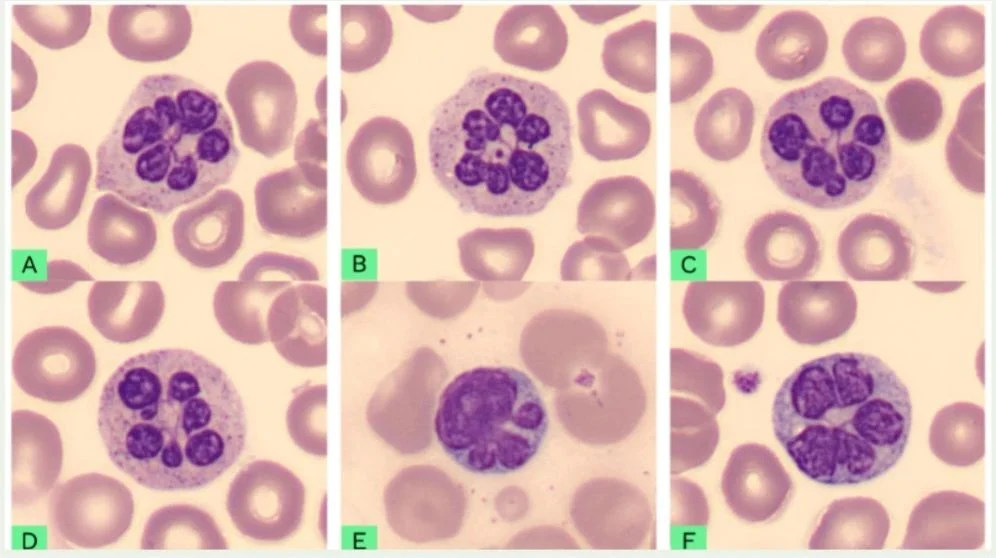
Stay updated with Hemostasis Today.
-
Sep 20, 2026, 09:51Ceasovschih Alexandr: A Closer Look at Lipid Disorders in CKM Syndrome
-
Sep 20, 2026, 09:05World Stroke Academy: Can Adjunct IAT Improve Tissue Reperfusion?
-
Sep 20, 2026, 06:46Neeraj Songara: From Donated Blood to Engineered Therapeutics
-
Sep 20, 2026, 06:24Louise St. Germain Bannon: Improving Awareness and Care for Women Across the Lifespan
-
Sep 20, 2026, 05:17Maxime Dely: When ABO Compatibility Isn’t Enough for Safe Transfusion
-
Sep 20, 2026, 04:54William Aird: What Does a Complete History and Physical Really Mean?
-
Sep 20, 2026, 04:34Hons Saurabh Kaushik: Why Uncontrolled LDL Can Be Harmful
-
Sep 20, 2026, 03:58Salih Ehsan: The Complexities of HbF and HbA2
-
Sep 20, 2026, 03:22The Voices of People Living With Bleeding Disorders – EHC