


Thirunavukkarasu Angappan: Gene Therapy’s Slow Road to Routine Hemophilia Care
Thirunavukkarasu Angappan, Vice President of Operations and Manufacturing at PopVax, shared a post on LinkedIn:
“Gene Therapy Was Supposed to End Factor Concentrate Demand.
It hasn’t.
Three years ago, gene therapy was positioned to make routine factor concentrate infusions obsolete for hemophilia.
That hasn’t happened, and the reasons matter for anyone in plasma or recombinant protein manufacturing.
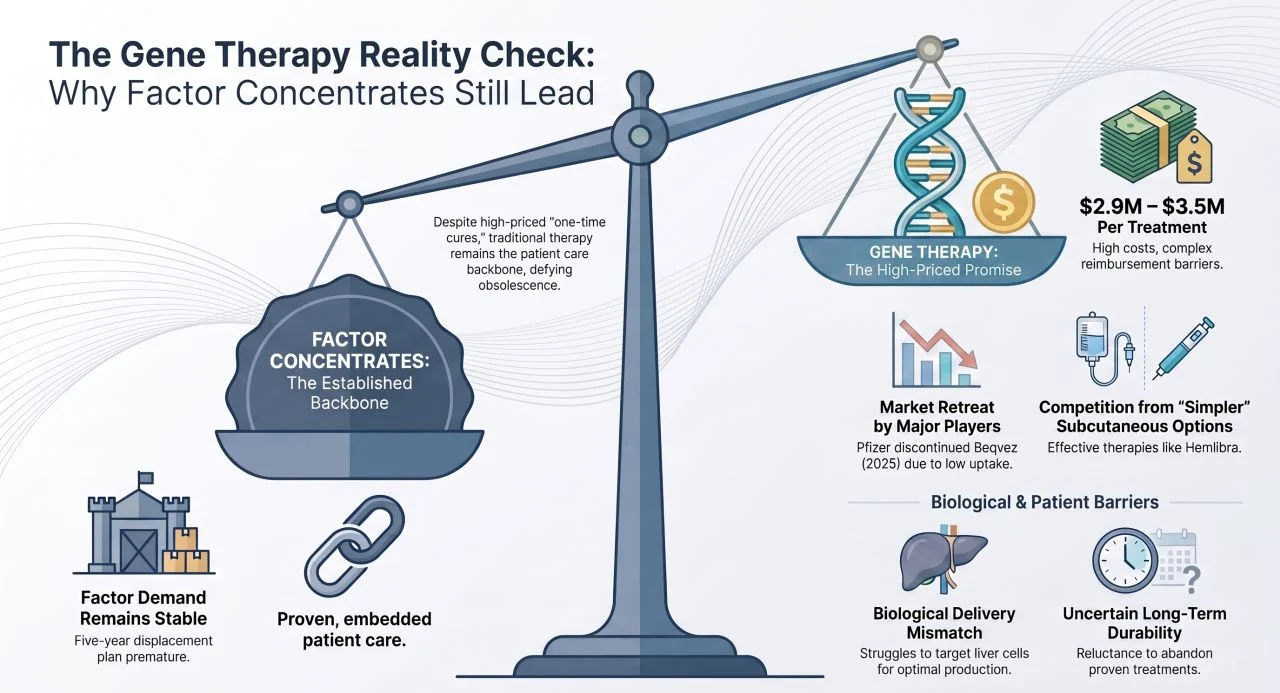
FDA approved Hemgenix for hemophilia B in 2022, Roctavian for hemophilia A in 2023, and Beqvez for hemophilia B in 2024 — one-time infusions priced between 2.9 million dollars and 3.5 million dollars, positioned to replace years of factor replacement therapy.
Uptake has been low enough that Pfizer terminated its hemophilia A gene therapy partnership with Sangamo in December 2024, then discontinued commercialisation of Beqvez itself in February 2025.
Part of the story is biology.
Both approved therapies deliver their gene into liver hepatocytes — the right cell type for Factor IX, but Factor VIII is normally produced by a different liver cell entirely.
Roctavian’s efficacy in hemophilia A has been comparatively modest, while emicizumab (Hemlibra), a simpler subcutaneous antibody therapy, already gets many patients to workable factor levels without an infusion regimen at all.
The rest is adoption economics: patients are reluctant to trade a therapy they understand and manage well for a one-time treatment with uncertain long-term durability and extraordinarily complex reimbursement.
For plasma and recombinant manufacturers, it’s a useful reminder that ‘one-time cure’ narratives move slower through clinical adoption than through press releases.
Factor concentrate demand — plasma-derived and recombinant — remains the backbone of hemophilia care for now, and capacity planning built around gene therapy displacing it on a five-year horizon looks premature.
For those tracking cell and gene therapy portfolios — is hemophilia a case where the biology was harder than the platform, or an adoption and pricing problem that better data eventually solves?”
Stay updated with Hemostasis Today.
-
Sep 21, 2026, 03:00Family History Can Reveal Hidden Risk of Aortic Dissection – The Marfan Foundation
-
Sep 21, 2026, 02:47Transitioning from Paediatric to Adult Haemophilia Care – Haemophilia Foundation Australia
-
Sep 21, 2026, 02:29Diana Castro Paupério: A New Era for Patient Blood Management
-
Sep 21, 2026, 00:29Iheanyichukwu Ike: Childhood Anaemia in Nigeria Through an Analysis of the 2018 NDHS
-
Sep 21, 2026, 00:27Nicole De Vita: The Global Burden of Iron Deficiency and Anemia in Women at SABM
-
Sep 21, 2026, 00:25Giuseppe Panuccio: IVUS and OCT Guidance Reduce MACE and Stent Thrombosis in Calcified Coronary Lesions
-
Sep 21, 2026, 00:23Parveen Yograj: Anemia in Older Adults 2026 – Don’t Call It “Just Old Age” and Find the Cause
-
Sep 21, 2026, 00:22Peter A. McCullough: McCullough Protocol Base Spike Detoxification and Oral Anticoagulation for Athletes
-
Sep 21, 2026, 00:20Rolando Claure: Apixaban Shows a More Favorable Benefit Risk Balance in Advanced CKD With AF